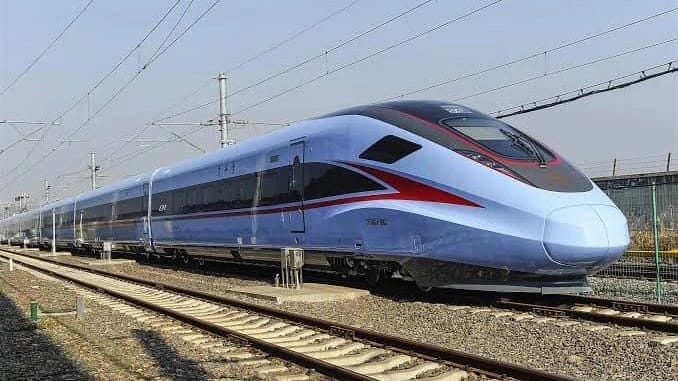
The SRT Board has approved a 655-day extension for the Thai-Chinese Railway Contract 3-3, covering the Ban Dai Ma–Lam Takhong section, until 19 June 2028, due to delayed site handover. Contract 4-1, worth 22 billion baht, overlaps with C.P.'s high-speed rail project; the proposal to transfer the budget for self-construction will be submitted to the Cabinet. For the Ban Pho–Phra Kaeo section, a consultant will be hired to redesign Ayutthaya Station and conduct an archaeological survey, taking approximately one year, with civil works targeted for completion in 2030 and trial operations in 2031.
Mr. Anan Photnimdaeng, Governor of the State Railway of Thailand (SRT), disclosed that the SRT Board meeting held on 11 August 2026 passed a resolution approving an extension of the contractual working period and an amendment to the construction contract for the Thailand-China Government Cooperation Project on the Development of a High-Speed Rail System to Connect the Region, Bangkok–Nong Khai (Phase 1: Bangkok–Nakhon Ratchasima), Contract 3-3, Civil Works for the Ban Dai Ma–Lam Takhong section, by an additional 655 days from the original contract end date of 3 September 2026 to a new end date of 19 June 2028.
The reason stems from problems with site handover, caused by delays in the realignment of the existing railway track — originally part of the double-track railway construction project on the Mab Kabao–Chumthang Thanon Chira line, Contract 1, covering the Mab Kabao–Khlong Khanan Chit section. Contract 3-3, covering the Ban Dai Ma–Lam Takhong section over a distance of 21.60 km, has Thai Engineering and Industry Co., Ltd. as the contractor, with a contract value of 9,838 million baht. As of July 2026, cumulative construction progress stands at 60%, still running approximately 38% behind schedule.
@Rushing Cabinet proposal to transfer budget and self-construct Contract 4-1 overlapping section
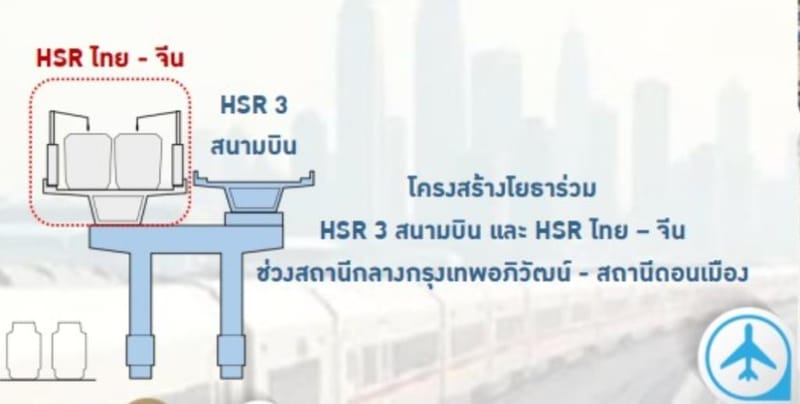
Regarding progress on Contract 4-1, covering the Bang Sue–Don Mueang section over a distance of 15.21 km — which overlaps with the High-Speed Rail linking 3 Airports — the SRT has reported to the Project Management Committee meeting that it will proceed with the construction on its own in order to accelerate the project and resolve implementation problems. C.P. has no objection to this approach. The construction cost for this section stands at 22,000 million baht, divided into the cost of upper trackwork of approximately 4,336 million baht, which is already included in the Thai-Chinese Railway project budget, and the cost of foundations and columns of approximately 18,000 million baht (the total sum of which is included in the joint investment works of the High-Speed Rail linking 3 Airports).
"Because there is an existing Cabinet resolution, it will be necessary to submit the matter to the Cabinet to request a budget allocation for the implementation of Contract 4-1, by bringing the construction costs of the columns, piers, and foundations that are currently within the High-Speed Rail linking 3 Airports into the Thai-Chinese Railway Contract 4-1. This will constitute an increase in the budget framework of the Thai-Chinese Railway, while simultaneously requesting a reduction in the investment budget framework for the High-Speed Rail linking 3 Airports."
The SRT Governor said that Contract 4-1 already has preliminary designs and is currently in the process of reviewing the designs for appropriateness and estimating the reference price. This contract will be tendered as a Design & Build procurement, with conditions requiring the contractor to take responsibility for both design and construction work. It is expected that a proposal will be submitted to the SRT Board for approval of changes to the scope of work of Contract 4-1 within this year, before being submitted to the Cabinet, so that construction can begin in 2027, with a construction period of approximately three years.
@Ban Pho–Phra Kaeo awaiting Ayutthaya Station design and archaeological survey — another one year
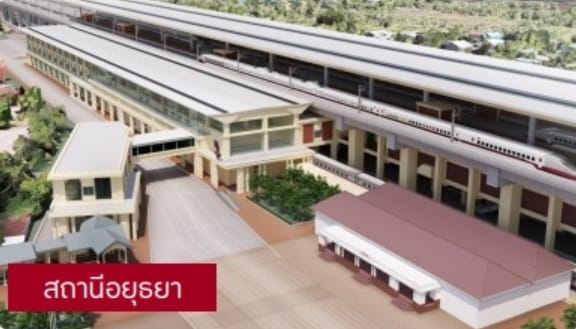
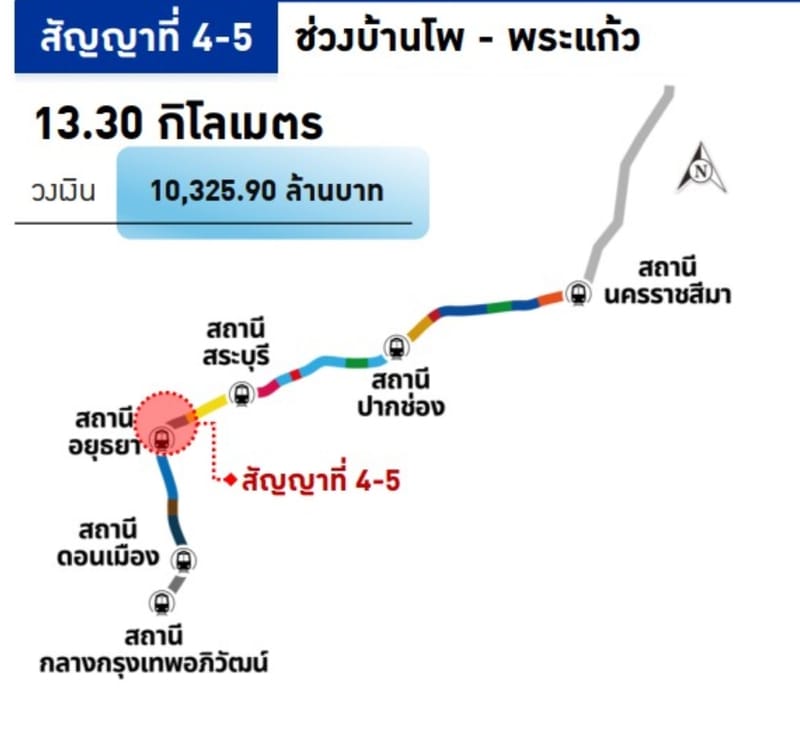
As for Contract 4-5, Ban Pho–Phra Kaeo, with a budget framework of 11,801.22 million baht, a new tender must be held because the contractor did not hold its price, owing to issues surrounding the redesign of Ayutthaya Station to reduce the visual impact on the World Heritage Site and to lower the height of the elevated trackway structure. Originally, the construction contractor was also to carry out drilling and archaeological surveys, but this proved unfeasible. A consultant must therefore be hired to carry out the design of the Ayutthaya Station building and conduct an archaeological survey beforehand, at a consulting fee of approximately 30–40 million baht. The terms of reference (TOR) are currently being drafted; the tender is expected to be held within this year, with the design and survey work taking approximately one year. The construction tender is expected to be held in 2028.
The target is to complete all civil construction works by 2030 and conduct trial operations in 2031.
Regarding Contract 2.3 — covering the design, procurement, and installation of track systems, electrical and mechanical systems, as well as the procurement of rolling stock and personnel training — with a value of 50,633 million baht: NTP 1 for the system design and rolling stock work has already been issued and is currently under inspection and acceptance. NTP 2 for the installation work will need to be considered in conjunction with the civil construction works across all 14 contracts, in order to plan site handover for the continuous laying of track and installation of electrical systems, signalling systems, and communications systems. It is expected that the at-grade section sites will be handed over first.
Contract 2.3 is being carried out by China Railway International Co., Ltd. and China Railway Design Corporation, both Chinese state-owned enterprises. The contract was signed on 28 October 2020 with a duration of 64 months, and the contract end date is 22 April 2026. A preliminary extension of 45 months is currently under consideration, and the work plan will need to be adjusted so that the systems installation under Contract 2.3 can proceed and the system can be tested in 2031 as targeted.