The SEC has released figures for July 2026, clearly pointing to a deepening crisis of confidence in Thailand's digital asset market. Active accounts vanished by more than 20% in a single month, trading volume plunged sharply, yet operators continue to flood in seeking licences. Meanwhile, the annual returns of Thai stocks and gold have left Bitcoin and Ethereum in the dust, reflecting a full-scale flight by investors from risky assets into safe havens.
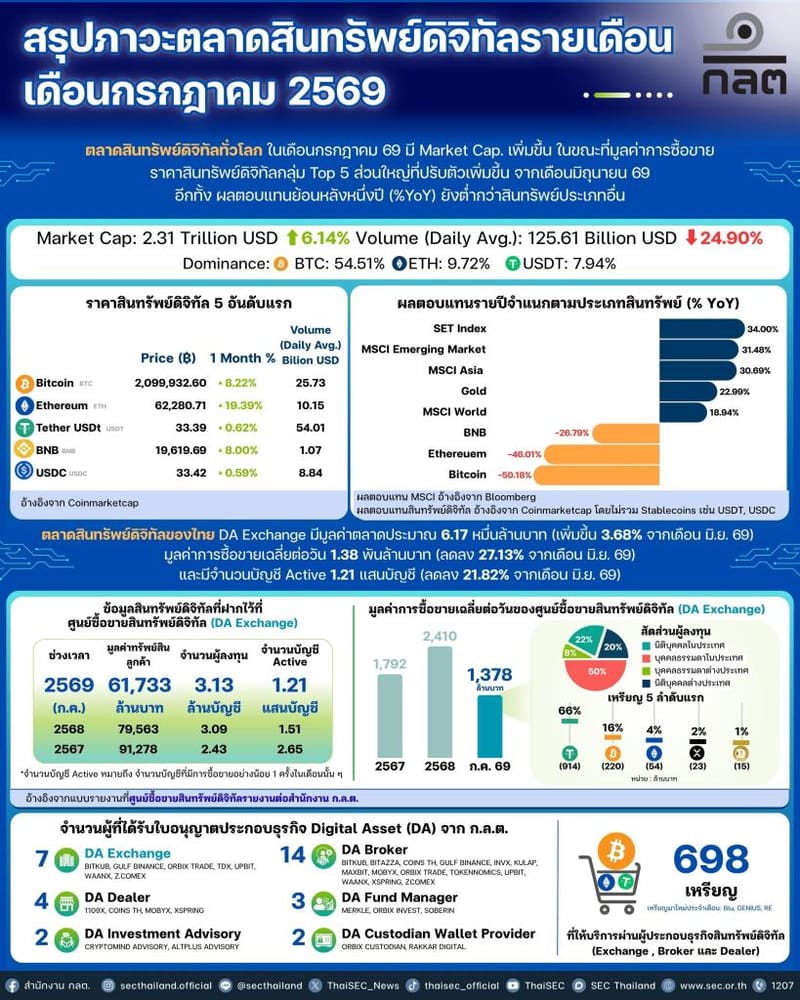
Global digital asset market figures for July 2026 may look attractive on the surface, with total market capitalisation surging to $2.31 trillion — up 6.14% — but behind those green numbers lies the opposite reality: global daily trading volume fell by 24.90%, dropping to just $125.61 billion per day, clearly signalling that fresh money is shunning risk assets. The situation in Thailand runs in even starker contrast to the global market.
Data from the Securities and Exchange Commission (SEC) show that while the value of customer assets in the Thai market edged up 3.68% from the previous month to 61,733 million baht, this increase merely tracked rising global asset prices and did not reflect any new buying pressure whatsoever. The number of active accounts fell to just 121,000 — a decline of 21.82% within a single month — while the average daily trading value plunged to 1,378 million baht, contracting by 27.13% compared to the previous month.
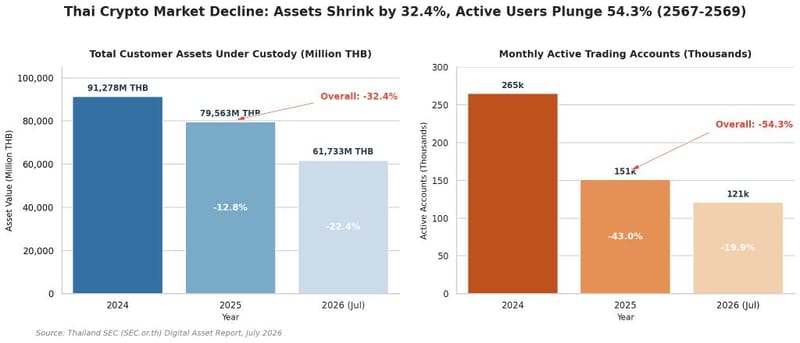
Looking back at three years of statistics makes the deterioration even clearer. Customer asset values fell from 91,278 million baht in 2024, to 79,563 million baht in 2025, and further down to 61,733 million baht in July 2026 — a loss of nearly 32% in just two years. At the same time, the number of active accounts dropped from 265,000 in 2024 to just 121,000, a decline of more than 54%. This runs contrary to the total number of investor accounts, which actually increased from 2.43 million to 3.13 million — underscoring that more and more people are opening accounts and simply leaving them dormant without ever using them.
Equally noteworthy is the structure of trading volume on Thai exchanges, which is concentrated primarily in stablecoins. Tether (USDT) recorded an average daily trading value of 914 million baht, accounting for roughly 66% of total volume, far ahead of Bitcoin in second place at 220 million baht (16%) and Ethereum at 54 million baht (4%), followed by XRP and other coins, each holding less than 2%. These figures indicate that the Thai market is now functioning merely as a "money transfer bridge" in and out of the system, rather than serving as a speculative board for technology-based coins as it once did.
In terms of returns, the contrast between traditional assets and crypto is extreme. The SET Index delivered an annual return as high as 34.00%, followed by gold at 22.99% and the MSCI World at 18.94%, while Bitcoin posted a loss of 50.18% and Ethereum a loss of 46.01% over the same one-year period. This reflects a global capital flow back toward safe-haven assets and equities, rather than into highly volatile digital assets.
The structure of players in the Thai market itself also reflects fragility. Domestic retail investors account for as much as 60% of trading volume, while foreign institutional investors hold a share of only 10%, indicating that the market still lacks confidence from professional institutional investors. Although there are as many as 698 coins available for trading, real liquidity remains concentrated in just a handful of names.
The most contradictory aspect of all is that even as the market contracts and investors retreat, the number of operators holding digital asset business licences from the SEC has not followed suit. Thailand currently has seven digital asset exchanges — including Bitkub, Gulf Binance, Orbix Trade, TDX, Upbit, Waanx, and Z.com — along with 14 brokers such as Bitazza, Coins TH, Kulap, and XSpring, plus a number of dealers, fund managers, advisors, and custodians. With actual active market participants numbering just over a hundred thousand accounts but nearly 30 service providers operating, competition for the remaining customer base is likely to intensify, and may well lead to consolidation or closures among some operators in the period ahead.
The overall picture painted by all these figures points in one direction: Thailand's crypto market is facing a major turning point. The frenzy over digital assets that once surged in earlier periods has passed its peak and is now entering a prolonged correction phase. Many Thai investors are choosing to park their money in safe-haven assets such as stocks and gold, or to hold stablecoins while waiting for the right moment, rather than taking on the kind of extreme volatility they once embraced. Operators in the industry therefore face a difficult challenge in retaining their customer base amid continuously shrinking liquidity.