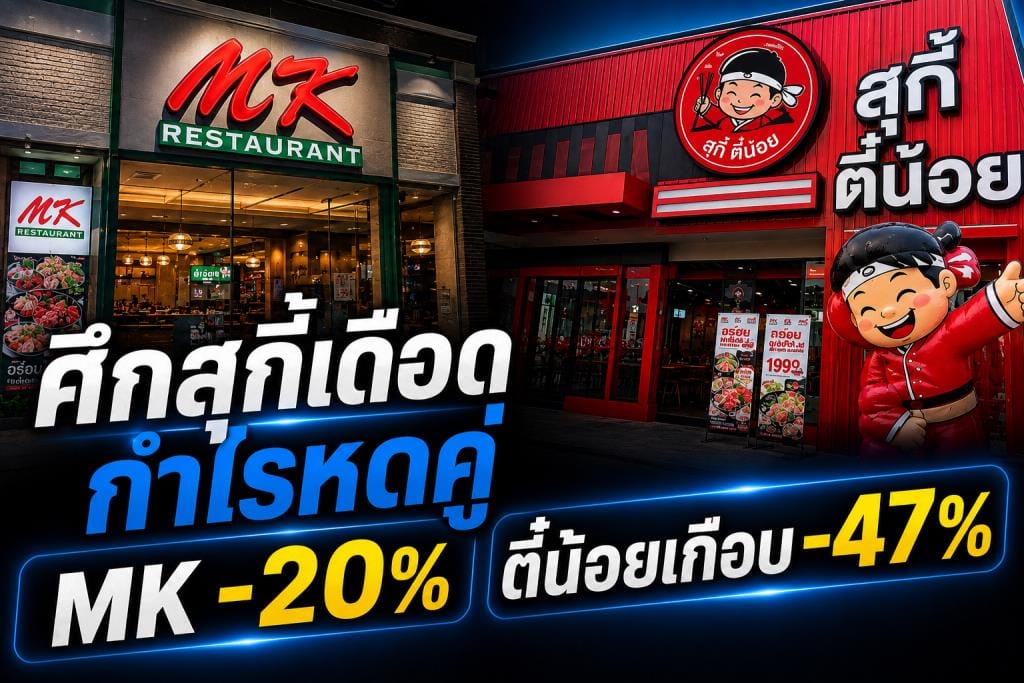
Hotly contested sukiyaki war squeezes profits at both players! "MK Restaurant" posted Q2 2026 net profit of 221 million baht, down 20%, even as revenue grew 10.6%, supported by "Bonus Suki" and MK Buffet — yet raw material costs, energy costs, and fierce competition weighed on margins. Meanwhile, "Sukishi" saw its Q2 profit shrink to 48 million baht from 90 million baht a year earlier, a drop of nearly 47%, even as first-half revenue continued to grow, reflecting a buffet war where the harder players compete, the more profits across the entire market are squeezed.
MK Restaurant Group Public Company Limited, or M, reported consolidated results for the company and its subsidiaries: Q2 revenue from sales and services reached 4,196 million baht, up 10.6% from the same period last year. For the first six months of 2026, revenue from sales and services came to 8,243 million baht, up 12.4% from the same period last year, reflecting continued business growth. Key drivers included branch expansions under the "Bonus Suki" brand and MK Buffet, which continued to receive strong consumer response and generate sustained sales growth, and reflected increasingly efficient operations and the results of ongoing cost management.
For the quarter, despite the company's ability to sustain revenue growth, the restaurant business continued to face pressure from elevated operating costs — including raw materials, staff costs, transportation, and consumables — while competition across the industry remained intense, making margin management an ongoing challenge.
Nonetheless, gross profit margin declined from 65.2% in Q2 2024 to 61.8% in Q2 this year, driven by aggressive market expansion through the buffet model via the "Value Beyond Value" promotion under the "MK Suki" brand alongside continued branch expansion by "Bonus Suki," which pushed raw material cost ratios higher in line with the business structure. In addition, the war in the Middle East has been pressuring energy and transportation costs, while raw material prices have continued to rise gradually. In Q2, the company posted net profit of 221 million baht, down 20% from the prior year's 275.58 million baht.
Meanwhile, "Bonus Suki," which began operations in the second half of 2025, remains one of the group's key growth engines. During the first six months of this year, it increased its share of portfolio revenue to 12%, driven by branch expansion and continued consumer uptake. It currently has 39 branches and has plans to expand further to capture growth opportunities in the high-potential budget buffet market.
"Sukishi" Q2 profit shrinks to 48 million baht, down nearly 47%
JMART's Q2 performance surged, boosted by associate company profits. JMART Group Holdings Public Company Limited, or JMART, reported Q2 net profit of 212,961 million baht, up from 110,956 million baht in the same period last year, an increase of 91.9%. For the six-month period, net profit was 588.9 million baht, up 98.4 million baht or 20.1%, driven by growth in profit from the mobile phone and accessories distribution business under JMART Mobile, and an increase in profit-sharing from investments in joint ventures and associates — particularly JK Asset Management Company Limited, KBJ Capital Company Limited, Singer Thailand Public Company Limited, and BN En Restaurant Group Company Limited, or Sukishi.
Sukishi's financial statements for the six-month period ending 30 June 2026 showed net profit of 335 million baht, while Q2 profit came to 48 million baht, down from 90 million baht in the same period of 2025. JMART, which holds a 30% stake in Sukishi, will receive a profit share of 100.5 million baht. Revenue for the first six months of this year stood at 2,966 million baht, up from 2,390 million baht in the same period of 2025.
As for Sukishi, the company targets full-year profit of 1 billion baht, having already achieved 335 million baht in the first half. Although Sukishi recently launched a new brand, "Nai Pran Mu Kratha," a mookata buffet restaurant, as a move to diversify the group's food business portfolio — and the company believes its broad customer base will help enhance reach to new customer segments — the intensely competitive environment and the wide range of promotions being pushed by rivals will exert significant pressure on sales and revenue generation.