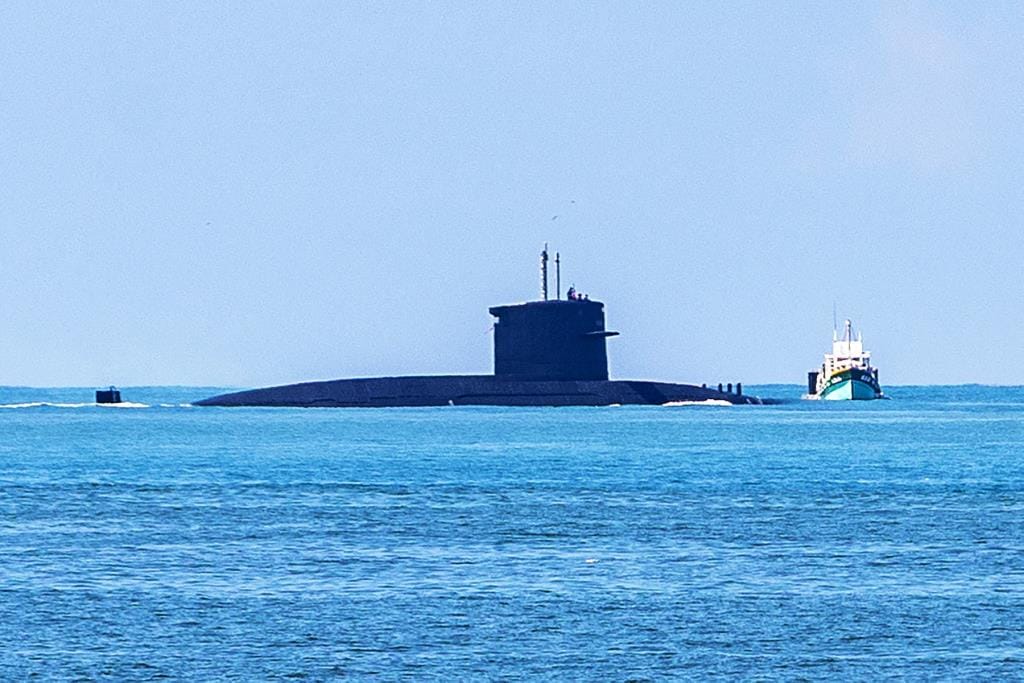
A research team from the Hefei Institutes of Physical Science, together with the Ningbo Institute of Materials Technology and Engineering — both affiliated with the Chinese Academy of Sciences (CAS) — has succeeded in developing a new type of magnetic sensor no larger than a dust particle, yet possessing extremely high detection sensitivity. In theory, it is capable of detecting the magnetic signature of a steel-hulled submarine at a depth of up to 500 metres beneath the sea surface.
The research was published in the academic journal Physical Review Letters on 17 July 2026. In it, the team resolved a long-standing technological challenge of several decades' standing concerning the relationship between detection sensitivity and noise: under conventional approaches, reducing the size of a sensor to increase its sensitivity invariably causes the noise level to rise in tandem.
The researchers found that macroscopic noise originates from the microscopic movement of spin textures within magnetic materials, and that the velocity of this movement is inversely proportional to the noise level. Drawing on this knowledge, the team designed a synthetic ferromagnetic structure, fine-tuned the thickness of the magnetic layers, and controlled the annealing process. The result is a sensor with a detection area of just 20×20 micrometres that is nonetheless high-performance, low-cost, and consumes less energy than conventional magnetic detection devices.
Although this technology can be adapted for magnetic anomaly detection (MAD) to locate submarines at close range, its primary near-term focus will be on medical and industrial applications. The sensor is capable of detecting magnetic signals in the picotelsa-to-nanotesla range — the same range as the magnetic signals produced by the human heart and brainwaves. It can also be used in microscopy instruments for micro-level measurement in the automotive and electronics industries.
Source: South China Morning Post