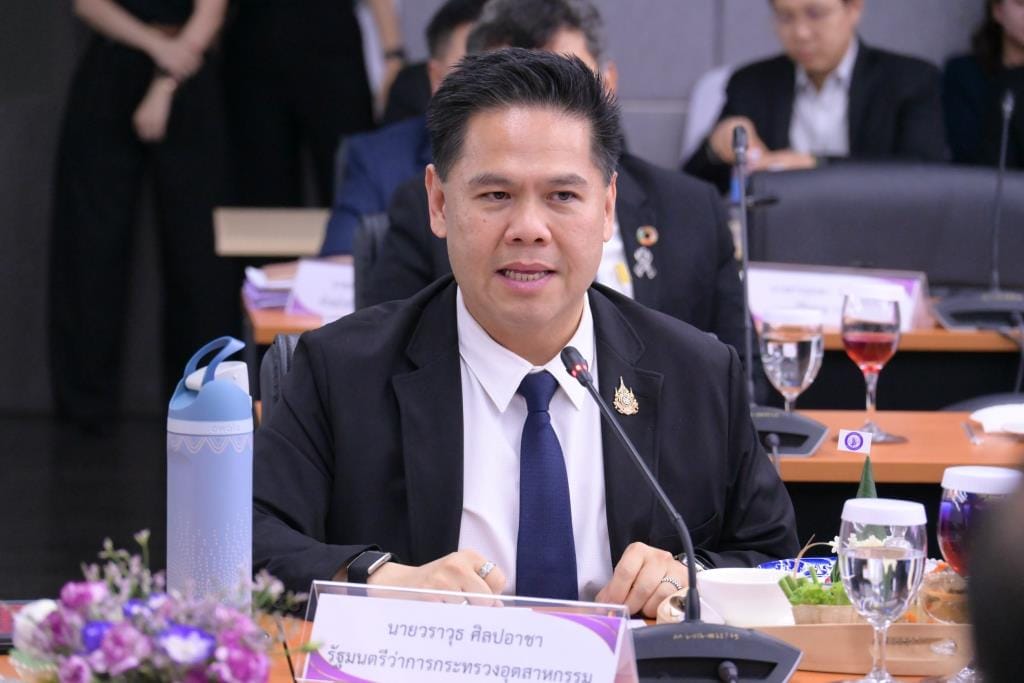
Varawut orders an overhaul of new industries, drawing supply chains to create economic value domestically, vows not to abandon internal combustion vehicles, supports the use of biofuels, and moves to court Toyota into investing in Thailand.
Varawut Silpa-archa, Minister of Industry, revealed that the ministry has announced a strategic reset for Thai industry to accommodate a rapidly changing global economic structure, pressing ahead with driving an industrial strategy from a manufacturing base while accelerating the development of new industries (New S-Curve).
Thailand's challenge is not merely to attract investment into the country, but to connect research, production, markets, and investment, while also upgrading SMEs so that Thai entrepreneurs can participate in the supply chains of future industries as broadly as possible, in line with the policy of Supajee Suthumpun, Deputy Prime Minister and Minister of Commerce.
This is because Thailand's industrial structure is undergoing transformation, as evidenced by the semiconductor industry and photonic technology — which uses light to transmit and process data — both of which have seen explosive growth. Sales have approximately doubled compared with the previous year for the second consecutive year, driven in part by the global expansion of large-scale data centres and the increased adoption of optical data transmission systems.
The tools used to measure the industrial sector must therefore change accordingly. The Ministry of Industry, through the Office of Industrial Economics (OIE), is preparing to shift the base year for the Manufacturing Production Index (MPI) and Capacity Utilization rate from 2021 to 2024, so that these indicators better reflect the current structure and potential of Thai industry, and can accommodate the rapid rise of advanced technology industries. Emerging high-potential industries such as biotechnology, digital and AI, modern automotive, medical, and defence industries must have Thai entrepreneurs pushed into their supply chains.
In addition, the ministry is in the process of coordinating with the Ministry of Finance to review excise taxes, with the goal of creating a level playing field between Thai and foreign operators, ensuring that the tax structure supports competition rather than becoming a business cost that puts Thai entrepreneurs at a disadvantage in the market. The ministry is also promoting bioenergy — both biodiesel and ethanol — in order to balance the market and distribute benefits to farmers from the transition to clean energy.
In particular, regarding the electric vehicle (EV) industry, the government is in the process of considering new measures and adjusting the excise tax base as incentives to create competitive equality between domestic operators and imported vehicles, so that the cost structure is not excessively disadvantaged, and to attract investors to Thailand. Specifically, in light of reports that Toyota is considering expanding its investment to Indonesia, multi-party cooperation will be needed to devise a strategy to woo the carmaker back.
The ministry also stands ready to promote the internal combustion vehicle industry that uses biofuels for energy security. This encompasses vehicle promotion measures — setting excise tax and BOI measures to support HEV and mHEV vehicles — as well as fuel and pricing measures, including oil tax measures, pricing structures, and flexible blending ratio formulas for E-flex and E-flex and B-flex that are appropriate to each period, along with support for adapting fuel retail models to be flexible in response to raw material conditions and energy prices. These measures aim to increase the use of bioenergy and reduce exposure to global oil price volatility.
At the same time, the ministry is ready to push forward the draft Factory Act and the draft Industrial Waste Act for consideration by the Cabinet and Parliament through the proper legislative process, so that the laws keep pace with changes in the industrial sector and can effectively support environmental management.