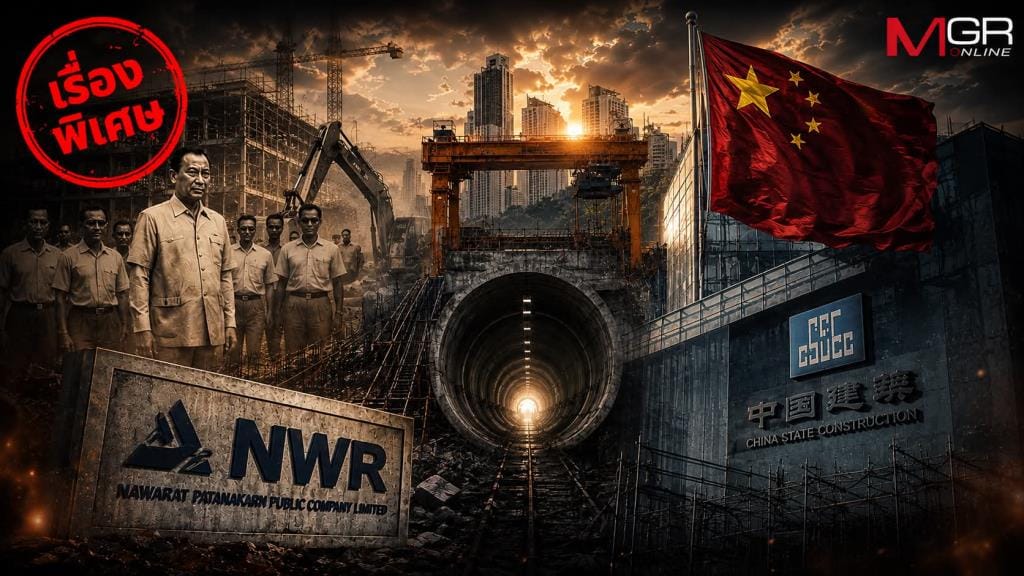
Decoding NWR: from the 50-year legend of the Kannasut family to a debt abyss of 3.4 billion baht — an inside look at the "scaffolding-rights rental operation" that let Chinese capital assume the right to bid on Bangkok's 9.5-billion-baht water tunnel project.
Special series… The Heavy Battle of Thailand's "Big Five" Contractors? (EP.1): The 50-Year Turning Point of "Naowarat Pattanakarn" — Awaiting the Court's Bankruptcy Ruling on 17 Aug.
In the dimension of public procurement, Naowarat Pattanakarn Public Company Limited, or NWR, is the lowest bidder for the Bueng Nong Bon water tunnel project in Bangkok, valued at 9,561 million baht. But in the dimension of Thai construction history, this moment represents a cross-cutting portrait between the "great past" of the Kannasut family — the pioneers of NWR — and the "faded present" of one of the Big Five giants that has been reduced to nothing more than a "scaffolding" for Chinese construction capital.
On 6 August 2026, Naowarat Pattanakarn Public Company Limited (NWR) submitted a clarification letter to the Stock Exchange of Thailand to deny suspicions surrounding a nominee case being investigated by the Department of Special Investigation (DSI), affirming that its joint-venture partner in "Joint Venture NC-NB" is in fact China State Construction Engineering (Thailand) Co., Ltd. — not China Real Estate Co., Ltd.
This clarification may have succeeded in clearing doubts on paper, but it cannot silence the echoes from nearly half a century of past glory — nor answer the question of why a legendary Thai contractor now finds itself compelled to serve as a "legal scaffolding" for a Chinese state-owned construction enterprise.
The Legend of "Kannasut" — Birth of the Fifth Tiger
Looking back to 1976, amid an era when Thailand was pumping budget into building infrastructure across the country, Mana Kannasut, together with master engineers from the Kannasut and Sawatburi family lines, co-registered and established Naowarat Pattanakarn Co., Ltd. with an initial capital of just a few million baht.
Armed with specialised engineering expertise, NWR grew rapidly by taking on difficult work that ordinary contractors dared not touch — mountain tunnel boring, large-scale dam construction, deep-sea port works, and offshore structures. Hundreds of billions of baht in national budget were transformed into public utilities sustaining the country through the hands of Thai craftsmen.
Its glory reached its peak in 1995, when NWR converted and listed on the Stock Exchange of Thailand, and ascended to the throne as one of the "Big Five Thai Construction Tigers" alongside Italian-Thai Development PCL (ITD), Ch. Karnchang PCL (CK), Sino-Thai Engineering and Construction PCL (STEC Group), and Unique Engineering and Construction PCL (UNIQ). It was a golden age in which the Kannasut family wielded influence closely bound to top-tier ministries across every administration — a symbol of purely Thai construction capital that no one dared dismiss.
Into the Abyss — Losses Mount, Bankruptcy Looms
Cutting back to the first quarter of 2026, the figures in NWR's financial statements bear no trace of its former glory. Its accumulated losses have surged past 7,318 million baht, after suffering a net loss of 3,983 million baht in 2024, compounded by a further loss of 1,001 million baht in 2025. NWR has fallen into a state of insolvency, with shareholders' equity deep in the red at negative 3,401 million baht, while current liabilities exceed current assets by more than 3,200 million baht. On 29 May 2026, NWR was forced to swallow its pride and file a business rehabilitation petition with the Central Bankruptcy Court, seeking a debt moratorium.
But what stunned the construction industry most happened on 22 June 2026 — just 24 days after filing for rehabilitation — when NWR, under the name "Joint Venture NC-NB," unexpectedly emerged as the lowest bidder at 9,518 million baht for the Bangkok water tunnel project.
This is the origin of the "scaffolding-rights rental operation." NWR lacked the liquidity to furnish a bank guarantee, yet it still held, within the e-GP system, a "Special Class Contractor Licence in the Irrigation Works category." Meanwhile, China State — the world's number-one contractor — had ample capital and machinery at the ready but lacked the qualifying track record in Thailand's Electronic Government Procurement (e-GP) system.
A mutually beneficial arrangement thus came into being: NWR agreed to put its name and Thai licence to work as a "front scaffolding," enabling the Chinese state enterprise capital to assume the rights and operate behind the scenes as the financial backer — injecting funds, providing bank guarantees, and managing actual field operations.
In the past, the political clout and connections of old establishment families may well have helped major contractors negotiate deadline extensions, project handovers, or push for subsidy budgets to prop up liquidity and weather every crisis.
But today, Thailand's Electronic Government Procurement system (e-GP), administered by the Comptroller General's Department under the Ministry of Finance — the digital hub used to announce procurement calls, submit bids, and track government projects in the name of transparency and auditability — has completely transformed the legal mechanisms and government work-acceptance processes. When Circular No. Wor 225 of the Comptroller General's Department measures eligibility by net worth figures and auditor-certified financial statements, and when shareholders' equity is nearly negative 3.5 billion baht and NWR failed to submit its status-tracking documents by the 30 June 2026 deadline, no government official dares put pen to paper to provide cover — the risk of criminal prosecution under the NACC is too great.
At the same time, NWR's three existing Bangkok Metropolitan Administration projects, with a combined value of 11,000 million baht (Khlong Prem Prachakon, Khlong Thawi Watthana, and Din Daeng Wastewater), are running 28% to 74% behind schedule due to a lack of working capital to pay for materials. The political connections of the past have thus become a hollow relic when confronted with today's accounting obstacles. The only remaining lifeline is to sell off the rights and let foreign capital step in and take over.
Examining the Business Partner — Bloodline of a Chinese State Enterprise
NWR's Stock Exchange of Thailand announcement reaffirming "China State" as the true partner — clarifying it is not "China Real Estate" — does nothing to diminish the picture of Chinese capital bloc assuming Thai procurement rights. Because when one peels back the layer and examines the structure at the level of geo-economic politics, both business groups have root systems that trace back to the State-owned Assets Supervision and Administration Commission of the State Council of China (SASAC) — both are ministerial-level bodies of the Chinese central government.
The first strand — China State Construction Engineering (Thailand) Co., Ltd., established in Thailand since 1990, is the direct Thai subsidiary of CSCEC (China State Construction Engineering Corporation), a front-line central government state-owned construction enterprise. CSCEC is listed on the Fortune Global 500, and the Engineering News-Record (ENR) global contractor rankings have placed CSCEC as the world's number-one contractor for multiple consecutive years.
The second strand — China Real Estate Co., Ltd. / China Railway is a legal entity within the network of CREC (China Railway Group), likewise a Chinese government giant in railway and transportation construction. In Thailand, "China Railway No. 10 (Thailand) Co., Ltd." — one of Italian-Thai Development's business partners and the builder of the Office of the Auditor General building that collapsed in the earthquake — stands as a defendant in a criminal case stemming from its use of Thai nominees to front a 51% shareholding and the covert injection of over 2,000 million baht in disguised loans, as part of the DSI's nominee case dossier.
The difference between China State and China Real Estate thus amounts to nothing more than the corporate name in the Department of Business Development's registry. In the dimension of competing for concessions funded by Thailand's national budget, both are "puzzle pieces from the Chinese government's state-owned construction enterprise machinery," systematically dispatched to harvest gains from Thai infrastructure projects.
Two Crossroads — Fate Decided on 17 Aug. 2026
Two timelines — past and present — are converging at a decisive juncture on 17 August 2026, the date the Central Bankruptcy Court has scheduled the hearing on NWR's rehabilitation petition.
The legal landscape has been clearly split into two diverging paths.
The first path: if the court approves the rehabilitation, NWR will continue to receive interim protection, and will invoke Circular No. Wor 124 to demand that the Bangkok Metropolitan Administration sign the 9.5-billion-baht project contract. However, the BMA would then be exposed to maximum risk should the rehabilitation plan process in the future be opposed by creditors to the point that the project grinds to a halt once again.
The second path: if the court does not approve, or dismisses the petition, the debt moratorium will end immediately. Financial institution creditors and debenture holders will rush to file for absolute receivership, while the Comptroller General's Department will enforce Circular No. Wor 225 and order NWR's name struck from the list of special-class government contractors — opening the way for the BMA to invoke its authority under TOR Clause 6.5 and announce cancellation of the bidding process.
This would also lead to the termination of government contract rights totalling more than 12,000 million baht, comprising: the Bueng Nong Bon water tunnel extension project (BMA), with a reference price of 9,561 million baht, and highway/expressway construction and irrigation projects in the regions, with a combined value of approximately 2,500–3,000 million baht currently under negotiation — all terminated outright.
Bangkok Governor Chadchart Sittipunt's public statement on 4 August 2026 — that he had sent a letter to the Comptroller General's Department to verify the private entity's qualifications before signing — is in reality a "policy time-buying strategy," awaiting the court's order on 17 August 2026.
If the court rules against approval, the BMA will be freed from accusations of handing a project to transnational capital. But if the court approves the rehabilitation plan, a critical question will immediately challenge Governor Chadchart's leadership: will he dare use TOR Clause 6.5 authority to cut the problem off at the root — or will he put pen to paper and sign a multi-billion-baht contract backed by a collapsed giant of scaffolding standing as the guarantor of Bangkok's public utilities?