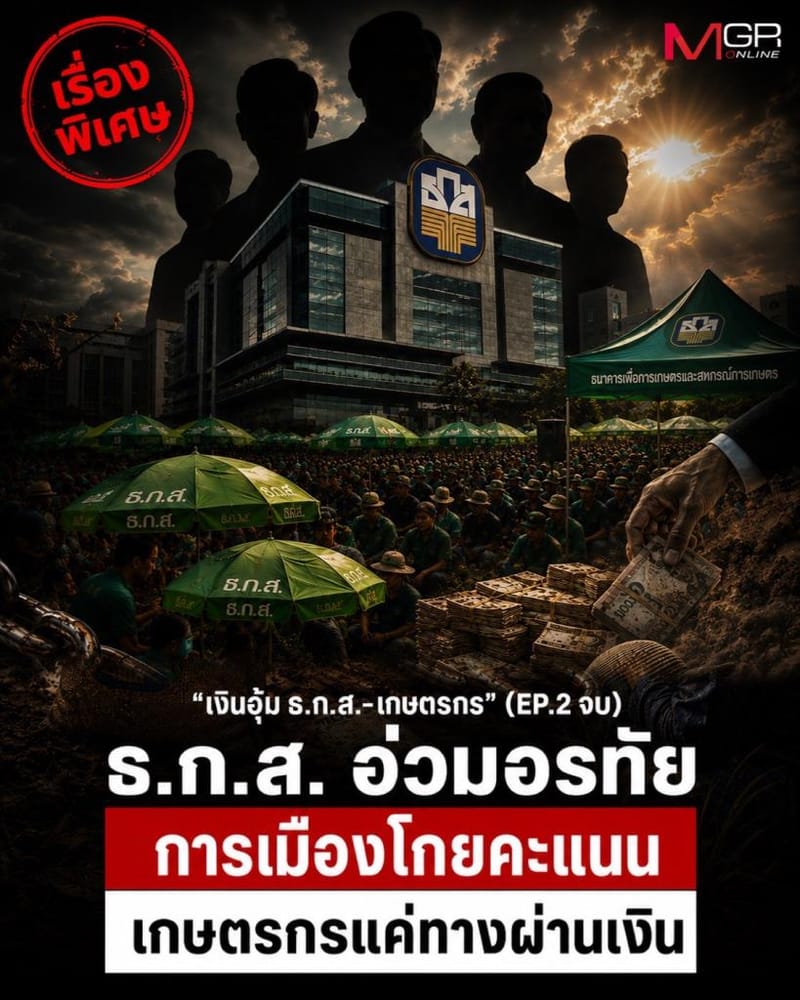
Investigating the Section 28 loan trail — exposing how hundreds of billions of baht in taxpayer money channelled through the BAAC barely reaches farmers' hands, while politicians harvest votes and leave Thai people to shoulder the interest burden.
Series: "Money Propping Up the BAAC and Farmers" (EP.2 — Final): The BAAC in Deep Distress, Politicians Score Points, Farmers Are Just a Conduit for Money
When the reality is plain for all to see — that more than 30 million Thai farmers remain buried under crushing debt, mired in dire poverty, and have never once been able to get ahead in life — the critical question that must be answered is this: "Who exactly are the true beneficiaries of the nearly one trillion baht that the government has borrowed through the BAAC and poured into the agricultural sector over the past several decades?"
Beyond the group of agricultural input traders, it appears that the political side — the politicians and election-seekers — are the most comfortable beneficiaries, having gained everything without investing any effort of their own. Politicians use the mechanism under Section 28 of the BAAC as a "cheap vote-buying tool." Rather than spending time devising difficult, intellectually demanding policies to restructure agriculture, they simply order the BAAC to advance money and hand it out, creating the image of benevolent benefactors, sweeping up votes from the public during election season, and then leaving behind an interest burden of over 30 billion baht a year for the entire Thai population to carry.
It is therefore abundantly clear that Thai farmers are not the true "beneficiaries" of the nearly one hundred billion baht that the government has borrowed from the BAAC using its authority under Section 28. Farmers hold the status of mere "political hostages" and "legitimate pretexts" that the political side uses as a front — to approve and disburse enormous amounts of taxpayer money — while ultimately politicians pocket the popularity gains. This is something that has occurred in every era, in every administration.
Through in-depth research and analysis of data from the Fiscal Risk Report of the Fiscal Policy Office (FPO) and the financial statements of the Bank for Agriculture and Agricultural Cooperatives (BAAC), as well as from ThaiPublica's news report on fiscal risk — "On-budget and Off-budget Debt: Ballooning Without End! The BAAC Awaiting Compensation of Over 800 Billion Baht" — the following is a summary of borrowings under Section 28, which constitute quasi-fiscal policy, and the projects that consumed the most funds over the past 10 years.
The question is: which government used its authority under Section 28 to borrow from the BAAC the most?
Looking at fiscal burden statistics over the past decade, the government under Gen. Prayut Chan-o-cha (2014–2023) was the administration that approved the most projects and generated the highest quasi-fiscal debt under Section 28 ever recorded — shattering records for new debt creation. During fiscal years 2018–2022, the value of newly approved projects under Section 28 surged by as much as 84.4%.
The year that generated the highest debt was fiscal year 2022, which holds the record as the year with the most newly approved projects under Section 28 in history, with a total value of 210,040 million baht. Of that amount, measures to assist the agricultural sector through the BAAC accounted for as much as 89% of the approved total. As a result, cumulative outstanding commitments under Section 28 across all agencies surpassed 1 trillion baht for the first time in 2022–2023, with the BAAC shouldering the highest share — as much as 85% of all outstanding obligations.
Although the Srettha Thavisin government and the current government attempted to slow the approval of new projects during 2024–2025, additional major projects worth over 140,000–160,000 million baht were approved while budget allocations for repayment were reduced. This has caused the BAAC's cumulative outstanding debt to soar to a new record of 963,000 million baht.
The question is: where was most of the Section 28 loan money spent over the past 10 years?
Statistics on the value of projects implemented through the BAAC clearly show that 75%–80% of quasi-fiscal loan funds were channelled into "agricultural price support and subsidy measures." The three projects that consumed the most funds and generated the largest outstanding compensation obligations are as follows:
Rank 1: The Farmer Income Guarantee Project for Rice Growers and the Production Cost Management and Quality Development Support Project (the 1,000-baht-per-rai payment). This project is a policy of direct cash subsidies and price-gap compensation for rice farmers nationwide. During the 2019/20–2022/23 crop years, the government channelled money through the BAAC for this group of projects at an average of 80,000–150,000 million baht per year, most of which was outright grant spending. This has become the largest outstanding debtor balance awaiting government compensation on the BAAC's books.
Rank 2: The Agricultural Produce Pledging Project (debt legacy from 2011/12–2013/14). The former paddy and cassava pledging schemes, for which the government used BAAC borrowings in lieu of the Public Debt Management Office (PDMO), left behind debts that, despite more than 10 years having passed, still have outstanding principal and interest owed to the BAAC as of the close of the BAAC's accounting year (31 March 2026) amounting to 107,207 million baht, requiring budget allocations to be repaid in instalments of 25,000 million baht per year.
Rank 3: Debt moratorium measures for small-scale farmers and interest subsidy on loans — such as the 3-year debt suspension measure covering borrowers with outstanding debt of over 270,000 million baht, as well as low-interest loan projects to assist with drought and COVID-19. The government must bear the cost of paying interest to the BAAC on behalf of farmers, with cumulative interest compensation running to tens of billions of baht per year.
In summary, over the past 10 years (2016–2025), the era of Gen. Prayut was the period in which borrowing and utilisation of funds under Section 28 were the highest. The majority of those funds went into the "cash handout, 1,000-baht-per-rai, and crop income guarantee projects," widely regarded as policies oriented toward short-term political gain, without translating into sustainable improvements in irrigation systems, technology, or farmers' production structures. The result is an accumulated "outstanding debt awaiting compensation" in the BAAC that has nearly reached 1 trillion baht today.
Breaking Out of the Vicious Cycle
The crisis of over 1.1 trillion baht in quasi-fiscal off-budget debt swept under the rug — if Thai society continues to allow the political side to channel money through the BAAC to hand out to farmers for vote-buying purposes day after day, the country's fiscal system will be no different from a sinking ship. The time has come for a major structural overhaul of the budget system, before financial ruin spreads and causes total collapse. The very first step must be to curb fiscal recklessness: pressing the State Monetary and Fiscal Policy Committee to reduce the spending ceiling under Section 28 from its current level, which has expanded to 32% of the annual expenditure budget, back down to no more than 30%, and to end the practice of allowing off-budget loan money to be funnelled into cash handouts for vote-buying.
Most critically, legislation must be enacted to require budget allocations for repayment of "principal" to the BAAC in clearly defined proportions — similar to the criterion for public debt principal repayment, which is mandated at no less than 4% of the annual expenditure budget — in order to halt the state of "dead debt" and to prevent the BAAC's financial statements from continuing to bear these risks.
At the same time, the government must stop squandering the budget on cash giveaways, and stop losing 25,000–35,000 million baht in taxpayer money each year to "wasted interest," redirecting those enormous funds toward structural investment that generates real returns in areas critical to the agricultural sector — such as expanding irrigated areas to cover more than 30% of total agricultural land nationwide, subsidising technology costs, promoting high-value agricultural processing, improving crop varieties sought by global markets, and so on — without waiting for government price guarantee payments.
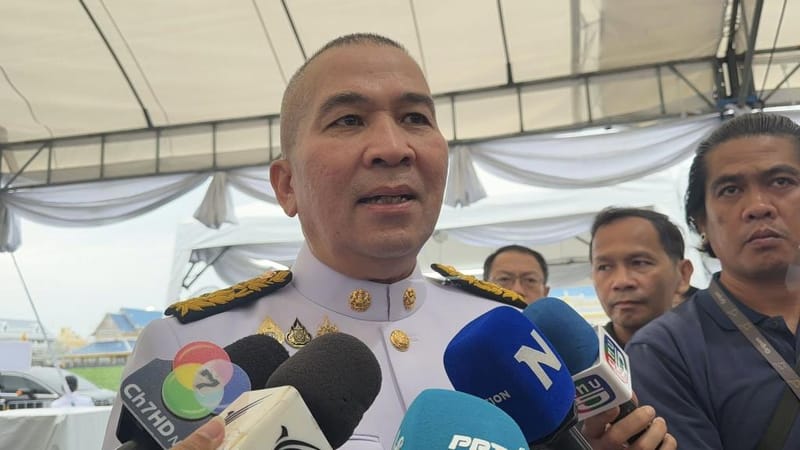
As for the position of Dr. Ekniti Nitithanprapas, Deputy Prime Minister and Minister of Finance, he has sent warning signals about the state of fiscal risk after outstanding obligations under Section 28 of the State Fiscal and Financial Discipline Act surged past 1.13 trillion baht, affecting the country's financial discipline and credit rating. He has urged government agencies to avoid creating additional commitments and to urgently draw up budget plans to repay the compensation debt owed to state financial institutions in instalments. At the same time, he has declared a direct challenge to old-style populist policies, reaffirming the strict principle that BAAC funds must no longer be injected into outright cash subsidy programmes for farmers. The approach is being shifted to the use of database innovation for screening and identifying eligible beneficiaries so that assistance is precisely targeted, alongside a focus on channelling budget funds into investment to enhance the efficiency and productive capacity of Thailand's agricultural sector over the long term, replacing short-term compensation.
In addition, the Ministry of Finance has proposed that the Cabinet approve strict criteria and guidelines for supervising the implementation of projects under Section 28, issuing a ban on submitting projects that take the form of direct subsidies, assistance, compensation, or agricultural price guarantees. The Section 28 mechanism is to be permitted only in cases of genuine urgency where normal annual budget appropriations or emergency contingency funds cannot be mobilised. Crucially, every new project seeking to invoke Section 28 is required to undergo thorough screening and risk assessment jointly by the Ministry of Finance and the Prime Minister before being submitted to the Cabinet for approval — in order to block state banks from being used as political ATM machines.
Now that the Ministry of Finance has clearly declared that the government must stop using the BAAC as a borrowing source to craft vote-seeking projects that burn through taxpayer money in interest payments — because this mountain of debt is the country's fiscal future — the question remains: how far can the voice of a "minister from outside politics" push back against the demands of powerful political clans or politicians who derive their authority from "special power"? That remains to be seen.
Read back: Series "Money Propping Up the BAAC and Farmers" (EP.1): Dissecting the Section 28 Debt Surging to 1.1 Trillion Baht! The Political ATM Machine, Dead Debt, the BAAC Nursing Farmers Along in Chronic Illness