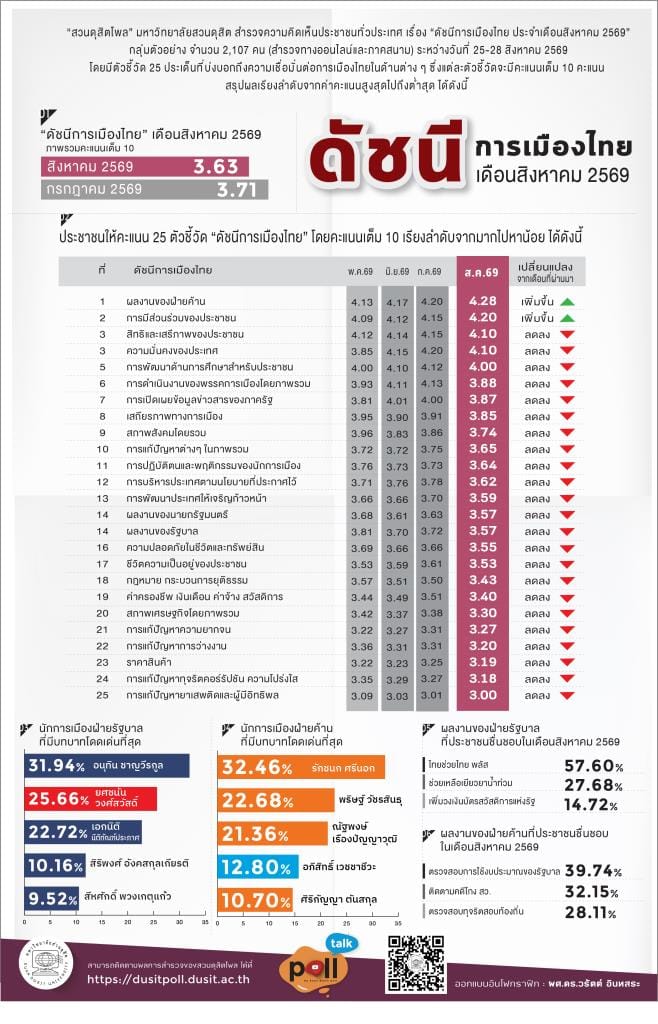
Suan Dusit Poll reveals the August political index has dropped to 3.63 points. The opposition's performance score remains in the lead, running counter to the low score on drug and influential-figure problem-solving. "Anutin-Ice" are the most outstanding figures. The government's Thai Chuay Thai Plus initiative tops the list of favourite government achievements, while the opposition is praised for scrutinising the budget.
Today (30 Aug.), Suan Dusit Poll, Suan Dusit University, conducted a public opinion survey nationwide on the topic of "Thailand's Political Index for August 2026." The sample group comprised 2,107 people (surveyed online and in the field) between 25–28 August 2026. The results show that respondents gave an average overall score of 3.63 points for Thailand's Political Index for August, down from 3.71 points recorded in July 2026.
The indicator with the highest score was the performance of the opposition, averaging 4.28 points. The indicator with the lowest score was the resolution of drug problems and the influence of powerful figures, averaging 3.00 points. The most outstanding government-side politician was Anutin Charnvirakul at 31.94%, followed by Yotchanon Wongsawat at 25.66%. On the opposition side, the most outstanding was Rakchanok Srinawk at 32.46%, followed by Parit Wacharasin at 22.68%. The favourite government achievement of the month was Thai Chuay Thai Plus at 57.60%. The favourite opposition achievement of the month was scrutinising the government's budget expenditure at 39.74%.
Dr. Pornpan Buathong, President of Suan Dusit Poll, stated that the decline in Thailand's Political Index for August reflects the impact of ongoing situations spanning the economy, society, corruption, disasters, and national security. Although the government has responded with various measures, many issues have yet to show clear results. Meanwhile, the opposition has continuously exercised its oversight role and maintained sustained political communication, which is why the opposition's performance and public participation are the only two indicators that have increased.
Ajarn Pinyo Kuwattanaseni of the Bachelor of Laws Programme, School of Law and Politics, Suan Dusit University, explained that the survey results indicate a decline in Thailand's Political Index across almost every dimension, reflecting a crisis of public confidence in Thai political institutions — particularly regarding the resolution of corruption, transparency, and the problem of drugs and influential figures, which scored at the bottom. Another significant issue is the erosion of legal legitimacy of the executive branch, causing the scores for the Prime Minister's performance and the government's performance to fall to just 3.57 points each. Although the relief measure "Thai Chuay Thai Plus" received the highest popularity among government achievements (57.60%), it is not enough to compensate for the overall failure reflected in the consumer price index, cost of living, and the general economy, all of which have declined across the board. Meanwhile, public participation scored among the top indicators — a warning signal both legally and politically that if the government structure lacks transparency and the rule of law, public faith in the system of governance and Thai political institutions will inevitably continue to erode.