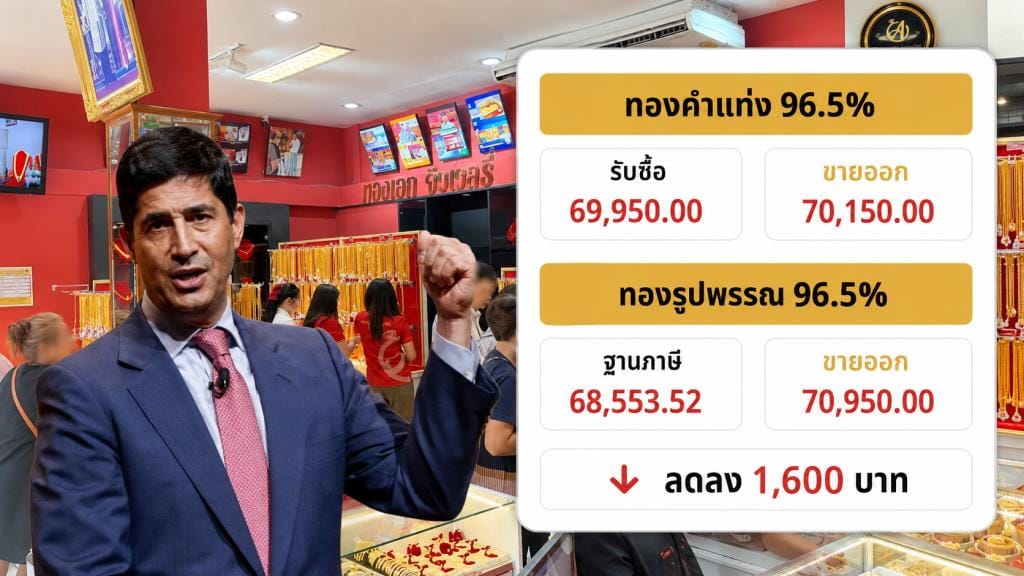
Thai gold prices opened sharply lower on 29 August 2026, tumbling 1,600 baht from the previous day's closing price, pushing the selling price of gold bar down to 70,150 baht per baht-weight, after the Fed chairman signalled readiness to raise interest rates if inflation fails to decline. The move sent the U.S. dollar and bond yields higher, while gold on the world market was sold off by more than 3%.
Domestic gold prices on the morning of 29 August 2026 fell sharply in line with global gold market direction, after remarks by the chairman of the U.S. Federal Reserve led investors to place greater weight on the possibility that the United States would resume raising interest rates.
The Gold Traders Association announced its first price fixing of the day at 09:08 a.m. Gold bar of 96.5% purity was quoted at a buying price of 69,950 baht per baht-weight and a selling price of 70,150 baht, down 1,600 baht from the closing price on 28 August, which had stood at 71,750 baht.
Ornamental gold of 96.5% purity was quoted at a buying price of 68,553.52 baht per baht-weight and a selling price of 70,950 baht, falling in the same direction.
Calculated from the gold bar selling price, the decline from 71,750 baht to 70,150 baht represents approximately 2.23% within a single overnight session.
The primary cause of this Thai gold sell-off originated in overseas markets, where global gold prices were dumped by more than 3% after Kevin Warsh, the Fed chairman, said at the Jackson Hole conference that the Fed still has work to do if it is not confident that core inflation is returning to the 2% target.
Those remarks were interpreted as the Fed leaving the door open to further rate hikes if inflationary pressures remain unresolved — a departure from the market's previous expectation that the U.S. rate-hike cycle was approaching an easing phase.
Reuters reported that the spot gold price during trading on 28 August fell 2.9% to $4,567.23 per ounce, its lowest level since 20 August. The U.S. gold futures contract for December delivery closed down 2.9% at $4,529.90 per ounce.
Later, during the morning session of 29 August, spot gold was trading around $4,456–$4,457 per ounce, compared with the more-than-three-month high of $4,696.18 reached on 25 August — a pullback of approximately $240, or more than 5%, within just a few days.
Markets Increase Bets on a Fed Rate Hike
Following the Fed chairman's remarks, investors raised the probability of the Fed raising interest rates at its September meeting to 58%, up from 36% previously. The probability of a rate hike by December rose to 89%.
These expectations pushed U.S. government bond yields higher, while the dollar index strengthened to its highest level in more than one week.
Both factors are negative for gold prices, since gold is a non-interest-bearing asset. When bond yields rise, investors face a higher opportunity cost from holding gold, while a stronger dollar makes gold — which is priced in dollars — more expensive for holders of other currencies.
Independent analyst Tai Wong told Reuters that gold faced heavy selling pressure after the Fed chairman affirmed that inflation has not slowed significantly, and the market began to assess the probability of the Fed raising rates at its September meeting as roughly a coin flip, or around fifty-fifty.
Brokers Warned in Advance to Watch Jackson Hole
Before this sell-off materialised, InterGold noted in its analysis on 28 August that investors needed to watch the Jackson Hole conference closely, setting resistance for global gold at around $4,680, or approximately 72,000 baht for Thai gold.
Prior to that, an analysis on 25 August had already warned that selling pressure was building and that gold prices might be nearing the end of a short-term rally, while on 24 August the recommendation had been not to chase prices higher and to wait to buy on a pullback.
Short-Term Volatility but Long-Term Outlook Still Supported
Technically, a drop below $4,500 per ounce is a clear signal that gold has entered a short-term correction, after prices rose rapidly on safe-haven buying and reached a high of over $4,690 at the start of the week.
Pressure going forward will depend on the direction of the dollar, bond yields, and U.S. inflation data. If the market assigns greater probability to a rate hike, gold prices may remain volatile and continue to face selling pressure.
Nevertheless, medium- to long-term factors still provide support, stemming from U.S. public debt, fiscal risk, geopolitical uncertainty, and central bank gold demand.
Hua Seng Heng assessed, ahead of the Jackson Hole meeting, that gold still has the potential to test $4,900–$5,000 per ounce within this year if factors related to U.S. debt, central bank reserves, and geopolitical risks remain supportive. However, that forecast is a medium-term target and does not represent confirmation that the current correction has ended.
Watch Whether Thai Gold Breaks Below 70,000 Baht
The key short-term level for Thai gold is around 70,000 baht per baht-weight, after the market-open selling price of 70,150 baht left it just 150 baht away from that level.
If global gold remains below $4,500 and the baht does not weaken enough to provide support, Thai gold bar prices could break below 70,000 baht. However, if buying returns in global markets or the dollar weakens, gold prices may recover swiftly from the sell-off that occurred.
Today's decline of 1,600 baht is therefore insufficient to conclude that gold has ended its long-term uptrend, but it does reflect that "the market has changed the narrative driving prices" — shifting from hopes of rate cuts back to the risk of rate hikes. Investors should therefore monitor Fed statements, U.S. inflation data, bond yields, and the baht exchange rate in tandem.