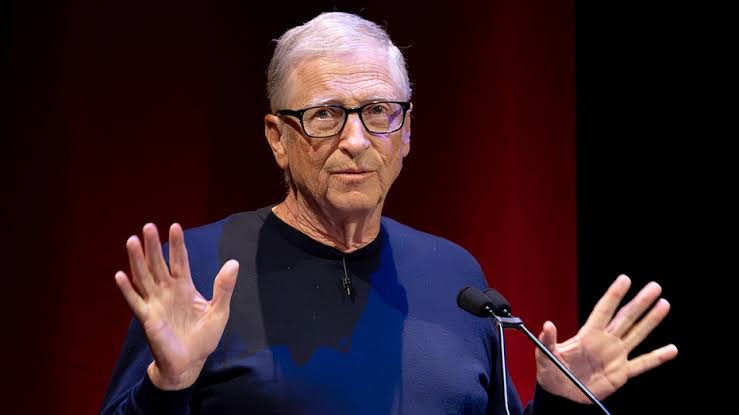
Microsoft co-founder Bill Gates has published a sweeping analysis of more than 6,000 words that is shaking up the world of macroeconomics, putting forward an extreme proposal to tax AI tokens and industrial robots directly, while also floating the idea of "Human Reserved" zones that would ring-fence up to 40 percent of the economy from being touched by machines. This comes amid warnings from Anthropic CEO Dario Amodei, who has declared that half of all entry-level jobs could disappear in less than five years, while figures for degree-holding unemployed workers in California are already beginning to move in ways that cannot be ignored.
Even as institutional capital pours into artificial intelligence infrastructure at a breathtaking pace, Bill Gates chose to open his personal blog to fire off the question that the technology industry has been trying to sidestep all along: "If AI can truly replace humans as advertised, where will hundreds of millions of workers fit in the economy?" His proposal goes far beyond philosophical rhetoric — it reaches down to the level of tax policy, calling for a direct levy on the processing tokens of large language models alongside a tax on industrial robots, in order to remove the incentive for employers to treat human labour as surplus overhead to be eliminated.
A time bomb the labour market is ignoring
Reactions from front-line players within the technology industry itself offer little comfort. Anthropic CEO Dario Amodei assessed plainly that more than half of entry-level white-collar positions could vanish within less than five years — a timeline far shorter than anything mainstream economists had previously projected. Meanwhile, the latest report from the Yale Budget Lab, together with the Brookings Institution, had not yet detected signs of mass unemployment in US federal employment data as of July. Yet warning signals are appearing clearly from another direction: California's AI impact tracking database has found that the number of degree-holding workers in high-displacement-risk occupations filing for unemployment benefits has begun climbing to a statistically significant degree. This is the gap between macroeconomic figures that still look calm and a group-specific reality that is already beginning to crack.
Why tax "tokens" rather than profits?
The point at which Gates breaks from conventional robot-tax proposals is his choice to levy the tax at the unit of computation directly, rather than waiting to collect it from net corporate profits — which are already wafer-thin in highly competitive markets. The reason is that the current tax structure blatantly advantages capital: when an organisation hires people, it must shoulder payroll taxes and social security contributions, but when it invests in robots or AI systems it can immediately write off the cost as depreciation. Machines deteriorate over time but never have to contribute to anyone's social fund. This asymmetry is precisely what accelerates the flow of capital away from employment and into AI infrastructure at a compounding rate, and causes a tax system that should be neutral to become, inadvertently, a mechanism that turbocharges the replacement of human labour.
What makes this different from previous industrial revolutions
What makes this round more dangerous than any before it is speed. The past migration of labour from agriculture to services took several generations and still opened space for new occupations that depended on human judgement. AI bypasses that step entirely by substituting cognitive capability directly — whether in law, customer service, medicine, software engineering, or manufacturing. A cycle that once took centuries may compress into a single decade, with no guarantee that new jobs will emerge to absorb displaced workers in time.
"Human Reserved" zones — a real solution, or merely consolation?
To absorb the shock, Gates has proposed the concept of "Human Reserved" zones, modelled on nature reserves: roles requiring deep human sensitivity — such as childcare or jury duty — would be designated as areas where AI may not tread. Education and public health would fall into a semi-reserved category, keeping humans at the core while AI functions only as a supplementary tool. He estimates that the proportion of the economy eligible for such protection could reach a maximum of 40 percent, and that pushing the figure any higher would threaten overall economic stability.
Yet the question this proposal still cannot answer clearly is: who draws the line between what is "reserved" and what is not? And do governments around the world — which have still been unable to enforce even a basic robot tax since Gates first proposed one in 2017 — possess the political will to push through a framework more complex than that, given that the major capital players in the AI industry are the very same groups that exert influence over policy-making in many countries?
A fork in the road to be decided this year, not next decade
Gates concluded that AI has the potential to become either the greatest equalising tool in history or the source of the worst inequality ever seen, and that this trajectory will be determined by policy decisions in the next few years — not at the level of decades. But given that the history of the robot tax since 2017 is one of repeated failures of political courage, what may deserve closer scrutiny than the 40 percent figure or the name of the reserve zones is a more straightforward question: are those who stand to gain the most from replacing human labour with AI today truly prepared to surrender a share of their profits for the survival of human workers tomorrow?