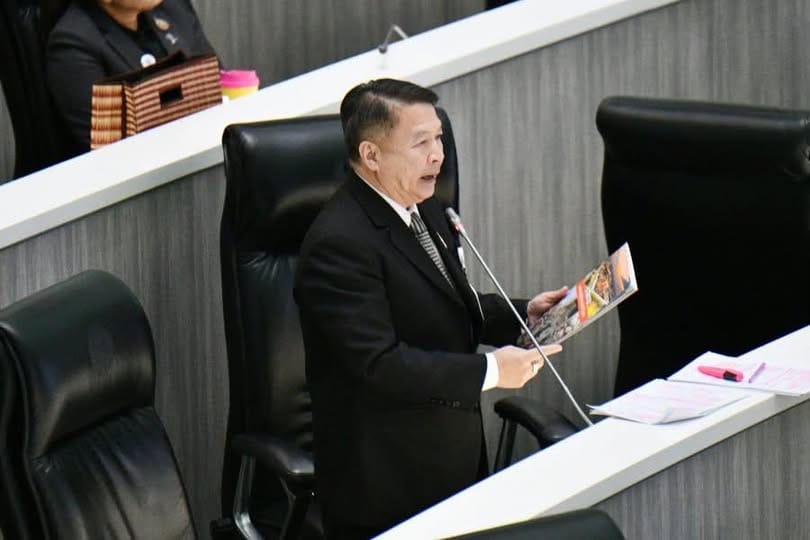
"Dr. Prem" dissects Thai PBS in the middle of the Senate, pressing on whether the 2-billion-baht annual budget represents value for money, questioning the issue of "claiming flat-rate car allowances while using pool vehicles," keeping watch on specific-method procurement and the outsourcing of programme production to private firms, and stressing that public media must be transparent — "Don't dig up dirt on others while being dirty yourself."
On 26 August, Dr. Premsak Phiayura, a Senator, delivered a speech during a Senate meeting convened to consider the annual performance report for 2025 of the Thai Public Broadcasting Service (Thai PBS), raising questions about the value for money and transparency in Thai PBS's budget management. He stated that the organisation receives approximately 2,000 million baht per year in funding derived from taxes on liquor and tobacco, and that over nearly 19 years of operation its cumulative budget has amounted to nearly 40,000 million baht. It is therefore a matter on which the public has every right to ask how well that sum of money has been managed and how much benefit has flowed back to the people.
Dr. Premsak said that Thai PBS had declared itself a "public media outlet" and "media for everyone," adhering to the principles of good governance, transparency, and accountability. When doubts arise, it is therefore necessary to open the organisation up to straightforward scrutiny. He emphasised that this debate was not aimed at attacking operational staff, reporters, or field personnel, but rather sought to examine matters at the level of policy and management — it was "criticism to build, not criticism to destroy."
One of the issues raised in the debate was a matter that had previously appeared in the news towards the end of last year, concerning a complaint lodged with the National Anti-Corruption Commission (NACC) against two Thai PBS executives. The allegation involved the executives receiving monthly flat-rate vehicle allowances while still making use of the organisation's pool vehicles. One of the executives reportedly received a car allowance of 27,000 baht per month and the other 15,000 baht per month.
"If one is already receiving a flat-rate car allowance, is it still permissible to use a pool vehicle on top of that? If it is permissible because there is no regulation prohibiting it, then the next question must be whether it is appropriate — and if it is later found to be improper, who will be held responsible, and in what manner?" Dr. Premsak said.
He also called on Thai PBS to disclose how many of its personnel currently receive flat-rate car allowances and how much the organisation spends on this item in total each month. Since the money used to run the organisation comes from the public's taxes, he said, management should be mindful of economy and value for money, and should explain to society the necessity of such remuneration or welfare benefits.
Dr. Premsak also questioned the necessity of having both the state television station NBT Channel 11 and a public media outlet like Thai PBS, given that some of their roles and content appear to overlap. He was of the view that each organisation must clearly demonstrate to the public the distinction of its mission and the value for money of the budget it receives.
Another point he raised concerned the procurement process, questioning the use of the specific-method approach across several projects — whether it is genuinely necessary and consistent with the principles of competition, transparency, and procurement law. In particular, he noted that if the same contractor has been selected continuously for multiple years, a clear explanation should be provided to avoid allegations of favouritism or conflicts of interest.
Dr. Premsak cited as an example the production of a documentary on the events of 14 October to mark the 50th anniversary in 2023, for which a private firm was contracted at a cost of approximately 2–3 million baht. He questioned why, given that Thai PBS has its own personnel and in-house production capabilities, outsourcing the work to an external party was necessary and whether it delivered maximum value for money.
Dr. Premsak concluded by saying that the money Thai PBS receives is not the organisation's own private money but the taxpayers' money. Having declared itself a transparent and accountable public media outlet, it must be ready to face questions and scrutiny from society.
"I want this station to be the eyes and ears of the people — to monitor, expose, and dig out all manner of corruption. But we must not become that ourselves. The organisation must return value to taxpayers, have tangible output, and be a refuge for the voiceless among our fellow citizens," Dr. Premsak said.
Nevertheless, Thai PBS executives clarified to the meeting that past operations had been conducted in accordance with relevant regulations, including those of the Office of the Prime Minister and the Office of the Auditor General of Thailand (OAG). They affirmed that all actions had been carried out in good faith, though there may be certain shortcomings, and that the observations raised by Senators would be taken away for improvement. A report would be submitted to the Senate within one month to explain the corrective measures taken in response to the issues and observations raised in the debate.