The Stock Exchange of Thailand has revealed that the Thai capital market is flourishing, with the index touching 1,600 points — a positive outcome driven by foreign capital inflows following political stabilisation. The data centre and semiconductor industries remain sectors attracting strong investor interest, while the Thailand Fast Pass project is set to act as an accelerator for the investment process.
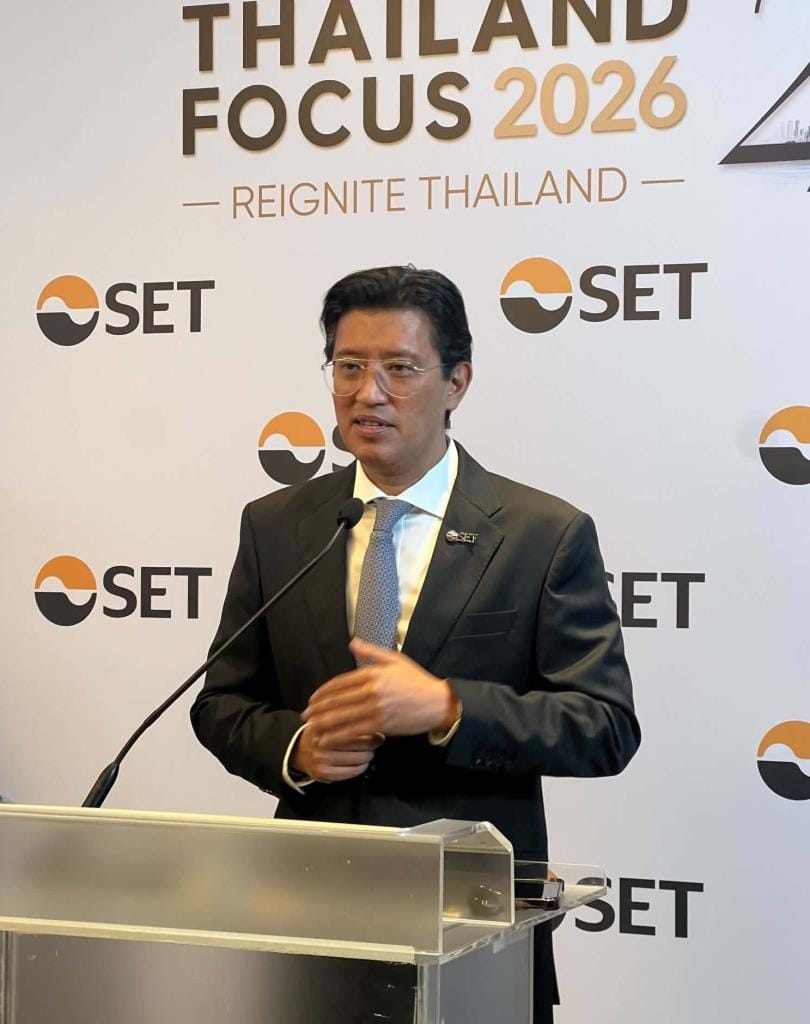
Mr Asadej Kongsiri, Director and President of the Stock Exchange of Thailand, spoke at the opening of the "Thailand Focus 2026: Reignite Thailand" event, stating that the Thai capital market has shown clearly positive developments compared with the same period of the previous year. The SET Index has risen from the 1,200-point level last year to 1,600 points at present, while average daily trading value has increased from below USD 1 billion in the previous year to an average of more than USD 2 billion. Foreign capital flows have also reversed — from a net outflow of USD 3 billion last year to a net inflow of more than USD 2 billion this year.
The investment climate in the Thai capital market has improved markedly, resulting from increased political stability following elections, which has given the government greater strength and confidence to push forward policies and structural reforms necessary for the country's development. Significantly improved recovery signals have begun to appear in foreign direct investment (FDI) and domestic private-sector investment, after the Thai economy underperformed over the past 5–10 years.
This year, 77 Thai listed companies are participating in one-on-one and small-group meetings with institutional investors to demonstrate their growth directions and potential. Marking the 20th anniversary of the Thailand Focus event, a joint forum has also been held among senior executives of regional stock exchanges to build networks of cooperation and long-term mutual support.
Comparing this year's Thailand Focus with last year's, investor priorities have clearly shifted. Last year, the focus was primarily on regulation, government policy, and risk management. This year's Thailand Focus has a much more forward-looking perspective — investors want to see how Thailand will generate growth and how it will drive the economy back to the level it should be performing at.
In response, the government has taken a clear role in communicating economic direction and policy. The Deputy Prime Minister presented an overview of economic policy, while the Minister of Energy outlined an approach to transform "energy risks" into "opportunities" for the country, and laid out a framework for connecting the work of each sector so that every part of the economic system can operate in a coordinated manner and help propel the Thai economy into long-term step-change growth. The industries attracting attention from foreign investors are new foundational industries — Data Centres, Semiconductors, and Electric Vehicle (EV) assembly — which stand out clearly, as reflected in the number of projects that have applied for investment promotion through the Board of Investment (BOI), with figures showing concrete investment volumes.
"What Thailand must urgently do from this point is to convert investment approval figures into actual investment, as well as create employment and domestic economic activity. On this matter, the Thailand Fast Pass project will play a role in accelerating the investment process, so that approved projects can move into actual investment more quickly. This will enable Thailand to communicate real, tangible outcomes to investors worldwide and sustain confidence on a continuous basis."
Meanwhile, AI-related stocks and the banking sector continue to attract high interest from foreign investors. The energy sector also has an ongoing positive outlook, set to benefit from new investments entering Thailand, as the expansion of industry and infrastructure increases energy demand.
Regarding the IPO market, it was acknowledged that the number of companies listing this year has not been large, and the overall fundraising size remains relatively small — which can occur during periods when market conditions are not conducive. However, companies are now beginning to show interest in fundraising, reflecting that the market atmosphere is becoming increasingly favourable for IPOs.
Mr Asadej stated that the Stock Exchange of Thailand is working together with the Securities and Exchange Commission (SEC) to revise regulations to make them more flexible, in order to open up greater capital market access for New Economy businesses, alongside investor protection — particularly through a Disclosure-Based approach, which emphasises comprehensive disclosure of risk information and company growth plans, so that investors can properly assess the opportunities and risks of businesses in a growth phase.
In addition, a project that has received a strong positive response from foreign investors is Jump+, an initiative that encourages listed companies to have clear three-year growth plans while emphasising Governance and Sustainability, enabling investors to assess the long-term potential and direction of companies.
"At this Thailand Focus event, 16 companies participating in the Jump+ project have attracted interest from institutional investors, as having a clear and trackable business plan is one of the key pieces of information investors use when making investment decisions."
Mr Asadej continued that another key objective of the Stock Exchange of Thailand is to position Thailand as a starting point — or trigger — for generating investor interest in capital markets across the ASEAN region, under the concept of ASEAN Connect. The Stock Exchange of Thailand has invited the CEOs of ASEAN member stock exchanges to join discussions in order to build cooperation and connect regional capital markets more closely. One collaboration that has already materialised is the Depositary Receipt (DR), which began as a cooperation between the Thai and Singaporean capital markets before being developed and expanded to other markets.
Mr Asadej noted that rating agencies had previously considered the possibility of downgrading Thailand's credit rating due to the impact of energy problems and the war situation. However, after the government continuously explained and presented its contingency plans, Thailand's credit rating was confirmed, with the prospect of a future upgrade. He added that building sustainable confidence cannot rely on communication alone — actual performance must be demonstrated, both at the level of listed companies and the broader economy.