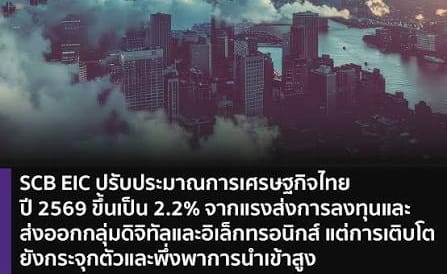
SCB EIC has revised its Thai economic growth forecast for 2026 upward to 2.2% (from 2.0%) and for 2027 to 2.1% (from 1.9%), driven by investment momentum and exports in digital- and electronics-related industries. Nevertheless, the recovery remains concentrated and highly import-dependent, while government measures are helping to cushion the impact of the Middle East conflict on the Thai economy. Close attention must still be paid to volatile energy prices and any further US import tariff announcements going forward.
**Thai economy supported by investment and exports, but positive spillovers remain concentrated**
The Thai economy is receiving a boost from private investment and strong export growth. Private investment has accelerated for five consecutive quarters and is expected to remain elevated going forward, as reflected in BOI investment promotion values that continue to stay high — particularly in projects related to digital infrastructure, data centres, and the electronics industry. Exports have also expanded well, with electronics goods serving as a key driver in line with the global AI investment cycle. However, economic activity linked to the digital and electronics boom remains heavily reliant on imported raw materials, intermediate goods, and capital goods from abroad. Moreover, most of the benefits are concentrated among large operators and foreign companies, meaning this momentum has yet to spread broadly throughout the wider economy.
Government policy will continue to play an important role in sustaining the economy during the second half of 2026 and throughout 2027, through two main channels: (1) People assistance plans — funds from top-ups to the State Welfare Card and the Thai Help Thai programme will help support purchasing power in Q3, with remaining funds also likely to be deployed to bolster purchasing power in Q4. Meanwhile, the review of projects under the energy transition plan funded by the 400-billion-baht emergency decree has moved more slowly than expected; SCB EIC has therefore adjusted its assumption so that more of those energy transition funds will flow into the economy in 2027. It remains to be seen whether the government will maintain the full budget allocation for the energy transition projects or redirect a portion of it toward additional people assistance measures in Q4 of this year. (2) Energy cost-of-living relief measures — the Oil Fund has resumed compensating for higher oil prices since mid-July, following a rise in global oil prices, causing the fund's cumulative deficit to widen rapidly to 75,562 million baht as of 16 August. At the same time, the government is likely to reduce the electricity tariff for the September–December 2026 billing period to 3.86 baht per unit, down from 3.95 baht per unit, even though underlying electricity costs remain high in line with global LNG prices. This will be achieved by clawing back excess revenue from the state electricity utilities (EGAT, MEA, and PEA) to subsidise the tariff, and by restructuring the electricity rate to remove the public electricity charge from the base tariff. These measures, combined with a lower-than-expected pass-through of costs to consumer prices, have led SCB EIC to revise its average headline inflation forecast for 2026 down to 1.7% (from 2.6%), with inflation expected to decelerate further to 0.8% in 2027.
Despite the upward revision, the Thai economy is still growing below potential, weighed down by long-accumulated structural problems and vulnerabilities, as well as additional pressure from the war in the Middle East. The projected growth rates of 2.2% in 2026 and 2.1% in 2027 represent a slowdown from the previous period and remain below potential, reflecting the fact that the Thai economy continues to face structural constraints and deeply entrenched vulnerabilities — even as the government introduces additional measures through the 400-billion-baht borrowing decree to support the economy over these two years. Another worrying signal is that the trade balance and current account balance deteriorated in the first half of the year and are on track to record simultaneous deficits this year. This stems from both temporary factors — such as the impact of the Middle East war — and structural factors that are driving import dependence higher, including imports for production and export purposes, investment in digital- and electronics-related industries, and increased spending on digital services from abroad. Looking ahead, key risks to monitor include a prolonged escalation of tensions in the Middle East, US import tariff measures — particularly on excess capacity and transshipment issues — and the risk of a Super El Niño, which could affect agricultural output and broader economic activity.
**MPC likely to hold the policy rate at 1% as inflation pressures ease, while the economic recovery remains uneven and households and SMEs stay vulnerable**
SCB EIC expects the Monetary Policy Committee (MPC) to hold the policy interest rate at 1% throughout the year. Although the Thai economy shows signs of improvement ahead, the recovery remains unequal (K-shaped), with economic momentum concentrated in certain sectors while debt burdens and financing costs for households and SME businesses remain elevated. On price stability, SCB EIC assesses that inflation risks have diminished, with inflation likely to move near the upper bound of the 1–3% target range this year — driven by energy prices and cost pass-through effects — before gradually decelerating next year. Nevertheless, the current challenge for the Thai economy lies in the vulnerability of certain groups; therefore, targeted financial measures to assist retail debtors and support SME access to credit will continue to play an important role in strengthening the breadth of the economic recovery.
**AI remains a key driver of the global economy, while the Middle East conflict and elevated long-term interest rates remain major risks**
The Middle East conflict continues to pose a significant risk to the global economy. US–Iran negotiations have made no progress, while shipping volumes through the Strait of Hormuz have fallen back to pre-MOU agreement levels seen in June, keeping global energy prices under supply-side pressure. On another front, US trade policy uncertainty persists, with the use of Section 301 on forced labour issues following on from Section 122 in order to maintain existing import tariff levels — moves that could lead to additional measures targeting excess capacity and scrutiny of Chinese goods being transshipped through key trading partners.
SCB EIC maintains its global economic growth forecast for 2026 at 2.5%, as the world economy proved more resilient to war-related headwinds in Q2 than expected, with AI technology investment serving as a key driver. However, energy prices that remain elevated due to the Middle East situation have kept inflation in many major economies above target, leading to the possibility that the ECB may raise rates one more time, while the Fed and the Bank of Japan are expected to hold rates steady throughout the year. In addition, concerns over inflation, fiscal stability, and the direction of policy rates continue to push long-term government bond yields in many countries to their highest levels in over a decade — even though the US government's long-term bond buyback programme has helped partially ease this pressure in the short term.