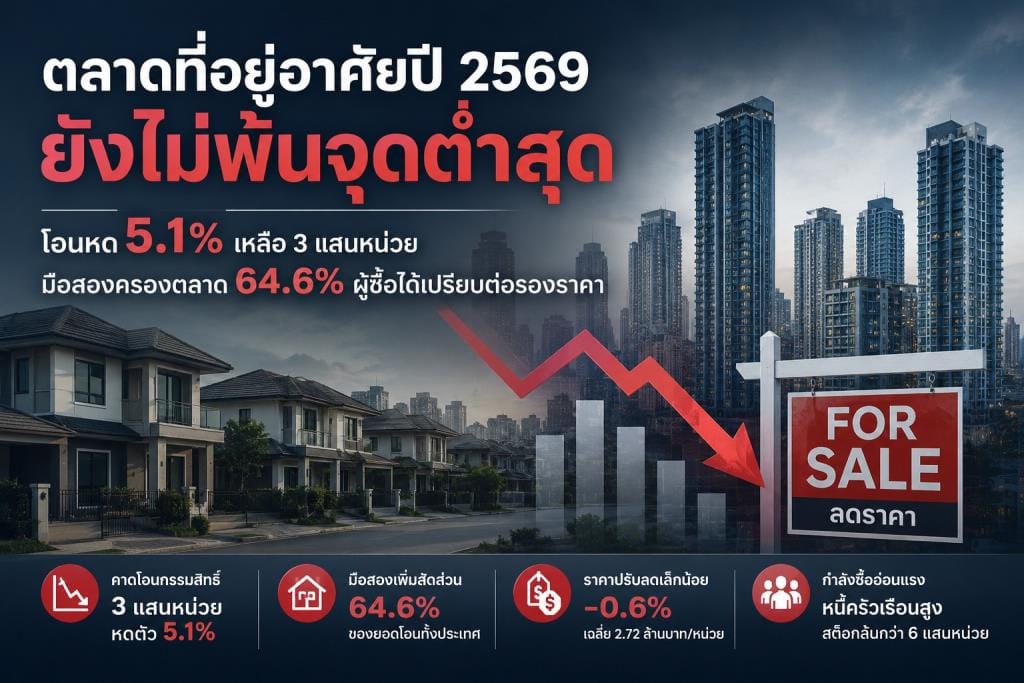
The residential property market in 2026 continues to press forward amid the major challenge of "purchasing power" and economic uncertainty. Although the government has measures in place to prop up the market, and condominium demand from foreign buyers continues to expand, the overall picture has not yet been able to reverse into an upswing.
Most recently, the Kasikorn Research Center has assessed that the residential property market in 2026 will continue to contract for the fourth consecutive year. Nationwide residential ownership transfers are expected to total approximately 300,000 units, a decline of 5.1% from 2025 and the lowest level in many years — reflecting that the market remains in a fragile state and has not clearly passed its lowest point.
**Weakening Purchasing Power Prompts Buyers to Delay Home Purchases**
The primary pressure continues to come from declining purchasing ability, as households are burdened by both high living costs and high debt levels. Data from the National Statistical Office covering the first six months of 2025 indicate that Thai households carry debt equivalent to approximately five times their average monthly income, while the average income stands at 28,151 baht.
Since a home is a high-priced asset that requires a long repayment period and has low liquidity, consumers tend to postpone their purchase decisions — especially those who have the desire to buy but are not yet financially ready. Some may choose to "rent" rather than "buy." This signal has been visible since the beginning of the year: the booking rate for newly launched residential projects in Bangkok and its vicinity in January 2026 averaged only 15%, while throughout all of 2025, new residential bookings totalled just 52,000 units — the lowest in many years.
**Secondary Market Gains Momentum, Giving Buyers More Options**
With purchasing power limited, consumers are turning greater attention to the secondary market, which offers price and space advantages compared with new projects in similar locations, as well as a wide variety of options — including detached houses and condominiums, along with properties in locations where new projects are hard to find.
The Kasikorn Research Center expects that in 2026, ownership transfers of secondary residential properties will total approximately 194,000 units, a decline of 4.7% — but a smaller decline than that of the new residential market. This means the share of secondary-market transfers will rise to 64.6% of total nationwide transfers. Simply put, while the secondary market is not growing, it is "capturing a larger market share" because buyers are looking for options that match their purchasing power, while the new market faces increasingly intense competition.
**New Market Still Struggles, Transfers Down 5.8%**
On the other side of the coin, nationwide ownership transfers of new residential properties from juristic persons in 2026 are expected to total approximately 106,000 units, a decline of 5.8% from the previous year.
The pressure stems from new-project booking figures that have yet to recover, compounded by competition from the secondary market, which holds a large inventory of properties and enjoys a price advantage.
This situation has prompted developers to shift their strategy — moving away from rushing to launch new projects and focusing instead on "selling existing inventory, generating cash flow, and reducing stock," while also deploying promotions and price offers to stimulate purchasing decisions.
**Inventory Surpasses 600,000 Units, Putting Buyers in the Driver's Seat on Price**
Another major challenge facing the market is the volume of accumulated supply, which currently exceeds 600,000 units when combining both new and secondary residential properties. When supply outstrips demand, financially ready buyers gain the upper hand — they have a large pool of properties to choose from and can compare prices as well as negotiate more effectively with sellers.
The Kasikorn Research Center therefore expects that the average price for residential ownership transfers in 2026 will decline by approximately 0.6%, settling at an average of 2.72 million baht per unit — reflecting the adjustments being made by both buyers and sellers in a market that continues to carry high supply.
**Government Measures and Foreign Buyers Provide Support, but Not Enough to Turn the Market Around**
Although the overall picture remains subdued, the market still has support from government measures. The government is expected to extend the reduction of transfer and mortgage fees for residential properties priced at no more than 7 million baht, along with LTV relaxation measures for first and second homes, which are currently set to expire on 30 June 2026.
At the same time, the condominium market continues to receive support from foreign buyers. Ownership transfers of condominiums by foreign nationals in 2026 are expected to total approximately 15,200 units, an increase of 1.8%, representing around 5% of total nationwide residential transfers. Nevertheless, these positive factors are still insufficient to offset the weakness in domestic purchasing power.
**War and Economic Uncertainty Add Pressure; Developers Take a Defensive Stance**
Beyond domestic challenges, the market must also contend with uncertainty from the global economy and conflicts in the Middle East, which could affect purchasing power, confidence, investment, and the foreign buyer market.
On another front, energy prices that may trend upward are adding further pressure on construction costs, compelling developers to be more cautious with their investments.
As a result, the picture of the real estate market in 2026 is not one of competing to launch new projects, but rather one of competing to "manage inventory and maintain liquidity." Developers are likely to open new projects with greater caution, selecting segments that align with the remaining stock on hand.
Ultimately, the Kasikorn Research Center views the residential property market in 2026 as still being in a consolidation phase. Although the pace of contraction is not as severe as the previous year, the fact that transfer volumes have remained negative for the fourth consecutive year clearly reflects that the market has not yet fully recovered and has not yet passed its lowest point.
The critical question, therefore, is not "when will the market grow" but rather how quickly developers will be able to clear their inventory, and when buyers will regain sufficient purchasing power. These two factors will be the key indicators of how soon the Thai residential property market will be able to enter a cycle of recovery.