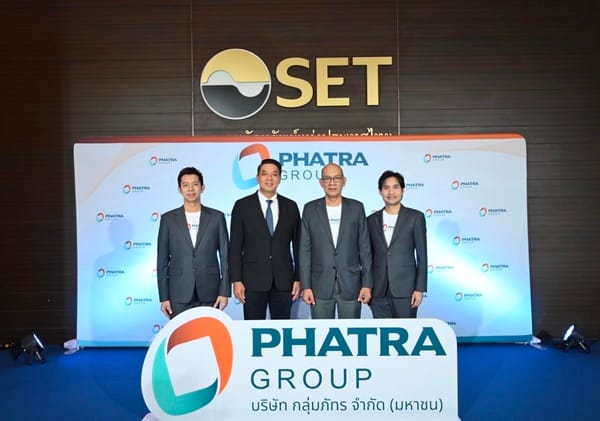
Investors who subscribed to shares in Phatara Group Public Company Limited, or PHAT, are likely feeling only a mild sting — because the stock's opening price on its first trading day came in just slightly below the subscription price, even though it debuted in a relatively supportive market environment.
PHAT was listed on the MAI market on Thursday, 20 August, as the second new stock of 2026. It opened at 1.84 baht, below the initial public offering price of 2 baht, reached a high of 2 baht before softening, and closed at 1.82 baht — 0.18 baht below the IPO price, or 9% below subscription price. Total trading value came to 116 million baht.
PHAT's financial advisers and management may have assessed the situation and agreed that the recovering stock market presented a good opportunity to bring the shares to market, and priced the offering at a P/E ratio of just 5.91 times in order to attract investors to subscribe.
The offering itself may have been successful, but once the shares actually began trading, they could not hold up. The price fell below the subscription level, reflecting the fact that a low P/E ratio is not, in itself, a selling point for speculating on PHAT shares.
The first stock of 2026, Unique Plastic Industry Public Company Limited, or UNIX, is still doing well. Since its first trading day on 1 April, UNIX has moved up from its subscription price of 1.89 baht, closing on its debut day at 2.14 baht — 13% above the subscription price — and most recently closing at 2.44 baht.
But the second new stock of the year has failed the test. Its price has been below the subscription level since day one, and this may serve as proof that the sky in the stock market has not yet opened up to new listings — especially those whose business outlook may not be particularly bright and whose offering price was not genuinely low.
Several companies that have been dressing themselves up to raise funds in the stock market are getting ready to move ahead with share offerings, believing that the investment climate is beginning to improve and that they should be able to sell their shares — and sell them at good prices.
But every one of those companies may now need to go back and look for a better moment, or revisit their offering plans altogether.
Because PHAT's stumble has caused a loss of face, and it reinforces the message that it is not yet time for new stocks to enter the market — not unless they are truly good stocks sold at a genuinely fair price.
Small-cap stocks, particularly almost all stocks on the MAI market, are in a state of lifeless stagnation, with prices slumped to the floor and investors still showing no interest in buying.
If a small new stock is not outstanding, not exciting, and not genuinely cheap — who would bother taking the risk?
Stung by PHAT, investors are likely to remain wary of new stocks for quite some time to come.