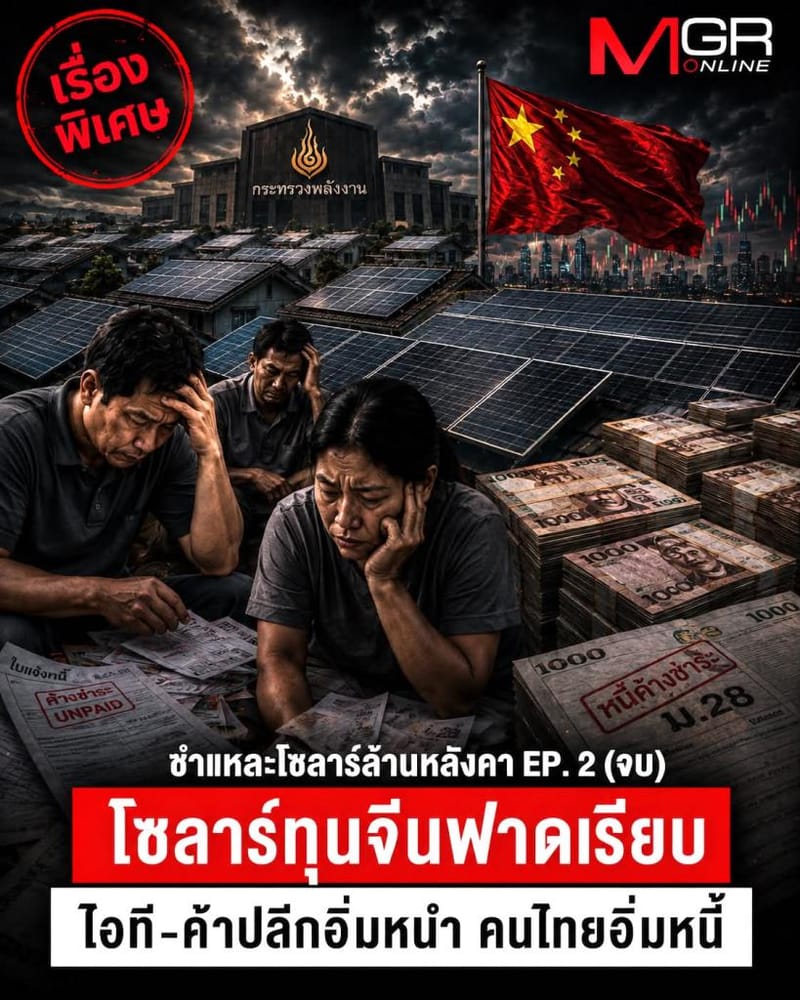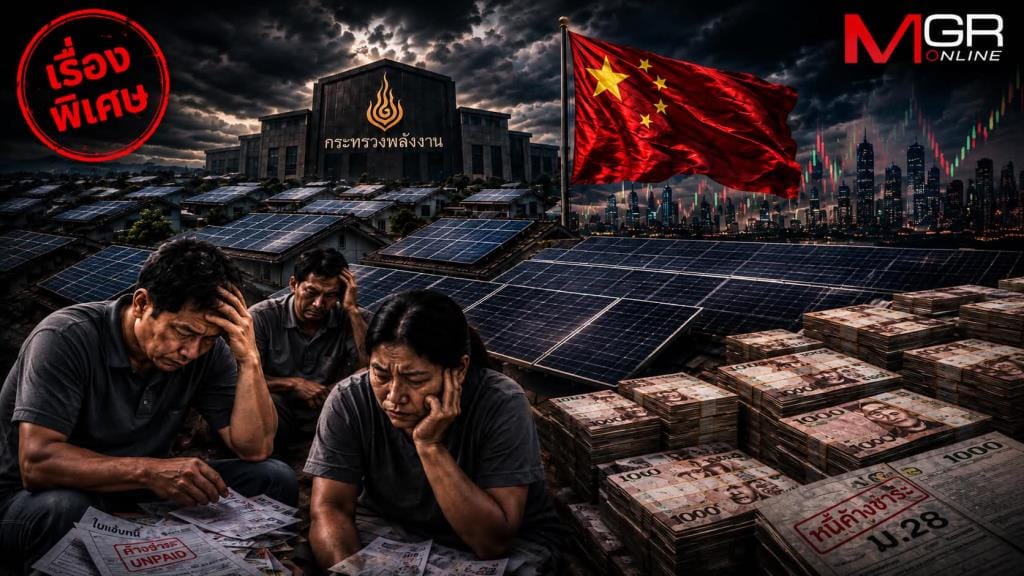
Series: Dissecting the Million-Rooftop Solar Scheme EP. 2 (Final): Chinese Capital Sweeps the Board, IT and Retail Gorge on Profits, Thais Gorge on Debt
The crucial question that society must press for an answer on regarding the Million-Rooftop Solar Project is this: when ordinary people are forced to become loan-debt carriers, state banks absorb the risk, and the entire Thai population is taxed to subsidise the scheme, who are the true beneficiaries of the enormous sum of 100,000 to 150,000 million baht flowing through this project?
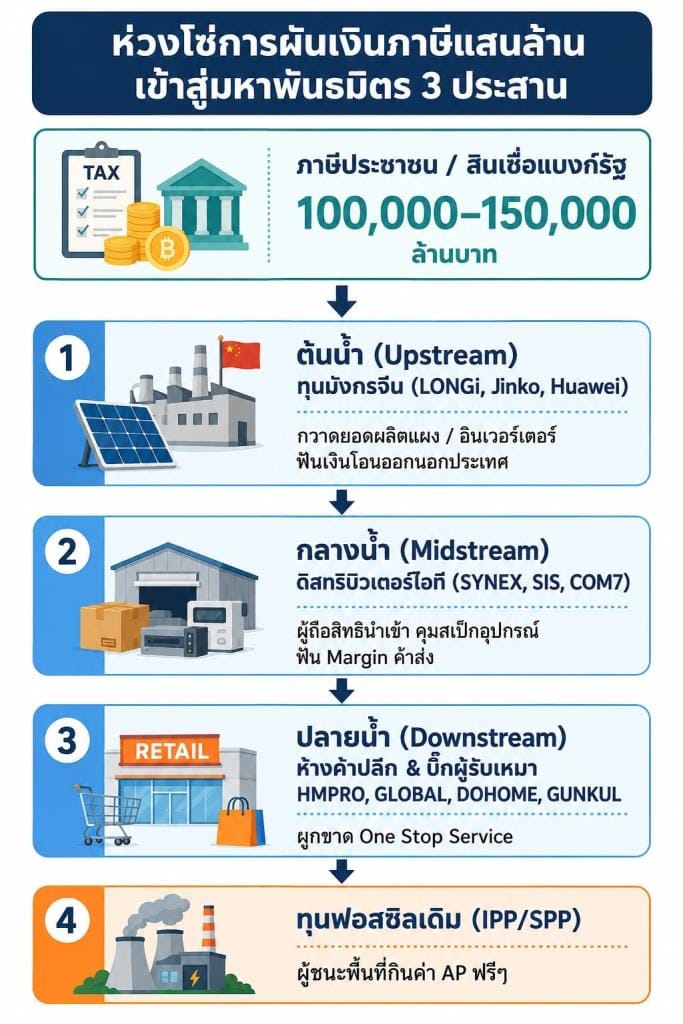
The grandiose claim that this project will distribute income to communities and build a grassroots green economy is nothing more than an illusion designed to blind the public. Because when one maps out the supply chain of the energy market and examines the perspectives of securities analysis firms in the stock exchange, it becomes clear that the structure of the system has been engineered to funnel hundreds of billions of baht directly into the pockets of a three-way partnership — Chinese dragon capital, IT distributors, and major retail chains — in one complete circuit.
Hundreds of Billions Injected, Stocks Surge in Response
The moment news broke that the government was preparing to pump 50,000 million baht in sovereign loan funds, paired with an additional 100,000 million baht in low-interest credit lines from the Government Savings Bank and the Government Housing Bank, securities analysis firms rushed to publish their market outlook reports. Not a single baht of that hundreds-of-billions budget circulates through community shops, yet it was welcomed as positive market sentiment, driving up the share prices of capital groups across a three-tier supply chain, as follows:
Tier One, Upstream — Chinese Dragon Capital: The Biggest Beneficiary
Thailand has no upstream industry capable of producing silicon crystals or solar cells domestically. Currently, China controls more than 80% of global solar panel manufacturing capacity and more than 70% of the inverter market. When a project worth hundreds of billions of baht materialises, the bulk of the subsidy money will be transferred overseas immediately to purchase equipment from China's Tier-1 giants — solar panel makers such as LONGi Solar, Jinko Solar, Trina Solar, and JA Solar, and inverter makers such as Huawei, Sungrow, Growatt, and Solis.
Tier Two, Midstream — Thai IT Distributors: The Gatekeepers of Profit Margins
Importing millions of units of equipment from China must pass through major importers and distributors in Thailand. The major IT players have been making conspicuous moves to partner with Chinese allies. SYNEX has signed an MOU officially bringing LONGi Solar and Huawei into the Thai solar market.
Meanwhile, SIS has been aggressively pushing into Energy Management, acting as a full-service distributor for global inverter brands including Sigenergy, Growatt, and Huawei. Similarly, COM7 has been expanding its IT retail network in preparation for capturing a portfolio of rooftop solar and Smart Home device sales.
These midstream IT groups act as the gatekeepers waiting to skim a gross profit margin by holding distribution rights before passing goods on to retail chains.
Tier Three, Downstream — Building Material Retailers and Major Contractors
Analysts from TTB Wealth Securities, Asia Plus Securities, Land and Houses Securities, and Dao Securities all point in the same direction: home improvement retail stocks such as HomePro, Global House, and DoHome, along with major contractors like GUNKUL, are poised to capture the large installation-service cake through the electricity authorities' One Stop Service system — a system whose qualification criteria and bond requirements have been set prohibitively high. These retail chains and major contractors thus become the monopolistic options that completely shut out local equipment shops and small independent electricians.
Chinese Solar Sweeps the Board
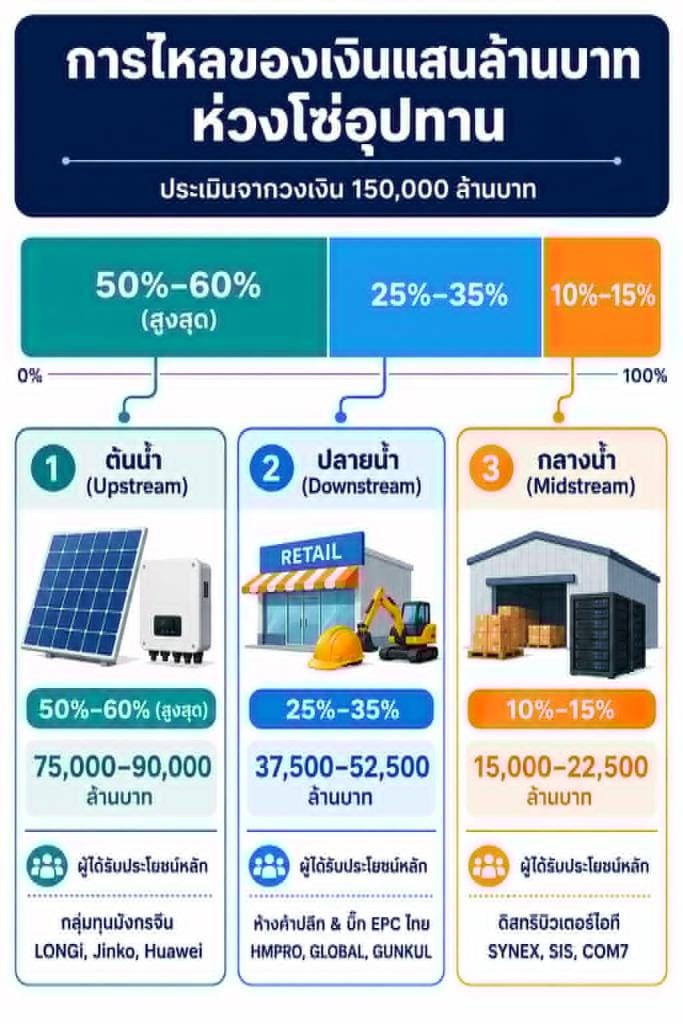
If one assesses the cost-structure breakdown of installing a 5-kilowatt rooftop solar system — priced at approximately 100,000 to 150,000 baht per household — the largest share of the money will flow to the "upstream chain," namely the panel and inverter manufacturing groups in China, ranking first. Meanwhile, the "downstream chain" — Thai retail chains and major contractors — will harvest the largest in-country profit margin, ranking second.
When the flow and distribution of the hundreds-of-billions-of-baht sum throughout the supply chain is analysed, it can be broken down into the following economic estimates:
1. The upstream chain, consisting of Chinese factories, takes the largest slice — approximately 50%–60% of total funds. The value flowing to them amounts to roughly 75,000–90,000 baht per unit, or 50,000–90,000 million baht out of the total hundred-billion-baht pool. This is because the core cost structure of a solar system is "hardware equipment": solar panels account for 30%–35% of the total system cost, and inverters account for 15%–20% of the total system cost. Since Thailand cannot manufacture either of these items at an upstream level, this single largest sum of money is "transferred directly out of the country" into the financial statements of Chinese giants.
2. The downstream chain of retail chains and major contractors will harvest the largest in-country margin — approximately 25%–35% of total funds. The value flowing to them amounts to roughly 35,000–50,000 baht per unit, or 25,000–50,000 million baht out of the total hundred-billion-baht pool. Retail chains and major contractors such as GUNKUL are the ones controlling "retail prices and installation services" on an all-inclusive basis.
In reality, the current actual upstream equipment cost plus wholesale price stands at around 90,000–100,000 baht. But because the government has set the reference price as high as 150,000 baht, this opens the door for the downstream group to skim a "package margin, installation labour fee, and One Stop Service handling fee" of 30–40% above wholesale price. This makes the downstream group the one that captures the highest "net domestic profit" in the entire chain.
3. Thai IT distributors, as the midstream chain, will hold a wholesale margin of approximately 10%–15% of total funds. The value flowing to them amounts to roughly 10,000–20,000 baht per unit, or 10,000–15,000 million baht out of the total hundred-billion-baht pool. IT distributors serve as "intermediaries and warehouse managers," earning a wholesale margin of approximately 8%–15% from large bulk orders. This gives them a smaller proportional share than the upstream and downstream players, but the emphasis is on "consuming massive volume" from distributing hundreds of thousands to one million units — without having to bear any risk relating to installation labour or credit.
Therefore, the 50,000-baht subsidy drawn from the taxes of ordinary people does not genuinely make solar panel installation cheaper for the public. Instead, it is channelled into excess profits for Chinese dragon capital, IT distributors, and major retail chains — while the entire Thai population is left holding the public debt to repay in instalments.
Squeezing Taxes and Thai Debt While Chinese Capital Rakes It In
This is "the single most dangerous knot" in terms of Thailand's industrial policy and technological security — and it is one the government has chosen to stay silent about.
The claim that this project creates jobs and builds domestic industry is nothing more than smokescreen rhetoric, for three structural reasons:
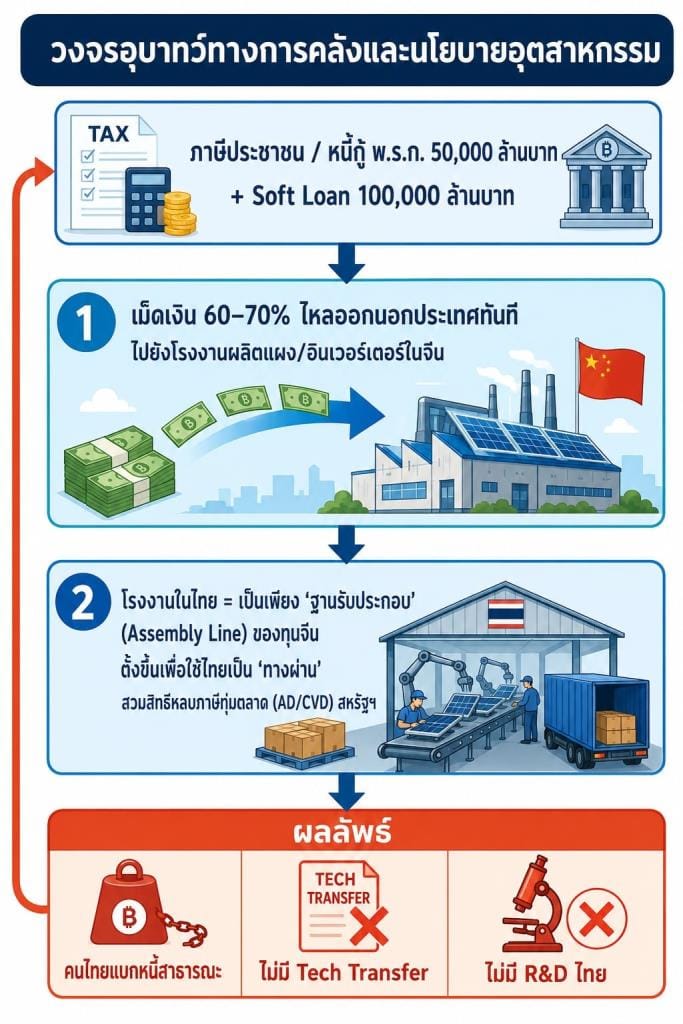
First Reason: Disguised Assembly Factories
The majority of solar panel manufacturing plants in Thailand are not Thai-owned and do not produce upstream components themselves. They are Chinese capital that has come to set up assembly bases in order to use the Made in Thailand label to disguise themselves and evade anti-dumping measures imposed by the United States and Europe.
Second Reason: Massive Fiscal Leakage
For every 100 baht of project funding, more than 60 to 70 baht flows out of the country immediately in the form of payment for panel and inverter equipment. Meanwhile, the 50,000-million-baht loan and the interest burden of the soft loans remain as "public debt that the entire Thai population must repay through tax payments."
Final Reason: Loss of Technological Sovereignty
Thailand has been elevated to nothing more than a "powerless buyer and user," never once advancing to become a "technology producer" or the owner of any innovation — even after pouring in hundreds of billions of baht in budget expenditure and accumulating national debt.
Probing the Four Traps "Beneath the Rooftop"
While the three-way alliance gorges happily on its profits, citizens who were taken in by the advertising promise of "install for free, save on electricity bills immediately" are in fact confronted with four dangerous traps concealed beneath their own rooftops.
Trap 1: Price Inflation to 150,000 Baht — Subsidies Flow into Capital's Pockets
Setting the reference price for a 5-kilowatt system as high as 150,000 baht creates a price distortion. The market installation price for Tier-1 grade equipment is only 100,000–110,000 baht, but once the government is handing out money, contractors and retail chains are ready to push package prices up to the 150,000-baht ceiling in unison. The government's 50,000-baht subsidy is thus absorbed entirely as the "profit margin" of capital groups, while citizens still have to take out a loan of 100,000 baht as before — not a single satang cheaper for the solar installation than without the scheme.
Trap 2: Electricity Usage Behaviour and the Net Billing Deception
Since most people have to leave home to work during the daytime, surplus electricity is sold back into the grid at the low rate of just 2.20 baht per unit. Come evening when they return home, they must buy that electricity back at approximately 4.00 baht per unit — losing nearly 2 baht on every unit. Electricity bill savings may not be enough to cover loan instalment payments, forcing households to top up out of pocket and turning the situation into a drawn-out, chronic debt burden.
Trap 3: Inverter Failure Before the Loan Is Paid Off
The technical truth the government has quietly suppressed is that an inverter, or power converter, has an average service life of only 5–8 years. The risk of the inverter failing before the loan is fully repaid is extremely high. The homeowner must then find 30,000–50,000 baht in cash to buy a replacement unit themselves — on top of the burden of panel efficiency degrading every year, annual panel-cleaning and system-inspection costs of 2,000–4,000 baht, and the hazardous waste problem that will arrive in twenty years' time.
Trap 4: Transformer Capacity Saturation and the "Elephant Ticket Quota" Scheme
Engineering standards allow solar electricity to flow back into each transformer at no more than 15–30% of its capacity. If as few as 10–15 households in a given village install solar panels simultaneously, the village transformer will reach full capacity. This opens the door for an "elephant ticket quota-cornering scheme," in which major contractors with insider connections pre-emptively corner transformer quota allocations and then sell these on bundled into outrageously priced panel-installation packages to the public.
Restructuring the System, Laying Out the Strategy
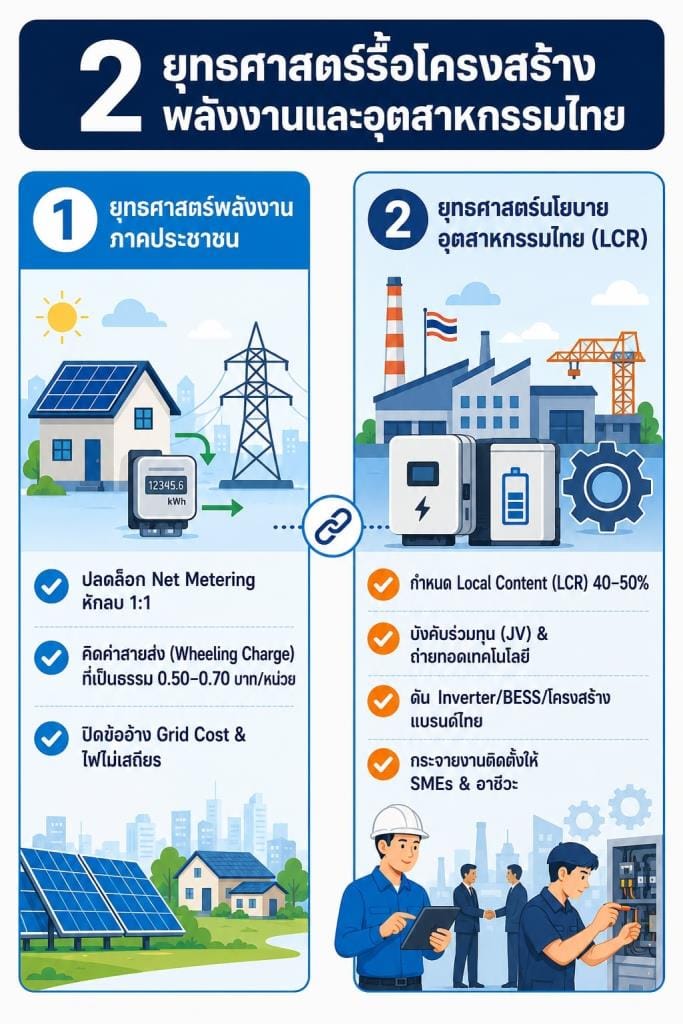
If the government is genuinely committed to leading the country into a just clean-energy transition — rather than merely executing an image-building measure that funnels loan money to capital groups — it must push forward two structural reform strategies.
Strategy 1: Unlock Net Metering 1:1, Paired with Fair Grid-Use Charges
• Silencing the grid-cost argument: Allow the public to use a Net Metering system that offsets electricity units on a 1:1 basis, but require payment of a "grid service charge" at a rate that is fair and reflects actual costs (for example, 0.50–0.70 baht per unit) for every unit of electricity fed into and drawn back from the system. The electricity authority will receive revenue to maintain the grid infrastructure, putting an end to the narrative that solar adopters are free-riding on non-adopters.
• Silencing the grid-instability argument: Channel revenue from grid-transmission charges into a Smart Grid Development Fund to invest in Smart Inverter Control systems and community-level energy storage battery systems, which address the engineering volatility problem directly at its source.
Strategy 2: Mandate a Domestic Content Ratio
• Tiered subsidy conditions: Require projects receiving the 50,000-baht subsidy and soft loans to use equipment with no less than 40–50% domestically produced components, in order to compel Chinese capital to enter into joint ventures and genuinely transfer technology to Thai entrepreneurs.
• Promote related industries: Provide tax incentives for Thai electronics firms to produce inverters and Energy Management Systems (EMS), and mandate that racking structures be 100% manufactured in Thailand.
• Distribute work to community SMEs and vocational education institutions: Mandate that no less than 40% of installation work be allocated to local SMEs, while drawing on vocational colleges nationwide to train and certify "green electrician" standards — in order to genuinely create employment and a circular economy at the grassroots level.
The Million-Rooftop Solar Project must not become merely a "measure to drain Thai people's blood to nourish foreign capital" — one that imposes long-term debt obligations on citizens while the root causes of high electricity prices and the monopolisation of energy by major capital groups remain firmly entrenched.
The time has come for the government to stop handing budget money to capital groups and instead turn to dismantling the structure through Net Metering 1:1 paired with fair grid-use charges, combined with Local Content requirements — to genuinely build a Thai-owned energy industry.
— Read back: Series — Dissecting the Million-Rooftop Solar Scheme EP. 1: The New Blue-Faction Energy Permanent Secretary Runs the Hundred-Billion-Baht Cake, Burying the Debt under Section 28