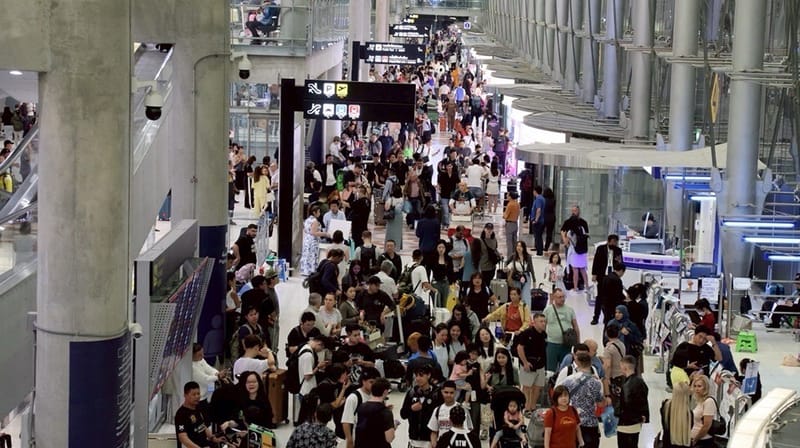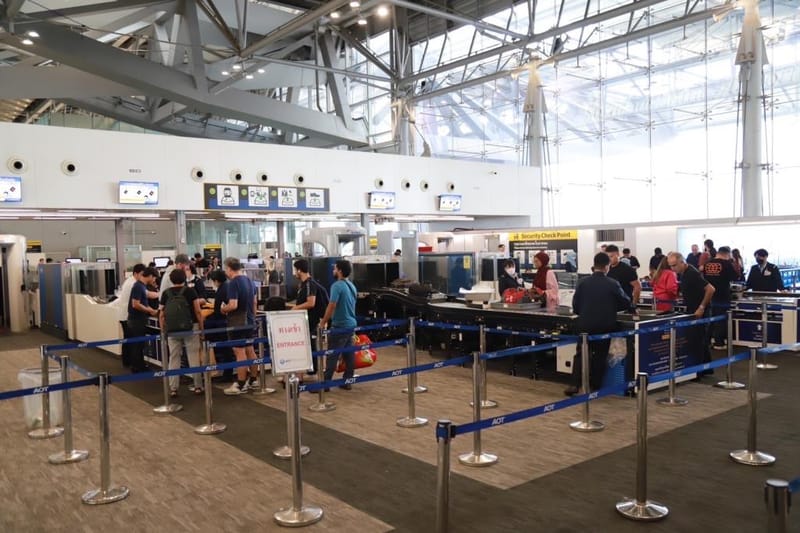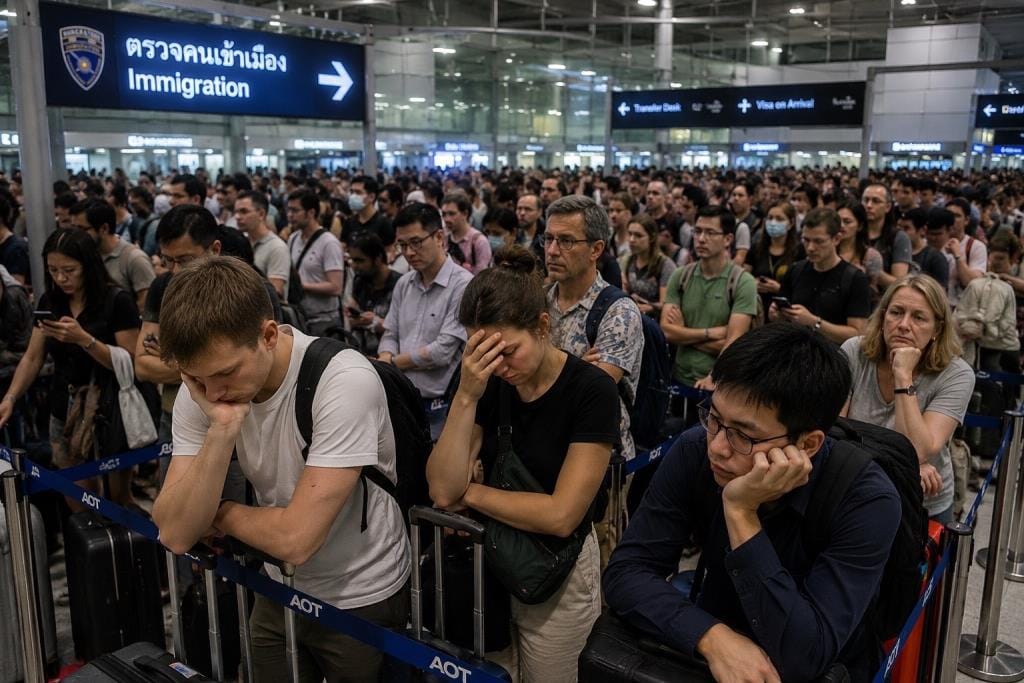
The on-site visit by Deputy Prime Minister and Minister of Commerce Supajee Suthumpun, together with the Cabinet, to Suvarnabhumi Airport to discuss ways of elevating the tourist experience and easing congestion in the arrivals area reflects the government's urgency in addressing one of the problems that has long damaged Thailand's tourism image — namely the immigration queues that stretch on endlessly and have become a top complaint among foreign visitors.
The key measure highlighted on this occasion is expanding the use of the Auto Gate system to cover passport holders from 33 nationalities, with the aim of speeding up passenger throughput and reducing the workload on immigration officers. But looking deeper at the structural level, the critical question is whether the government is tackling the problem at its root or merely treating the symptoms of a bottleneck that has been building up for years. As such, this approach to solving the problem might well be described as "scratching where it doesn't itch."
Suvarnabhumi has once again become a major aviation hub for the region. During peak hours, more than 5,000–6,000 arriving passengers pass through every hour, and during the tourist season the airport can handle nearly 100,000 passengers per day. Meanwhile, visa-free policies, the opening of new tourist markets, and the push to position Thailand as a tourism hub have all contributed to a continuous rise in passenger volumes.
What has not grown at the same rate, however, is the number of immigration officers. Over the past several years, airport executives and private-sector tourism stakeholders have consistently pointed out that the core problem does not lie in the number of inspection lanes or service areas, but in staffing levels that are insufficient to keep pace with the rapidly rising passenger load. Despite ongoing investment in technology and the continuous expansion of processing areas, without adequate personnel the entire system remains trapped by the same old constraints.
Although Auto Gates reduce inspection time to approximately 24–30 seconds per person and are considerably more efficient than conventional document checks, in practice a large number of passengers are still unable to use the system — whether because they hold passports from certain countries, because additional verification is required, or because the system cannot fully confirm their identity.
This means that even if some passengers are channelled into the automated system, a large number of others still have to wait to be served by immigration officers just as before.
The problem, therefore, comes down to this: if the number of officers does not increase, how much can shifting only a portion of passengers to the automated lane actually reduce waiting times? Lessons from leading airports around the world point to the same conclusion — technology can enhance efficiency, but it cannot entirely replace human personnel, particularly for border-security duties that still require officer judgment, interviewing, and in-depth information checks.
Beyond that, in actual operation Auto Gates come with a range of limitations — from failed facial recognition and passport-reading errors to system malfunctions and alerts requiring additional verification — all of which ultimately still require officers to step in and take action.
Adding more Auto Gates therefore amounts to increasing the "efficiency of the process," but it is not yet an increase in the "overall service capacity" of the system.
If a sustainable solution is truly the goal, what is needed may not simply be more machines, but must also include reallocating staffing levels, deploying more officers during peak hours, scheduling shifts in alignment with flight timetables, and linking advance passenger data to enable more efficient screening.
There is another dimension discussed in tourism circles — the impact of tighter state security enforcement over the past several years following the crackdown on grey-capital networks and the serious investigation into the misuse of Fast Track privileges. In the past, it was said that these privileges were bought and sold through private networks at prices of approximately 1,000–1,500 baht per person, with allegations that the proceeds were shared with certain individuals within the system.
As enforcement tightened, passenger screening procedures became more thorough and consequently more time-consuming. At the same time, the Fast Track service — which had previously helped drain some passengers out of the regular queue — was restricted, sending large numbers of passengers back into the standard inspection system and causing congestion at immigration checkpoints to surge, particularly during periods when multiple flights land simultaneously.
On top of this, problems with incomplete data entry, missing documents, or passengers who are unfamiliar with digital systems force officers to spend additional time conducting individual checks, slowing the entire process down yet another notch.
Ultimately, the success of any effort to solve the Suvarnabhumi problem may not be measured by the number of Auto Gates installed or the number of nationalities granted access to the automated system, but by how quickly passengers can clear immigration on the airport's busiest days.
This is because the true bottleneck at Suvarnabhumi today may not lie in the machines, nor in the number of inspection lanes open for service, but in the number of immigration officers standing behind those lanes. That is the central question the government must answer — whether it will add only machines, or whether it will also add the people who are the beating heart of passenger throughput across the entire system. Because in the end, whether Thailand's gateway is fast or slow still depends on immigration officers far more than on technology alone.