When a government — and its prime minister in particular — is under political attack over issues such as governance failure, corruption turning up wherever you look, political conflict, a plummeting approval rating, a loss of public trust, or pressure from the opposition, there are two main ways to fight back: fight back with results, or fight back with image.
As it happens, this government has no tangible achievements — nothing that gives the public any real satisfaction — so it is forced to fight back with image. That is the easier route, the faster route, and the voice inside the prime minister's head keeps reminding him that "politics is about image-building."
You need images of a leader who helps people… a leader who is down to earth… a leader who makes sacrifices… a leader who claims no special privileges… images of people who love their leader… and people who have benefited from that leader's help, stepping forward to confirm it themselves.
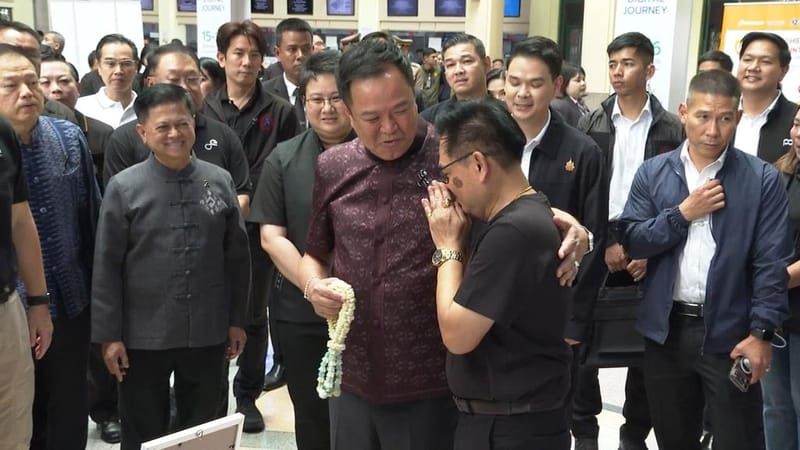
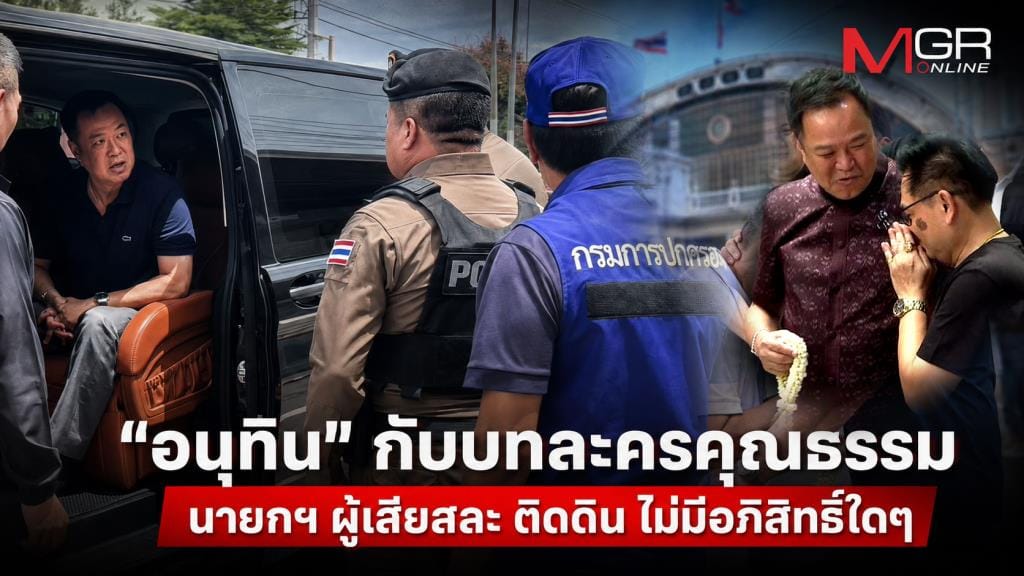
And so we got exactly that. On Saturday, 15 August, the prime minister attended an event at Hua Lamphong station, where he happened to encounter a postal worker who had undergone a heart transplant. The man came forward, knelt down, and presented a garland of flowers, then recounted how, on one occasion, the prime minister had sent his private aircraft to collect a donor heart — even though a powerful storm was raging that day.
The resulting image ticked every box.
An ordinary citizen — a patient who had survived — presenting a garland of flowers. The prime minister embracing him and expressing gratitude, letting the story tell itself: of a sacrifice made, of a private jet flown through a fierce storm to save a citizen's life.
In political terms, this constituted a "symbolic image" with enormous vote-winning potential.
Because it came at precisely the moment the government needed to communicate to the public that "Anutin" is not just a political figure, but a person who dedicates himself to serving the people.
Whether or not it was "staged," this scene was duly put to political use.
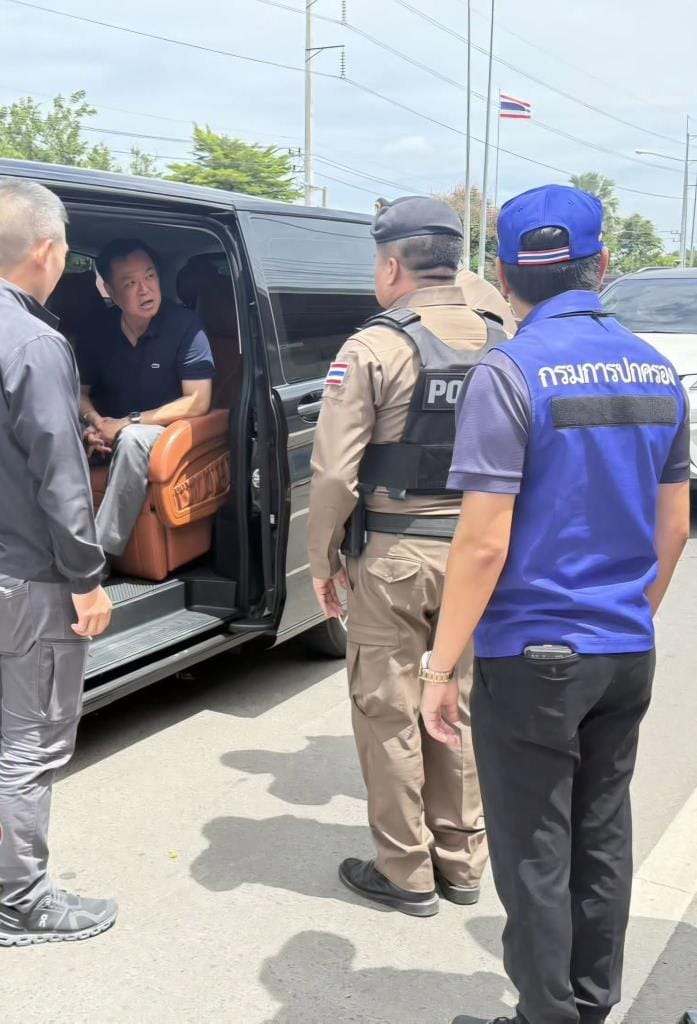
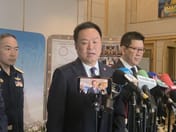
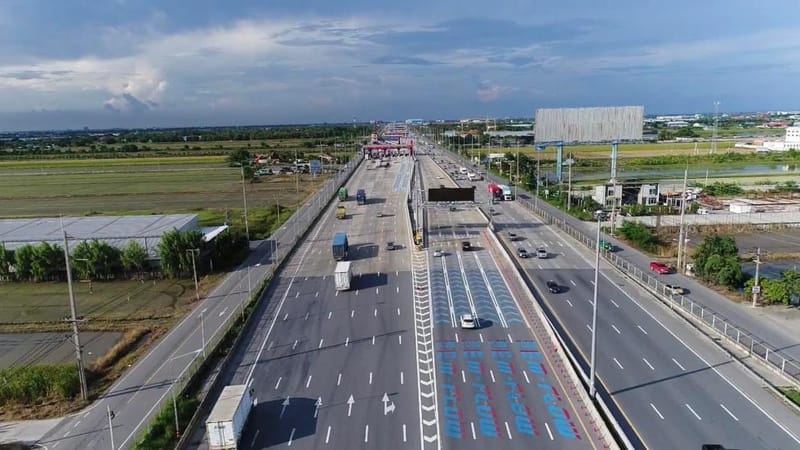
The following day, there were images of "Anutin" being pulled over by police at a checkpoint searching for illegal items. The prime minister said he had chosen to spend his day off making an unannounced field visit to inspect and monitor the work of officials across various provinces, following his strict orders banning the carrying of firearms. On that day, he was travelling to Buriram Province without notifying anyone of his schedule in advance, and so he ran into a checkpoint at Ban Dan district, Buriram Province.
Police officers asked to search the prime minister's vehicle — both the front and the back. The prime minister then asked, "Did you find anything?" The officers replied, "No, sir." He went on to ask about checkpoints elsewhere in the area and was told, "We're only finding drugs, sir."
The scene was designed for "Anutin" to project the image of someone who makes unannounced field visits in order to see the real picture — with no officials lined up to welcome him. More importantly, when his vehicle pulled up to the checkpoint, the officers did not wave it through upon recognising it as the prime minister's car; they followed procedure and conducted a search.
The prime minister got the image he wanted: no special privileges, everyone subject to the same rules across the entire country.
If even the prime minister's car gets searched, how could an ordinary citizen's car not be searched?!
As for the police at the checkpoint saying "we're only finding drugs" — that is an interesting point in itself.
Viewed positively, one might see it as evidence that checkpoints are being used seriously to crack down on narcotics. At the same time, one can flip the perspective: the government has failed at drug suppression, and the reason checkpoints keep finding drugs is that there are simply too many drugs.
In any case, scripting Anutin to make an unannounced inspection tour — without a motorcade — until he gets stopped by police, is meant to convey that "Anutin" didn't merely go to inspect the checkpoint; he put himself inside the checkpoint. It signals that the government is serious about cracking down on firearms and drugs.
But the public looked at the scene and spoke with one voice: whoever wrote this script wrote it very clumsily. In reality, even if the officers did not know that the car pulling into their checkpoint belonged to the prime minister, the moment they opened the door and found the prime minister sitting there, which police officer anywhere would dare conduct a genuine search for firearms or illegal items?
The image that was supposed to say: we have a self-sacrificing prime minister, a prime minister with no special privileges, a prime minister subject to the law just like any ordinary citizen — ended up becoming entirely negative, damaging beyond repair. All it showed was a government that is good only at staging scenes. The public are not fools; they are not going to be swayed by this kind of cheap melodrama.