Although the funeral of Kriang Kaltanant, former Deputy Minister of the Interior and former Pheu Thai Party MP, has already passed, many reflections — particularly political ones — emerged from within the event, and they may well have an impact on the stability of the coalition government in the days ahead.
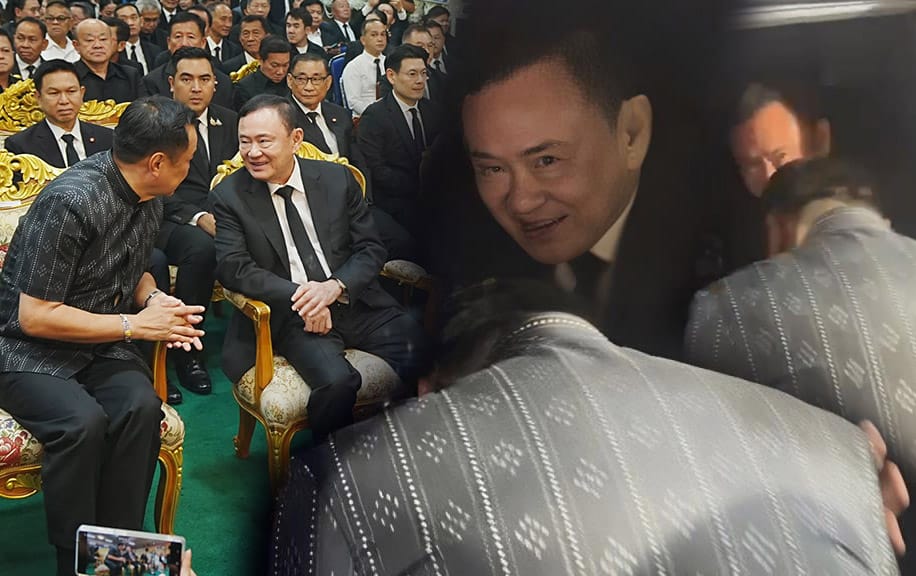
At that funeral, if one focuses specifically on a single moment, the image that stands out is that of party leaders — "party owners," or "influential figures," call them what you will. Setting aside the matter of Pheu Thai and moving past the "three former prime ministers" angle — because that carries no real significance — what does need to be discussed is just "one prime minister" and "one former prime minister."
The first is Anutin Charnvirakul, Prime Minister and Minister of the Interior, and leader of the Bhumjaithai Party. The other is Thaksin Shinawatra, former prime minister and the true "owner of Pheu Thai."
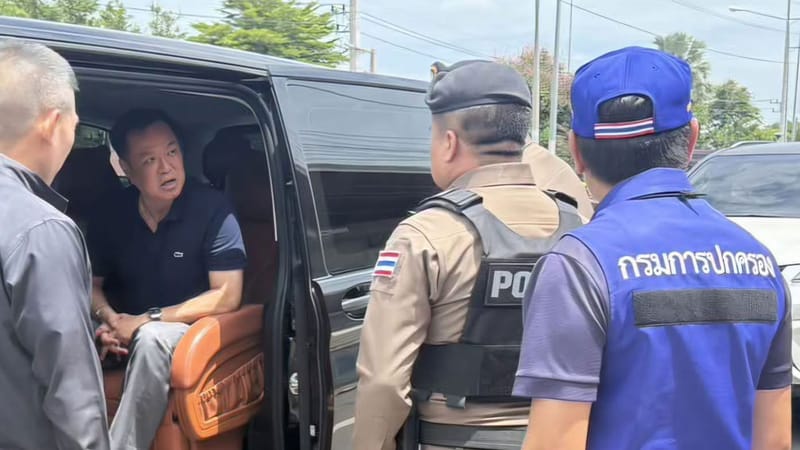
So, when one considers the body language of the current prime minister and Bhumjaithai Party leader — sitting close together at the event in an almost sheepish manner, and then prostrating himself at Thaksin Shinawatra's lap before they parted — it clearly carries meaning. It is, of course, a gesture of paying respect to an elder, and to "someone who was once a benefactor," just as Anutin himself explained afterwards: there was no politics involved, no political discussions — merely an exchange of pleasantries to check on each other's well-being.
Anutin described the atmosphere, saying: "We met at the funeral of someone we both respect — not in a cheerful or festive setting. Speaking and greeting each other and showing mutual respect is perfectly normal." He added that he has known Thaksin, Somchai Wongsawat, and Ms. Paetongtarn Shinawatra all along, and they have always been in contact. "Don't think of it as something we can't talk about. Now that we're in the same government, why wouldn't we be able to meet, if we want to?"
When asked whether the political adage "no permanent friends, no permanent enemies" still holds true, Anutin said: "Whether permanent friends or permanent enemies, if the goals are aligned — meaning the people and the nation benefit, the country grows stronger, development is achieved — then personal matters are set aside and the nation and its people become the goal we must achieve first." As for whether the coalition's solid bonds meant there was no need to bring in additional parties, Anutin replied: "Has that ever even been an issue?"
When pressed further — that there had previously been talk of certain parties wanting to join the government and waiting for a political realignment — Anutin said: "Every party wants to be in government. No party wants to be in opposition, because being in government allows you to fully drive work to the benefit of the people. But once elections are held and a government is formed, every side must do its job to the fullest. The opposition must scrutinize the government fully, and the government must work fully. That's just how it goes." As for whether the government would last a full four years, Anutin laughed before answering: "It has to last. If it can last, then it must — in order to serve the country and the people."
In summary: as coalition partners, they can meet whenever they like. As for "no permanent friends or permanent enemies" — if the goal is the people, then anything is possible. Which also means that anything is possible through the "invocation of the people's interests" — that's roughly the meaning. And every party wants to be in government, so they can deliver more benefits to the people (invoking the people, day and night).
However, looking at things from another angle — the reality for the coalition government under Prime Minister Anutin Charnvirakul — when one examines the numbers, it is undeniable that the Pheu Thai Party is the most critical "variable." That is to say: if Pheu Thai withdraws or "crosses to the other side," the "blue-red" government would immediately come crashing down.
Although there have previously been rumours of a secret deal for a new alignment — an "orange-red-green" coalition or something of the sort — which many believe would be difficult to pull off, at the same time, that sort of game is still enough to send a jolt of anxiety through people.
Even so, when one considers the external "shockwaves" that have been battering the government and the "blue party" during the past five months alone — a span during which the tremors have been so severe the government can barely keep its footing — the path ahead looks set to get even harder, because several cases are heading toward resolution, at least two or three of them in August alone.
The first is the "ballot paper" case. Although it may not be directly connected, if the verdict finds that the election was "not secret," it would carry risks and lead to considerable turmoil.
Then there is the "Senate vote-rigging" case, which the Election Commission (EC) has promised to conclude within this month as well. And the local government examination fraud case, which is currently being watched closely to see whether it will be "cut short" or not.
And critically, the heavy battle waiting ahead: when the ordinary parliamentary session opens at the end of this month, the government will once again face a barrage from the opposition. Toward the end of the session, a censure motion — which has already been "reserved in advance" — will certainly be filed. Anutin, as head of the government and Minister of the Interior, is set to take a severe hit, as is the real "favoured son," Chaichanok Chidchob, Minister of Digital Economy and Society (DE), the son of the "principal" Newin Chidchob, who has already been squarely "marked" by the opposition.
Therefore, when one looks at the "timeline" of what lies ahead — the scale of the battles that must be faced — it explains that "image of prostration" rather well. And when one factors in the mathematical reality that Pheu Thai is the crucial "variable," the sense conveyed is something along the lines of: "Brother, please don't abandon me no matter what." Even if, in reality, the situation remains stable for now — tomorrow is another matter, because things must be watched shot by shot. What may be impossible today might not be tomorrow. Don't take this lightly!!