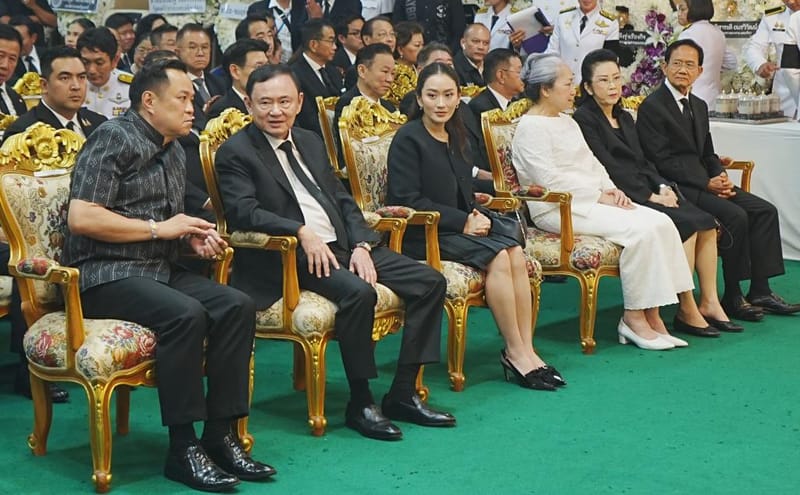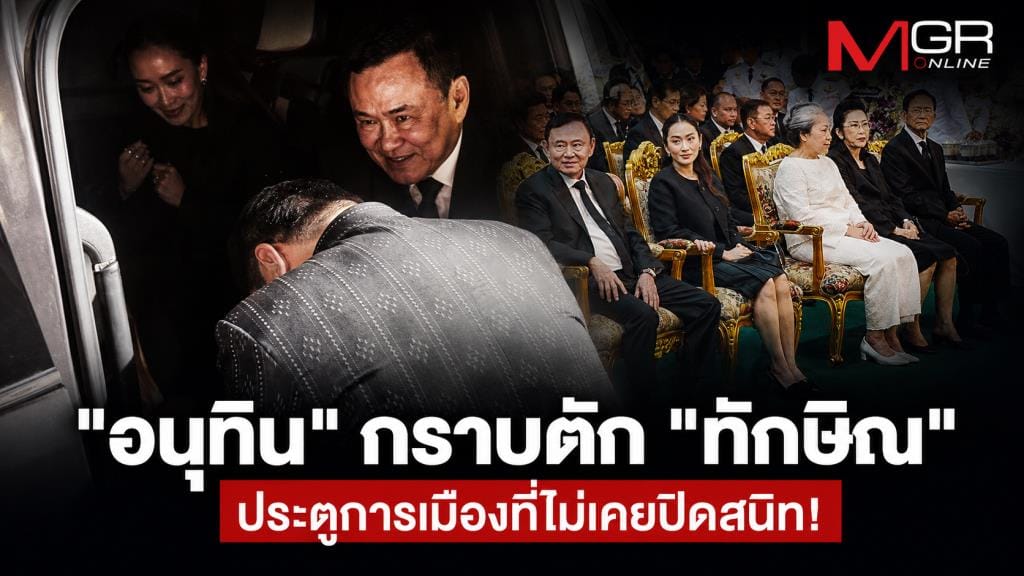
The meeting between Prime Minister Anutin Charnvirakul and former Prime Minister Thaksin Shinawatra at the funeral prayer ceremony for Kriang Kaltinant, a former Deputy Minister of Interior and former Pheu Thai MP, on the evening of 14 August in Ubon Ratchathani province, has drawn close attention and been analyzed as a political issue.
Because on that evening, in addition to the Prime Minister, three former prime ministers from the Pheu Thai Party were also in attendance: Thaksin Shinawatra, Ms. Paetongtarn Shinawatra, and Mr. Somchai Wongsawat. After the funeral prayer ceremony concluded, the hosts invited the Prime Minister and all four former prime ministers to join the Kaltinant family for a group photograph. It was notably observed, however, that Anutin did not appear in the same frame as the three former prime ministers from the Shinawatra family.
After that, guests were invited to continue with a dinner, which was held in a private room with media barred from entering to take photographs. Ms. Paetongtarn personally walked over to invite Anutin to join Thaksin at the table.
At the dinner table in that room, Anutin sat in the center, between Thaksin and Ms. Paetongtarn, with Somchai also dining with them.
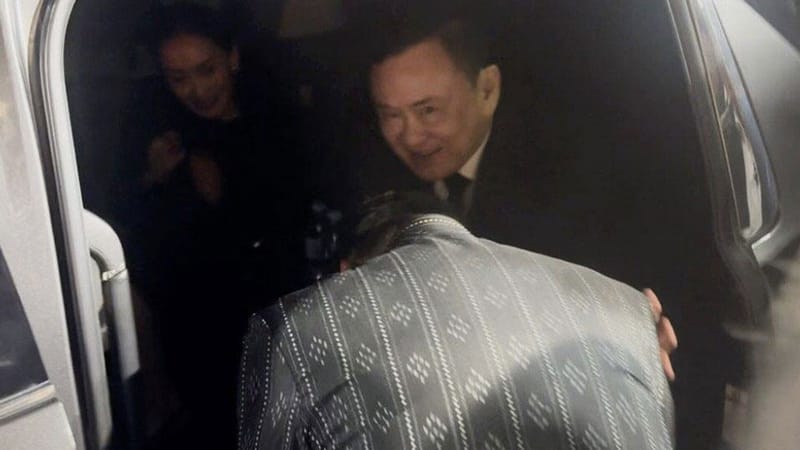
The key highlight that the media seized upon as an issue was that after dinner, Anutin walked Thaksin to his car. The two exchanged a brief conversation, during which Thaksin asked where the Prime Minister was headed next. Anutin replied respectfully that he was heading home.
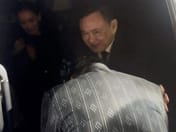
As Thaksin stepped up into the car, Anutin bowed down and prostrated at Thaksin's lap, before Thaksin departed from the temple — all in full view of members of the media and attendees who watched this warm and deeply deferential moment.
The meeting between Anutin and the three former prime ministers of the Shinawatra family on this occasion carries far greater political weight than an ordinary funeral gathering, because it is considered not a coincidental encounter but a deliberate one — intended to project a visible image of the meeting itself.
For had they not wished to meet, it would have been entirely possible to avoid it, since the funeral prayer ceremony spans several days. If either party did not want to cross paths, they could simply have checked on which day the Prime Minister planned to attend, or on which day Thaksin planned to attend.
Nevertheless, Anutin himself came out to confirm that no special political discussions took place, and that the prostration at Thaksin's lap was a matter of respect, as he had once received Thaksin's patronage when appointed as a cabinet minister in the Thaksin government back in 2004.
The noteworthy issue, beyond the "prostration," is the "approach itself."
In particular, the fact that Ms. Paetongtarn personally walked over to invite Anutin into the private dinner room, and that Anutin sat in the center flanked by Thaksin and Ms. Paetongtarn, with Somchai also at the table.
This can readily be interpreted to mean that Prime Minister Anutin was invited into the inner circle of conversation of the Shinawatra family, and that "the former power of Pheu Thai" and "the current power of the government" have now sat at the same table together.
This is therefore an image that every political faction must take away and think further about.
Another point of interest is that Anutin, in his capacity as leader of Bhumjaithai and as Prime Minister, has no need to position himself as an adversary of Thaksin — contrary to what the rumored "Green-Red-Orange" deal narrative implies.
The fact that Anutin is able to meet and talk with Thaksin openly is intended to signal that the coalition government is still proceeding smoothly, and that Bhumjaithai Party remains Bhumjaithai Party — a government pillar — and has not been reduced to a pawn of Pheu Thai.
If one were to say that Anutin gains from this meeting, do not forget that the Shinawatra side also gains — because having the current Prime Minister walk him to his car, converse with him, and publicly show respect by prostrating at his lap is an image that reflects the fact that Thaksin's political influence has not disappeared from the system, even though he holds no official political position.
It can be said that "Thaksin" remains a political center with whom the current Prime Minister can converse and maintain a relationship. As for the "prostration at the lap," even though Anutin has already come out to explain that one reason is respect and a past relationship — particularly Thaksin's having appointed him as a cabinet minister back in 2004 — in political terms, that image still carries power and continues to be picked up for criticism: that "the current Prime Minister bowed in prostration before a former prime minister who still holds considerable political influence."
Whatever "Anutin" intended to communicate, doing so amounts to a tacit acknowledgment that former Prime Minister Thaksin remains "the true power" in politics.
The conclusion of this meeting conveys several implications:
First… "Anutin" has not closed the door on Pheu Thai.
Second… "Thaksin" is still able to communicate directly with the Prime Minister.
Third… Bhumjaithai and Pheu Thai still have space for the coordination of interests, even if that does not mean a permanent alliance.
And what has taken place is that the link between the two networks has not been severed — and it will prove useful in the future, whether in terms of government stability… the configuration of the coalition equation… bargaining in parliament… the management of conflict… or even the alignment of political poles in the next election.
It remains to be seen whether, from this point on, there will be further off-the-record meetings, whether the coalition parties will adjust their stance, or whether additional signals will be sent regarding the government and parliamentary politics.
When that happens, the image of a meeting at a funeral — which is a "social image" — will become a full-fledged "political signal"!