The backstory behind the cross-agency move: "Chanthanan," the newly appointed Energy Ministry Permanent Secretary from the blue camp, takes on the mission of running the hundred-billion-baht solar cake, selling dreams to energy capitalists — even though the Finance Ministry has yet to approve it, while the Interior Ministry runs ahead.
Series: Dissecting the Solar Million Rooftops EP.1 — New Blue-Camp Energy Permanent Secretary Runs the Hundred-Billion-Baht Cake, Hiding Debt Under Section 28
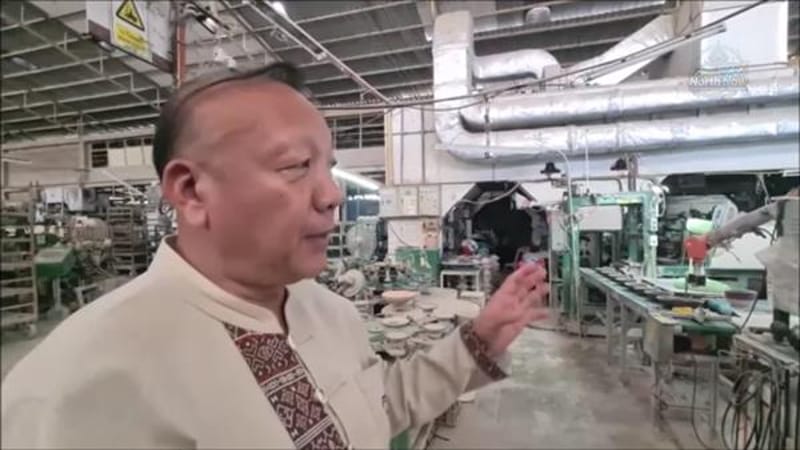
It immediately became a hot political and fiscal issue when the Cabinet meeting on 18 August 2026 resolved to approve the appointment of Mr. Chanthanan Wannakhajon, a special expert attached to the Office of the Prime Minister, to cross over and assume the position of new Permanent Secretary of the Ministry of Energy, replacing Mr. Prasert Sinsukprasert, who is about to retire from government service.
This victory over heavy favourites — an outcome that left pundits speechless — is considered a masterful strategic move by the blue camp, which sent a former "anteroom" civil servant and a protégé under the spell of Mr. Newin Chidchob, the powerful figure of Buriram, to cross over and take the top reins of the Ministry of Energy. The purpose: to take on a mission of political-architectural significance — namely, to oversee the seamless running of the "Solar One Million Rooftops" project worth hundreds of billions of baht.
The project has been coated with sweet-sounding "Quick Win" propaganda — a life-changing innovation — with the political side selling the dream that the public will be able to install solar panels for free, repay through their electricity bills, without needing to spend a single baht in cash. And even more striking is the crafted narrative that this is about transforming grassroots citizens into "new energy capitalists" who can generate their own electricity and sell it back to the state for income.
"Suppose you save 2,000 baht a month on electricity bills, the bank will gradually collect repayments from those savings... making it so that citizens barely have to spend anything at all and it creates no installation burden. Within 3–4 years, you break even..." said Dr. Ekniti Nitithanpraphas, Deputy Prime Minister and Minister of Finance, in his promotional pitch.
However, when the internal workings of the budget framework, fiscal burden figures, and legal linkages are laid out and dissected, a disturbing truth hidden beneath the glossy slogans is revealed. This policy is not about unlocking citizens to become energy capitalists — it is a legal transaction that society has questioned as a financial distortion that carves out loan funds and conceals quasi-fiscal debt to subsidise the well-off, while simultaneously locking in power purchase agreement structures to tightly protect the profits of existing energy capital groups. Whether or not this is indeed the case remains the central question.
The Interior Ministry jumps ahead to grab the spoils!
The distortion that has been pulling the wool over the entire country's eyes became even clearer when it emerged that the widely trumpeted policy of handing out 50,000 baht is, in reality, still nothing more than a "policy pipe dream" that has not received a single baht of legal or fiscal approval.
Based on information verified as of early August 2026, the project remains mired in the stage of working out details. The 50,000-baht subsidy is merely a proposal — not an entitlement that citizens can actually register to receive at present. Even though Mr. Ekniti Nitithanpraphas expressed confidence that a conclusion would be reached within one month, on that very same day, Mrs. Jindarat Wiriyathawikul, Director of the Public Debt Management Office (PDMO), came out to state clearly that project details had not even been submitted to the sub-committee responsible for screening loan expenditures, and that clarity would likely not come until September 2026.
While the project and its loan budget have yet to pass the Cabinet, the project's implementation has been racing ahead of the law in a manner that raises serious questions. The government has sped up its orders for the Metropolitan Electricity Authority (MEA) and the Provincial Electricity Authority (PEA), both under the Ministry of Interior, to pre-emptively open registration for installation contractors and equipment (solar panels and inverters) from 3 August to 30 September 2026, hastily setting up a One Stop Service system.
The question is: does this rush to open advance equipment registration constitute "dressing up and waiting for the hundred-billion-baht cake" on behalf of energy capital networks and major contractors who are ready to scoop up the benefits the moment the Cabinet approves? Whether or not that is the case demands an answer.
Concealing and burying off-budget debt under Section 28
The greatest legal and fiscal risk in this project is the choice to shortcut procedures under the Budget Procedure Act 2018 by routing quasi-fiscal policy through state-specialised financial institutions as the project's funding source — thereby evading scrutiny by the House of Representatives.
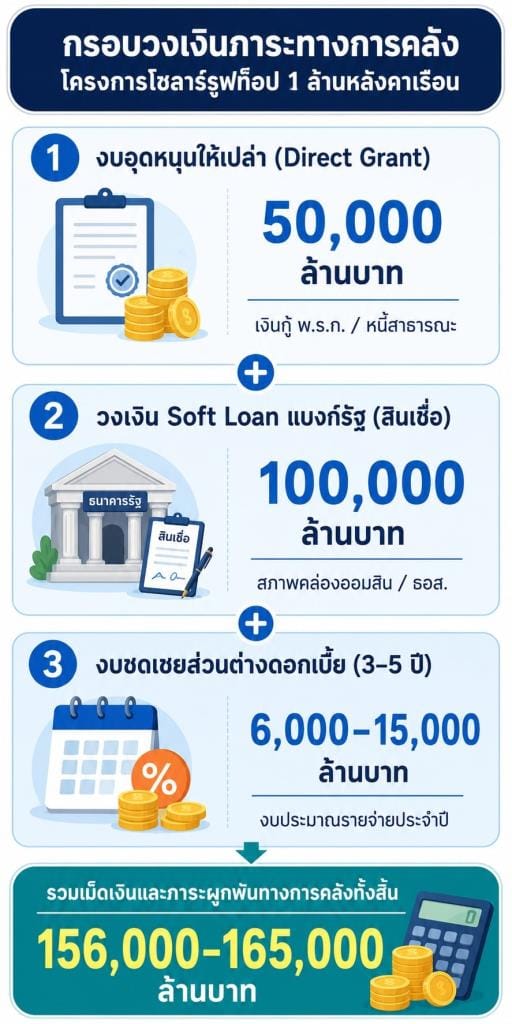
When examined against the actual financial framework, the funds required for the target of one million rooftops consist of: 1. A grant subsidy of 50,000 million baht (emergency decree loan funds / public debt); 2. A soft loan facility from state banks (credit) of 100,000 million baht (liquidity from the Government Savings Bank / Government Housing Bank); and 3. An interest rate differential compensation budget (for 3–5 years) of approximately 6,000–15,000 million baht (annual expenditure budget). Total funds and fiscal commitments: 156,000–165,000 million baht.
This course of action has been analysed and found to not align with the intent of Section 28 of the State Fiscal and Financial Discipline Act 2018.
This is because, at a time when the accumulated debt of the entire state bank system under Section 28 has surged past 1.13 trillion baht — nearly hitting the risk ceiling — and the Government Savings Bank alone is already carrying a backlog of accounts receivable pending government compensation totalling 51,431 million baht, the government is compounding the crisis by creating new burdens on top of it. The Budget Bureau allocates only a minimal amount each year to repay Section 28 debt — not even enough to service the principal — giving rise to a state of dead debt in which the state pays only scraps of interest while holding state banks' liquidity hostage.
Moreover, if the government chooses the tactic of avoiding recording Section 28 debt by forcing the Government Savings Bank to absorb the opportunity cost itself, the bank's net profit will decline, affecting the revenue remittance to the national treasury. The end result is a loss of state revenue without any scrutiny or approval from parliament.
This is something the government must explain thoroughly and without remainder.
Interior – Finance – Energy: "The Blue Tripartite"
The placement of Mr. Chanthanan Wannakhajon — widely analysed as a direct line from the blue camp — into the seat of new Energy Ministry Permanent Secretary has therefore prompted the question: is this meant to complete the tripartite power structure of "Interior – Finance – Energy" to drive the hundred-billion-baht project forward without friction?
• Ministry of Interior (the frontline operations team): MEA and PEA handle the cutout management, approve grid connections, inspect transformers, and calculate electricity bills.
• Ministry of Finance (the money-bag control team): The Government Savings Bank and the Government Housing Bank extend hundred-billion-baht soft loans, repaid through electricity bills, building a populist track record to consolidate political support.
• Ministry of Energy (the concession-guarding team): Under the leadership of the new Permanent Secretary, the ministry controls the rules so that public pressure does not force the government to "overhaul the electricity tariff structure." The coordination among the three ministries allows Bhumjaithai Party and the Anutin government to use the Interior Ministry and the Finance Ministry to push forward populist loan handouts to the fullest, while the Ministry of Energy plays the role of rules-keeper — preventing citizens from crossing a line that would affect the interests of major capital groups — and with the newly installed Permanent Secretary serving as the all-directions coordinator to ensure this project sails through.
Suppressing electricity buyback prices — a double standard
When examined through the lens of the Energy Industry Act 2007 and the regulations of the Energy Regulatory Commission (ERC), a legally inconsistent structure comes into view.
Most significantly, the government and the ERC have used their authority under Section 51 to set the electricity tariff structure by mandating a Net Billing system that buys back excess electricity from citizens at only 2.20 baht per unit, then resells it to those same citizens at night at approximately 4.00 baht per unit. This is considered a violation of Section 64, which stipulates that electricity tariff-setting must be fair and reflect true costs. The electricity authorities and the government have pocketed this financial differential and then cited grid transmission costs as a cover.
But the logic of transmission costs is swept under the rug when one turns to look at major private power plant capital groups — both IPPs and SPPs — with which the government has agreed to be bound by long-term 25-year Power Purchase Agreements (PPAs) in a Take-or-Pay format, guaranteeing revenue through Availability Payments (AP) passed on to major capital groups via the Ft charge in citizens' monthly electricity bills, even though those private power plants sell electricity to EGAT without ever having to pay a single baht in transmission costs.
Even though Thailand currently has a power reserve margin that is overwhelmingly high at 40% to 50% — far exceeding international standards by several times over — and creates hidden availability payment burdens in citizens' electricity bills of tens of billions of baht per year, the Anutin government and the Ministry of Energy have refrained from negotiating or unlocking PPA contracts with the existing capital groups. Instead, they have taken 50,000 million baht in tax-backed loans to subsidise citizens to borrow money to install solar cells — adding yet more generating capacity on top of a system already overflowing. This represents a structural inequality of power in which the state protects major capital concessions while squeezing every last baht and satang of cost from citizens.
At the same time, when one analyses the project's participation conditions, which require the installation of systems of 5 kilowatts or more — capable of generating as much as 18–22 units per day (550–650 units per month), suited for households with average electricity bills of 3,500 to 5,000 baht per month or more, or households consuming more than 700–1,000 units per month — the public policy inequity becomes even more apparent. The 50,000-baht subsidy per household (totalling 50,000 million baht) comes from loan funds that constitute public debt, which must be repaid through future tax collection — in particular, the 7% Value Added Tax (VAT) levied on everyday consumer goods, a tax that the poor must bear at a proportionally heavier weight relative to their income than the wealthy.
When this glossy project is stripped down to its bare reality, the Solar One Million Rooftops project under the Anutin government is not a Quick Win for the people.
And the most important question society must press for an answer to next is this: when citizens are turned into debtors, state banks absorb the risk, and the poor throughout the country must pay taxes to foot the subsidy — then into whose pockets does the massive sum of 100,000 to 150,000 million baht from this project actually flow?
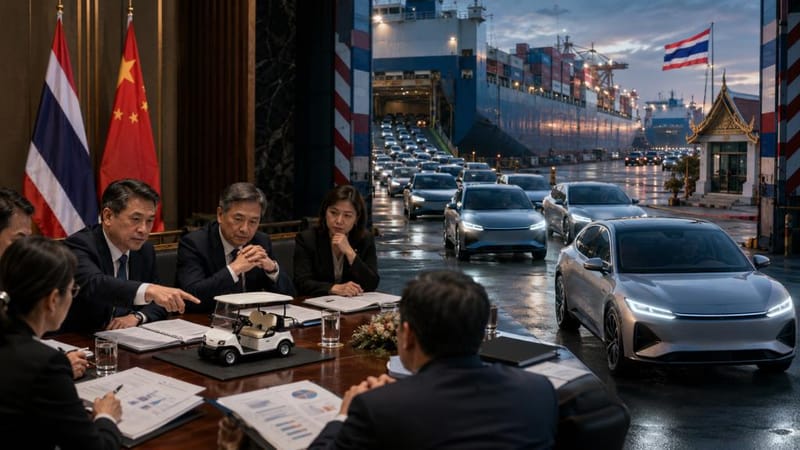
"Manager Online" will take readers to dissect the solar cell industry supply chain and the giants who stand to benefit from the hundred-billion-baht budget, while also delving deep into the "trap beneath the rooftop" that citizens must bear the risk of — but which the government is keeping silent about.
(Follow EP. 2 (Final): Chinese Capital Sweeps Solar Clean, IT and Retail Feast, Thai People Are Full of Debt)