Sky-high import tariffs and security restrictions have prevented Chinese-brand electric vehicles (EVs) from being sold in showrooms in the United States.
Yet Chinese EV manufacturers have managed to enter the American driverless vehicle market nonetheless — as suppliers of vehicle infrastructure or platforms designed for specific-purpose use.
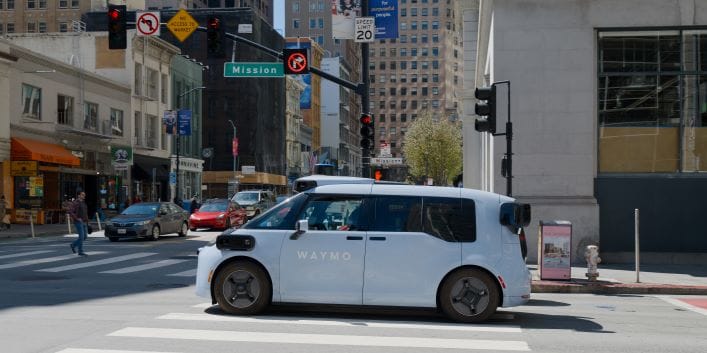
Since 2024, Zeekr has shipped more than 3,200 units of its CM1e vehicle platform — a minivan-shaped EV — to the United States, including more than 2,600 units this year alone. Waymo, the autonomous taxi service provider, is the only known partner of Zeekr, according to Forbes magazine.
Meanwhile, New York-based investment research firm MoffettNathanson estimates that Waymo receives approximately 300 vehicle platforms per month.
"What Waymo needs is not an ordinary passenger car, but a purpose-built robotaxi platform — one with a flat floor, easy entry and exit, sliding doors, a spacious interior, and suitability for high-frequency service operations," said Zhang Hong, a senior expert in the new energy vehicle industry at the China Automobile Dealers Association.
Zhang added that European and American automakers would struggle to meet supply demands of this nature, but China's supply chain can rapidly customize platforms to Waymo's specifications, thanks to China's densely clustered industrial base — comprising battery manufacturers, electric drivetrain suppliers, automakers, and engineering teams — which accelerates the transition from prototype to mass production.
This advantage stems from cost structure: Chinese automakers are producing at material costs and capital expenditure (CapEx) that are more than 30% lower. Furthermore, Chinese vehicles tend to be more technologically advanced than their Western counterparts and are favored by younger consumers, as Philippe Campeaux, McKinsey's global automotive sector leader, noted in July.
The deal between Zeekr and Waymo has survived despite the United States raising Section 301 tariffs on Chinese EVs to 100% in September 2024, followed by a separate 25% tariff on imported vehicles that took effect in April 2025. Combined with the standard 2.5% tariff on passenger cars, EVs manufactured in China could face a total tariff burden of as high as 127.5%.
The arrangement has also managed to sidestep US security restrictions that prohibit the installation of Chinese-made external communication software and autonomous driving software — because Zeekr ships only the vehicle body and chassis, which do not yet include any autonomous driving systems. Waymo then installs its own sensors and computing systems at its factory in Mesa, Arizona, and validates the vehicles for smart passenger transport services.
Zhang noted that US companies can reduce costs through this kind of cross-border division of specialized labor — a collaborative model in which China supplies the manufacturing infrastructure while the United States controls the intelligent systems.
However, Zhang added, this model also carries a warning for Chinese companies: if they remain mere hardware suppliers, the higher-margin service revenues and customer relationships will continue to stay in the hands of their American partners.
"In the past, automotive exports were judged primarily by shipment volume. But today, the more important question is: after gaining entry into overseas markets, what will allow Chinese automakers to build a truly stable long-term foundation?" remarked Wu Songquan, a senior expert at the China Automotive Technology and Research Center.