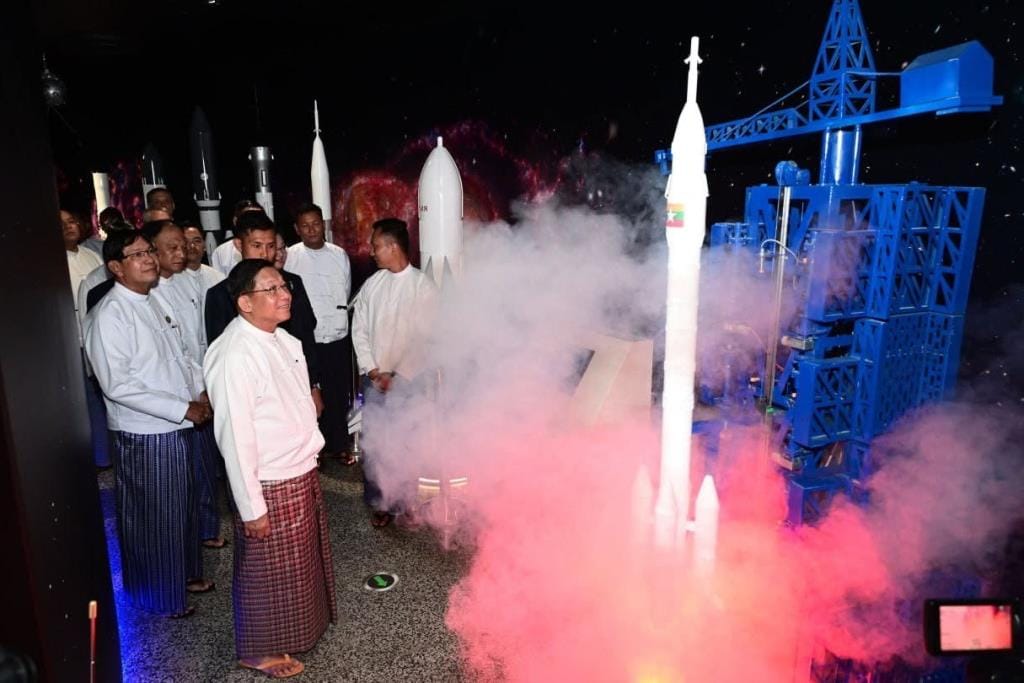
MGR Online — A Myanmar government spokesperson has announced that the country will send its first astronaut into space in 2028 under a bilateral agreement with Russia — one of 12 agreements the two countries signed during President Min Aung Hlaing's recent visit to Russia.
Government spokesperson Khaing Khaing Soe said the agreement also covers plans to establish a satellite-based search-and-rescue station in Myanmar, a Global Navigation Satellite System (GNSS) station, and a station for monitoring and guarding against hazards in space, including objects that may approach or impact Earth.
Russian media reported that Dmitry Bakanov, head of Russia's space agency Roscosmos, and Zaw Min Maung, Executive Director of the Myanmar Space Agency, signed four agreements on space cooperation between Myanmar and Russia in Moscow on 18 August.
Bakanov said Russia would help select and train Myanmar's first astronaut, making the statement during a visit to Naypyidaw on 26 February, when he held talks with government officials including Min Aung Hlaing.
"I don't believe Myanmar will be able to move into the stage of space exploration that quickly," Richard Horsey, Senior Adviser for Asia at the International Crisis Group, told the DVB news agency in an interview following Min Aung Hlaing's visit to Moscow.
Horsey said the space agreement was a diplomatic signal from Naypyidaw to show Moscow that the two countries share common interests.
BBC Burmese cited a Myanmar satellite communications expert as reporting that Myanmar has become a partner of Russia at a time when Russia is seeking to sustain its space travel industry.
Min Aung Hlaing also told Chinese state media on 17 June that Beijing and Naypyidaw are in discussions on cooperation in the space sector, including plans to launch a small satellite in the near future.
Myanmar's Space Agency was established on 1 June 2025 under the direct supervision of the head of state.