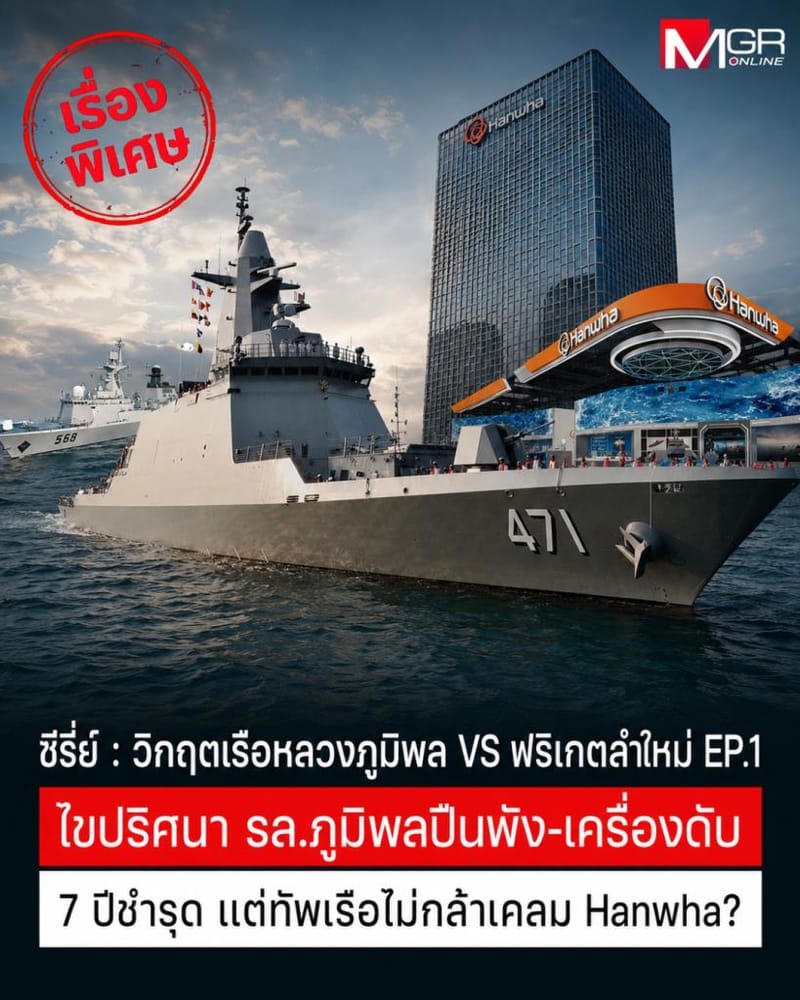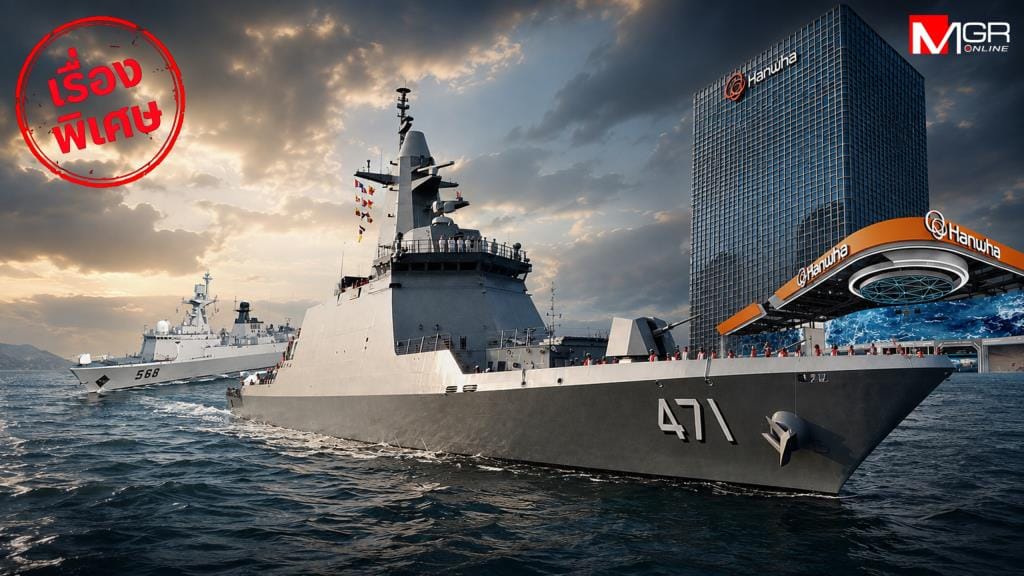
An in-depth look at the HTMS Bhumibol crisis: the Phalanx gun system broken for 7 years, MTU engines failed wholesale, hidden budget losses exceeding 300 million baht — exposing how the Royal Thai Navy has frozen a 1,500-million-baht performance bond and refuses to claim against Hanwha, even as it pushes a new frigate deal worth tens of billions.
Series: The HTMS Bhumibol Crisis vs. the New Frigate — EP.1: Unravelling the Mystery of HTMS Bhumibol — Broken Guns, Dead Engines, 7 Years of Defects, Yet the Navy Won't Dare Claim Against Hanwha
The intense wave of scrutiny over the budget and operational record of HTMS Bhumibol Adulyadej has prompted the Royal Thai Navy to launch an urgent image-recovery operation, issuing a statement that this 14,600-million-baht high-performance frigate "continues to carry out missions and remains fully operational." This was coordinated with a planned visit by Deputy Prime Minister Anutin Charnvirakul, who was scheduled to travel on 27 August 2026 to inspect the Royal Thai Navy's combat-readiness exercise in the Gulf of Thailand — as if to signal and reinforce the message that the picture of HTMS Bhumibol as "broken" was nothing more than a "misunderstanding."
Yet that image-management operation conceals a deeply dispiriting truth. The assurance that the ship can still "sail" is merely a technical talking point designed to paper over the complete failure of full combat readiness — because the country's most modern stealth frigate has been reduced to the condition of a vessel that "can sail but has no teeth." The Phalanx close-in weapon system (CIWS), the last line of defence against incoming missiles, has been inoperable for as long as 7 years, while both MTU diesel engines — the heart of the ship's cost-efficient cruising capability — have broken down simultaneously in a baffling double failure. All of this is set against the mystery of why not a single Commander of the Royal Thai Navy has had the nerve to sign off on seizing the 1,500-million-baht performance bond held by the Navy against Hanwha Ocean's shipyard — a bond that exists precisely to protect the national interest.
Engineering Marvel Turned Mystery: MTU Engines Fail Wholesale
In the annals of marine engineering, MTU diesel engines from Germany are legendary for their toughness, durability, and resilience — warships have been decommissioned while their MTU engines were still running perfectly. For both MTU diesel engines aboard HTMS Bhumibol Adulyadej to break down simultaneously is an engineering anomaly so rare it scarcely has a precedent in the history of global naval operations. The Royal Thai Navy depends primarily on its diesel engines for routine patrols, because the gas turbine engines that deliver high speed consume fuel at a rate far beyond what the Navy's fuel budget can sustain. The wholesale failure of the diesel engines has therefore forced the Navy to resort to cutting the ship's hull open to replace the engines entirely, with a budget request of 240 million baht tabled for the purchase of new units — yet the true cost of the damage has surpassed 300 million baht once the Navy began covertly diverting funds from other routine maintenance budgets to make up the shortfall.
Based on two years of in-depth research by the ThaiArmedForce.com page, three contributing factors are identified as the combined cause of the simultaneous engine failure:
• Design and hull defects: Believed to stem from design problems originating with Hanwha Ocean (formerly DSME), given that sister-class vessels operating in South Korea have encountered similarly problematic maintenance issues.
• Single Ship Concept crisis: Having only one genuinely capable high-performance vessel has compelled the Navy to drive HTMS Bhumibol Adulyadej far beyond its operational limits and beyond its design parameters.
• Accumulated maintenance system failures: Problems in the Navy's maintenance management and budgeting that have built up over the past 10 years.
Breaking down the expenditure figures for the engine crisis and the costs incurred for HTMS Bhumibol, the numbers are as follows:
• 14,600 million baht: The procurement budget for HTMS Bhumibol Adulyadej (budget commitments from 2013)
• 240 million baht: The budget the Navy requested to purchase a new set of MTU diesel engines
• 300+ million baht: The actual value of the damage when maintenance funds diverted from other budgets are included
• 2 engines: The number of MTU diesel engines that failed simultaneously, requiring the ship's hull to be cut open for replacement
"If only one engine had failed you could perhaps understand it as an engine-specific problem — but two engines failing at once? If you try to claim it's a quality issue with the engines, the odds of that must be extremely small — maybe about as small as Senate applicants independently picking the same number without any prior arrangement... The irony, of course, is that if the rumours are true, Hanwha Ocean will be the winner of the contract to build the new frigate for the Royal Thai Navy... Even if the shipyard sells you a substandard product, the Navy's solution is just to buy another one." — Analayo Korsakul, security analyst, ThaiArmedForce.com, writing on the page in August 2026.
7 Years of a Broken Phalanx — and Still No One Dares Claim
The claim that the ship is "operational" becomes even harder to accept when one examines the Phalanx close-in weapon system, which uses a 20 mm Vulcan rotary cannon capable of firing 75 rounds per second. This system has been damaged and non-functional since shortly after the ship was handed over, and has been left unrepaired for a full 7 years.
Although the Navy did at one point lodge a claim with Hanwha Ocean and with the system's manufacturer, General Dynamics of the United States, the repair effort failed entirely. The spotlight has therefore fallen on the 1,500-million-baht performance bond issued by Hanwha that the Navy holds under procurement law — a bond the Navy has the legal right to seize immediately in order to fund the ship's repairs, given that the fault lies with the contractor. The reason no Commander of the Royal Thai Navy has been willing to sign the order to seize those funds over the past 7 years comes down to an organisational culture shaped by the "one-year tenure" of each Navy Commander, a culture that prioritises passing the baton and offloading problems onto successors, out of fear of political repercussions and cross-border litigation.
The decision by political figures at the level of the Prime Minister to come and inspect the Navy's combat readiness at this particular moment has therefore been viewed as nothing more than political theatre — a staged endorsement certifying that the ship is not broken, before the Navy stubbornly pushes ahead with its proposal before parliament to approve the procurement of a second frigate worth 17,000 million baht.
A brief breakdown of the figures behind the weapons system crisis and the performance bond:
• 7 years: The length of time the Phalanx CIWS has been failed and paralysed
• 75 rounds per second: The capability of the Phalanx gun that Thailand paid for but has never been able to use
• 1,500 million baht: The value of Hanwha's performance bond that the Navy has shelved and refused to seize
• 1 month: The time within which HTMS Bhumibol had to reverse course and sail back for repairs at a shipyard in South Korea after being handed over
"The Phalanx issue is not the fault of the Royal Thai Navy — it is Hanwha's responsibility as the contractor. The question is: why, after 7 years, has it still not been repaired?... In summary, to this day the CIWS on HTMS Bhumibol still cannot be used. What caused the problem? And why has it never been resolved? It has been 10 years — how was it ever accepted and signed off?" — ThaiArmedForce.com (TAF Talk 275, 19 August 2026)
Meanwhile, Wasana Nanuam, a defence journalist, said during the programme Rueang Yai Live Talk on 29 July 2026, in part: "It has already started — letters are already being sent online saying that people are going to file complaints about this, people who were disqualified... The Air Force said, 'We feel sorry for the Navy — whatever they buy, they get burned. Why do they accept such shoddy deliveries?... Why aren't they like the Air Force?'"
The Billion-Baht Blueprint vs. Reality
When the 2013 procurement contract is laid against the "operational reality," the picture of the Royal Thai Navy's management failure over the past 7 years comes into stark, unsparing relief.
In the dimension of the diesel propulsion system: The contract clearly specified the installation of high-durability MTU diesel engines from Germany for economical-speed cruising. Yet the operational reality turned into a nightmare when both engines broke down simultaneously, forcing the ship's hull to be cut open for replacement and generating hidden budget liabilities exceeding 300 million baht.
In the dimension of the close-in weapon system: The original blueprint envisaged the 20 mm Phalanx cannon serving as the last line of defence, automatically intercepting guided missiles. In reality, the system has been paralysed and inoperable since the ship was handed over — for 7 years — leaving what is billed as Thailand's most modern warship to sail without any close-range air defence shield.
In the dimension of performance bond rights: Procurement law grants the Navy the authority to seize Hanwha Ocean's 1,500-million-baht performance bond immediately upon contractor default. The reality, however, is that the Navy has "frozen" that bond and refused to sign the order to seize the funds for ship repairs — causing the government to forfeit those resources and instead divert money from other maintenance budgets, a toxic inheritance that each successive Navy Commander has simply passed down to the next.
And in the dimension of combat readiness: Originally designated to be a high-performance frigate capable of operating across three combat dimensions — air, surface, and submarine — HTMS Bhumibol Adulyadej has instead fallen into a state of "Single Ship Concept," driven relentlessly beyond its limits because it is the only high-performance vessel available. And each time the ship has to stand idle for hull-cutting engine replacements, the security gap in the Gulf of Thailand opens up immediately.
The Navy's public rebuttals and its invitation to the Prime Minister to inspect its exercises do nothing to erase 7 years of structural failure aboard HTMS Bhumibol Adulyadej. The harder the Navy tries to insist the ship "is still operational," the more nakedly it exposes the contradiction: "If the first ship is truly of good quality and problem-free, why does the Navy need to resort to 'submitting six and having five disqualified' and every manner of contortion to hand the second contract to the same shipyard?"
What lies behind the selection process for a multi-billion-baht deal that swept all competitors off the table? How did weak operational specifications and a meagre Offset Policy proposal manage to defeat other world-class shipyards?
Follow the story in EP.2: "Submit Six, Five Disqualified" — Dissecting the Second Frigate Procurement Plan, When Low Specs Win Through Contortion.