Series: Unpinning the Civil Service Reform EP.1: Cutting 30,000 Government Posts in 8 Years — Real Action or Empty Talk?
Challenge the political will of Prime Minister Anutin Charnvirakul directly. Do not hide behind Pakorn Nilprapan, the legal technocrat. Do not use grand words to buy time on civil service reform and manpower reduction while pushing any real results off into the distant future!
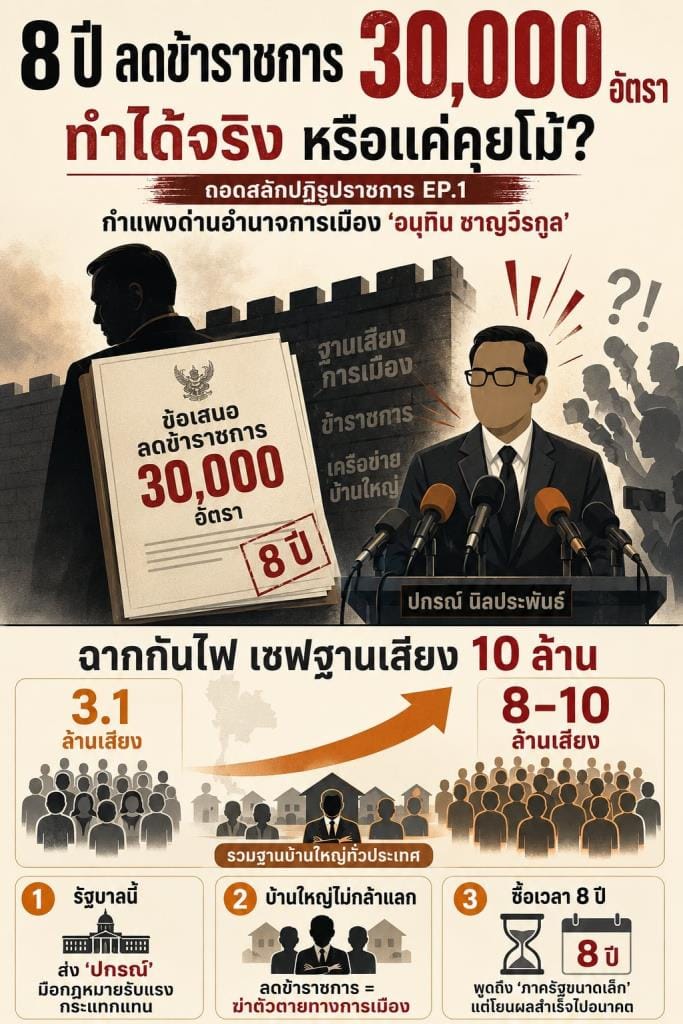
The Cabinet resolution on the Public Sector Human Resource Management Reform Plan was launched with Deputy Prime Minister for Legal Affairs Pakorn Nilprapan being sent out alone to hold the press conference and absorb all the blows — presenting an 8-year strategy targeting the freeze and reduction of 30,000 permanent civil service posts. Conspicuously absent was Prime Minister Anutin Charnvirakul himself, who never stepped forward to personally champion the cutting of civil servant numbers. This is the central question that strikes directly at the head of the executive branch: is he bold enough to step out and lead the civil service reform drive himself?
Hiding behind a legal technocrat while setting an 8-year target to slash the recurrent budget to 30% is, in truth, nothing more than a "burden-shifting" strategy — offloading responsibility onto the next government, and creating a fiscal illusion to conceal a recurrent budget so strained that the government may resort to tapping liquidity from state-owned specialised financial institutions (state banks) to pre-finance various projects through the mechanism of Section 28 of the State Fiscal and Financial Discipline Act 2018. Is that not so?
The 10-Million-Vote Trap: The Political Clan Won't Risk the Trade-Off
The Prime Minister's choice to stay silent and let the legal technocrat step forward to take the brickbats is, in reality, a shrewd construction of a political firewall. Anutin is acutely aware that 3.1 million public sector personnel, multiplied by household reach, represent a massive bloc of 8–10 million votes nationwide. Personally wielding the guillotine over civil service positions is a losing proposition all around.
For a politician who rose through a system of regional political clans and patronage networks, moving to cut into the bureaucratic flesh or trim welfare benefits is tantamount to building a mass of opponents — it amounts to "political suicide." The political bloc of clan-style politicians therefore chooses to "float above the conflict," letting the legal hand absorb the friction while maintaining good relations with civil servants for the benefit of the next election.
Looking back at his policy statement to Parliament, Anutin typically favoured sweeping visionary language — such as "restructuring the public sector to be smaller, more agile, and a facilitator" — but when the time came to deploy executive power to confront the entrenched state structure and actually cut procedures and budgets, there was no direct interview from the leader himself. This reinforces the picture that the government is engaged in nothing more than an administrative sideshow to buy time and avoid a collision with the deep-rooted state bureaucracy.
Running Into the Four Walls of the 'Deep State'
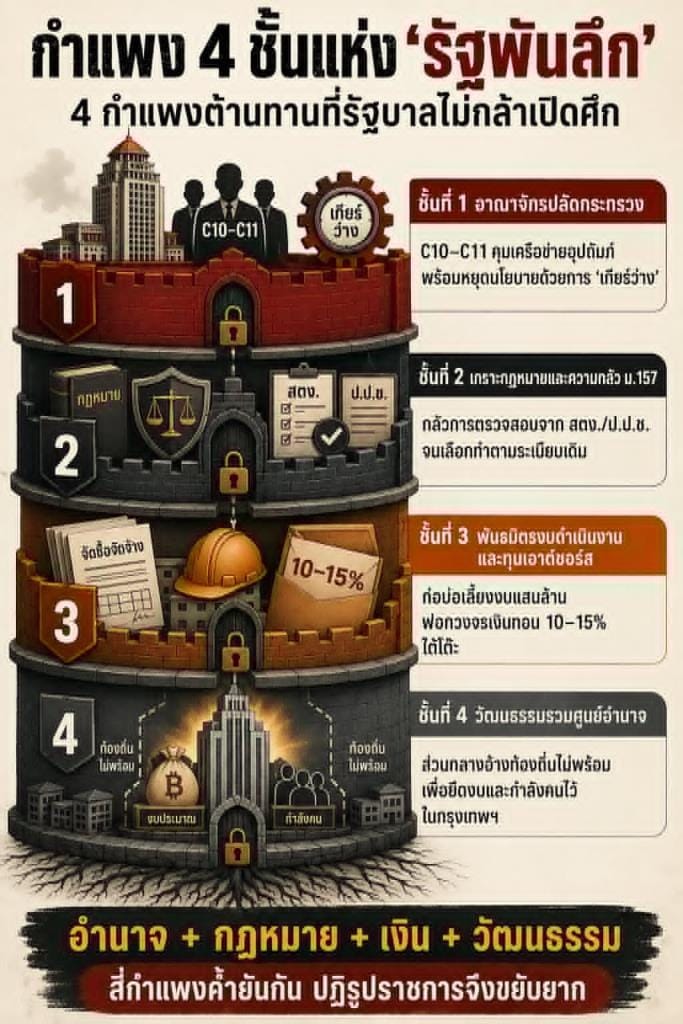
Beyond the fear of losing his voter base, the Prime Minister must also contend with four deeply entrenched layers of resistance — walls too thick for a fragile coalition government to dare opening a fight against.
• Wall 1: The Feudal Kingdom of the Permanent Secretaries. Under civil service administration law, ultimate authority rests in the hands of permanent secretaries and director-generals at the C10–C11 level, who command powerful patronage networks. If the political side attempts to issue orders over their heads, the response is deliberate "neutral gear" — dragging out budget disbursement until government policies are buried and neutralised.
• Wall 2: The Legal Shield and Fear of Section 157. The audit mechanisms of the State Audit Office and the National Anti-Corruption Commission have been turned by the bureaucratic system into a self-protective shield. Operational-level civil servants who contemplate dismantling approval procedures or scrapping paperwork are routinely threatened with criminal prosecution, giving rise to an "audit-phobia" in which everyone opts to preserve the old system for their own safety.
• Wall 3: The Operational Budget Alliance and the Outsourcing Capital. Hundreds of billions of baht per year in operational budgets form a common feeding pipeline between civil servants who control procurement and private outsourcing firms. Dismantling the service-contracting system in order to bring workers into a proper welfare framework would destroy the "10–15% kickback cycle" that functions as the bureaucratic system's hidden treasure trove.
• Wall 4: The Culture of Centralised Power. The deeply ingrained belief that only the centre can hold standards has resulted in the stubborn blocking of any transfer of budgets and manpower to local administrative organisations (LAOs), with the claimed unreadiness of local authorities used as a convenient shield.
The OCSC and OPDC — Failed Reform Mechanisms?
A root cause behind Thai civil service reform being trapped in a loop of cloning plans to fight against its own unwieldiness is the misplaced faith placed in two key institutions — the Office of the Civil Service Commission (OCSC) and the Office of the Public Sector Development Commission (OPDC) — both of which are themselves part of the problem.
• The OCSC: 98 Years and Going in the Wrong Direction. Since its establishment in 1928, the OCSC has positioned itself as the controller of the manpower framework — but has instead become a mechanism that perpetuates structural inequality. The OCSC has chosen to strictly cap permanent manpower ceilings for frontline operational posts, refusing to hire nurses, public health officers, and teachers by citing long-term budget burdens, while generously approving the expansion of management, expert, and advisory structures at the C9–C11 level in Bangkok, causing the centre to balloon. The result is a "bloated head, atrophied legs" condition that no government has ever managed to fix.
• The OPDC: 24 Years as a Paper Tiger. The OPDC was created under the Ministry, Bureau, and Department Restructuring Act 2002, during the 2002 civil service reform era of the Thaksin Shinawatra government, with the goal of being the "vanguard guillotine of regulatory reform" and a dismantler of the state structure. Yet over 24 years, the OPDC has been swallowed whole by the "deep state" system and reduced to nothing more than an "administrative department producing performance indicators" — generating hundreds of pages of KPI, PMQA, and evaluation forms that pile paperwork burdens on frontline workers, while never once actually abolishing a single ministry, department, or approval/licensing procedure.
Lessons from South Korea and Vietnam — Standards Thailand Cannot Match
When one looks beyond domestic benchmarks and compares Thailand with internationally successful civil service reform models, the Thai government's absence of political will becomes all the more starkly apparent.
• South Korea and the Mechanism of Reversed Proof of Burden. In dismantling regulations and downsizing the state, South Korea did not allow civil servants to conduct gentle self-assessments. Instead, it applied the Regulatory Guillotine Principle — reversing the burden of proof so that it became the duty of "civil servants" to answer to society and the executive branch as to why any given regulation or approval/licensing requirement still needed to exist. If a government agency could not explain it, those laws and administrative procedures were "automatically abolished" without conditions.
• Vietnam and the Lesson in Decisiveness. Vietnam, under its Project 30 administrative reform policy, had the executive exercise direct command authority from the Prime Minister, setting a target of reducing procedures and compliance costs by at least 30%, and tying results to a "ministerial performance index." If any ministry failed to meet its targets, the relevant minister was directly accountable politically.
Cutting back to Thailand: the Anutin Charnvirakul government has chosen the diametrically opposite path — not daring to set proactive targets, not daring to use executive power to slash approval and licensing procedures, and not daring to bind accountability to ministers. Instead, it has left senior civil servants in the OCSC and OPDC to sit and draft a drawn-out plan extending to 8 years — a timeframe that already exceeds the tenure of this government. Thailand's civil service reform is therefore set for failure from the very first count.
When the head of government does not dare to confront the deep state, and chooses instead to yield to the feudal walls of the bureaucracy, the outcome is inevitably the manufacture of an "on-paper headcount reduction illusion," while allowing the national budget to continue being siphoned through the "outsourcing cycle" — unchanged.
(Continued in EP.2 (Final): Headcount Cut, Budget Unchanged! Exposing the Service-Contract Loophole — Outsourcing Booms, Under-the-Table Dealings Flourish)