The Anutin Charnvirakul government is in a period of extreme decline, beset by corruption scandals and political legal cases — to such a degree that NIDA Poll has made it the subject of a public opinion survey to see whether its findings align with the current mood, posing the blunt question: "So many problems — will it survive?"
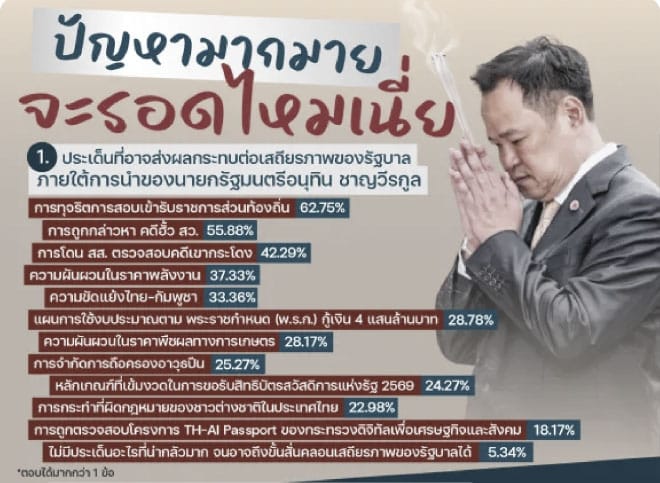
The results showed that over 37 percent of respondents stated with confidence that it "will not survive." Looking at the details of the poll, the top three issues shaking the Prime Minister's chair were: No. 1 (62.75%) — corruption in the local government civil service entrance examinations; No. 2 (55.88%) — allegations of bid-rigging in the Senate election; and No. 3 (42.29%) — intense pressure from opposition MPs and oversight bodies over the Khao Kradong land case.
Additional factors included economic problems and foreign disputes: energy price volatility (37.33%), the Thailand–Cambodia conflict (33.36%), the 400-billion-baht emergency decree borrowing plan (28.78%), as well as the criteria for the welfare card scheme and the investigation into the TH-AI Passport project. Only 5.34% felt that none of these issues was serious enough to destabilise the government. It so happened that NIDA Poll's questionnaire did not include questions about the encroachment of Chinese capital, grey-zone Chinese operators, or the audacity of Jewish or Israeli nationals attempting to move in and settle on Thai soil — otherwise, the percentage of public dissatisfaction that could affect the Prime Minister's position might well have exceeded that over the local civil service examination corruption, since Thai citizens are currently very alert to this issue but the government has not addressed it seriously, being preoccupied with concerns about the impact on tourism and investment. As for views on the government's ability to handle its problems, 39.69% of the public believe the government will be able to cope with only "some issues," while 31.99% feel it "will not be able to cope at all."
When asked for an overall verdict on the survival of the Anutin government, the largest share of respondents — 37.86% — assessed that it "will definitely not survive," while 26.03% thought it "will survive, but will be badly bruised." Only 17.71% were confident it would "survive comfortably."
Nevertheless, although the poll places the greatest weight on the local civil service examination corruption scandal, the "Senate bid-rigging" case is also approaching a critical turning point, after the Election Commission (ECT) set a framework indicating it would endeavour to conclude the matter within this month. All eyes are now on the ECT's stance and what its final resolution will be — and whether it will proceed to refer the case to the Supreme Court.
The matter has drawn a wide range of commentary. One such voice is "Loi Chunphongthong," a mathematician, specialist in astronomical calculation, YouTuber, and founder of Loy Academy, who posted on Facebook stating: "I'm laying out the Constitution for everyone to see — merely having reasonable suspicion is enough for the ECT to be obliged to refer the matter to the Supreme Court. It has no right to withhold the case file from the Supreme Court. If it doesn't refer it, it will certainly mean prison — the Constitution says so. Even the judiciary cannot wriggle out of this."
"Loi" stated that the key point of Section 226 is that if the ECT has "evidence that can reasonably be believed" that a candidate committed fraud or was aware of dishonest and unfair conduct, then once the results have been announced, the ECT has no power to revoke rights on its own authority. Instead, it has a duty to "file a petition with the Supreme Court" for the Court to consider and issue a ruling revoking the right to stand for election or the right to vote (black card / red card). At this stage, the ECT must gather evidence, and if after investigation it finds there is sufficient grounds as required by law, the ECT is obligated to refer the matter to the Supreme Court for a definitive ruling, through the constitutional channel.
If the ECT finds evidence with clear legal weight fulfilling the required elements and then fails to refer the case to the court, or deliberately neglects to do so, this may constitute a dereliction of duty under criminal law. However, if at the preliminary stage of reviewing the evidence it finds insufficient grounds, the ECT may pass a resolution dismissing the petition through its internal inquiry process.
Meanwhile, on another front, the political game in parliament has begun to move in a significant way, as the parliamentary session is set to reopen on 25 August, and the opposition has already announced that a no-confidence debate against the government will definitely be tabled.
With so many problems piling up all at once, there is a high chance that the government could collapse in this debate.