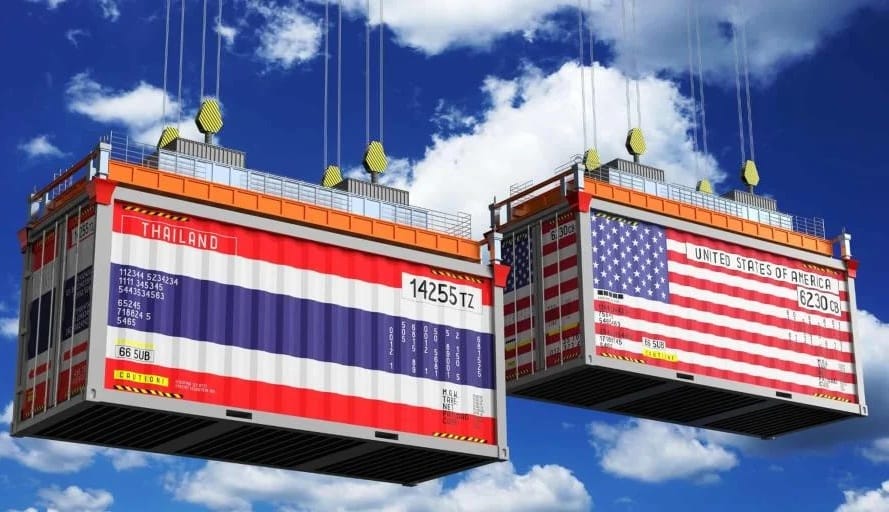
The Department of Foreign Trade has revealed that 25 U.S. states have filed a lawsuit with the U.S. Court of International Trade requesting a suspension of the new import tariffs of 10% and 12.5% imposed on goods from 60 countries on grounds of forced labour, arguing the measures are unlawful. The outcome is being closely watched in hopes the court will order the tariffs abolished. However, in the case of structural excess capacity, there is a chance Thailand could still be hit — and if it is, some 28% of Thai exports to the United States would be affected. The department affirmed it will continue pressing the U.S. for tariff exemptions.
Ms. Arada Fuangtong, Director-General of the Department of Foreign Trade, Ministry of Commerce, disclosed details regarding the United States' announcement of a 12.5% import tariff on goods from Thailand, effective from 24 July 2026, citing the use of forced labour under Section 301 of the Trade Act of 1974. She stated that 25 U.S. states, led by the Democratic Party, have filed a lawsuit against the administration of President Donald Trump in the U.S. Court of International Trade, seeking a suspension of the new round of import tariffs at rates of 10% and 12.5% imposed on goods from 60 countries and trading-partner economic zones. The states are requesting that the court rule these measures unlawful, on the grounds that invoking forced labour as justification is an attempt to circumvent a previous court ruling, constitutes an overreach of executive authority, and they are also asking that tariffs already paid by importers be refunded.
Based on the department's analysis, in its capacity as the defending agency, it assessed that the forced-labour tariff measures would not be enforceable and could ultimately be struck down — similar to what happened with the import tariffs previously imposed under the International Emergency Economic Powers Act (IEEPA), which granted the U.S. President the authority to raise tariffs without waiting for Congressional approval. This is because the investigation into forced labour across various countries worldwide took only a short two months, and market conditions differ vastly from country to country, yet the tariff rates announced for each country vary only slightly — at 10% and 12.5% — meaning the U.S. must be able to explain what criteria it used to determine the rates. The final outcome remains to be seen.
As for the allegation concerning structural excess capacity, it is expected that the U.S. will be able to enforce such measures, given that on 13 August 2026, the White House published a report titled "The Great Transshipment Scam," stating that more than 40 countries have helped China circumvent U.S. tariff measures by routing exports through third countries subject to lower import tariff rates. Thailand was included on that list, placed in Tier 2 alongside Brazil, Indonesia, Malaysia, Turkey, and Vietnam — countries identified as having significant linkages to China's supply chain.
Based on the department's analysis, it is estimated that when the tariff rates from both cases — forced labour and excess capacity — are combined, the total should not exceed 19%, which is the original baseline tariff rate that had been imposed from the outset. However, if that scenario does materialise, approximately 28% of the product categories Thailand exports to the United States would be affected. The department will proceed to identify which product categories to seek tariff exemptions for from the U.S., with a focus on agricultural and food products, while also waiting to see which specific products the U.S. ultimately chooses to subject to tariffs.
In the meantime, between 27 August and 1 September 2026, the department will travel alongside the Thai team to negotiate with the United States on resolving the tariff measures, with a target of concluding negotiations on the Agreement on Reciprocal Trade (ART) during this visit. This is because the Thai side has already prepared data on each issue raised by the U.S., as well as proposed solutions for each point. Furthermore, the negotiations will take place in person — not via an online platform — allowing Thailand to provide more extensive clarifications. It is expected that a conclusion should be reachable.