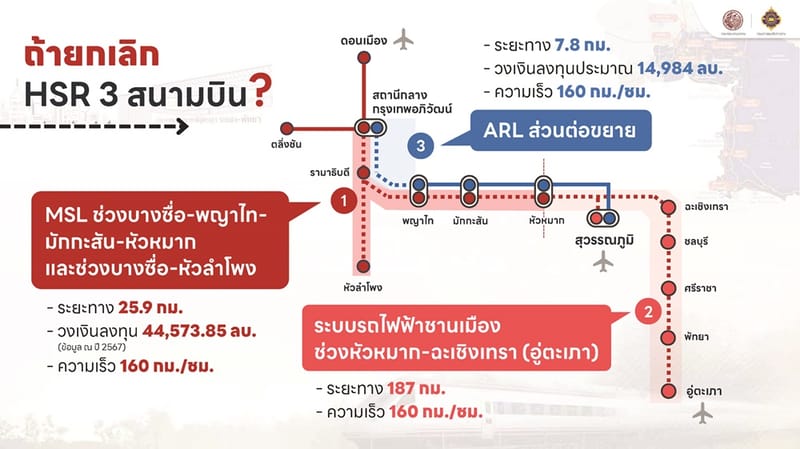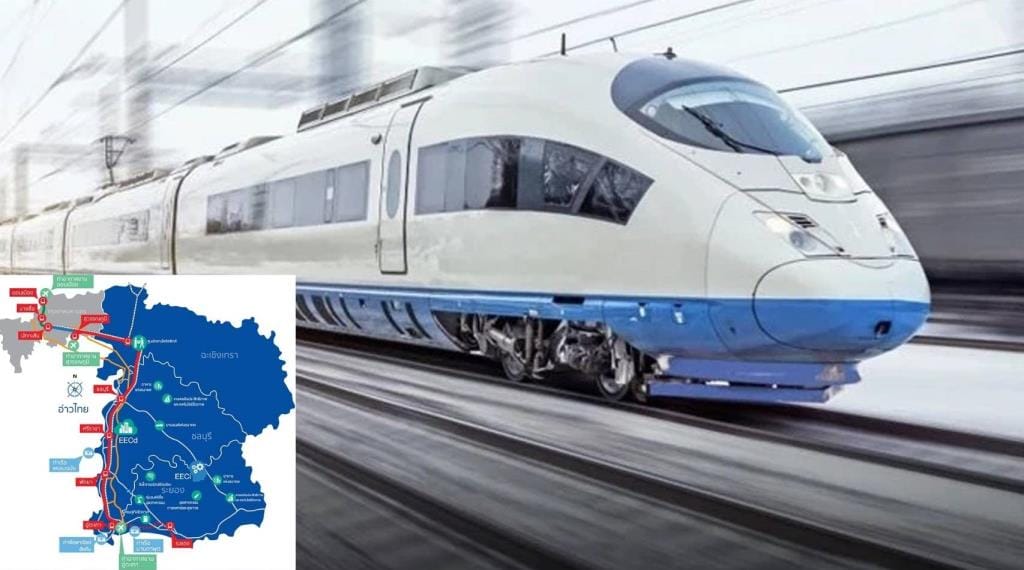
Revealing the contingency plan in the event that the "High-Speed Rail Linking 3 Airports" project is cancelled: the State Railway of Thailand (SRT) has prepared 4 options, pressing ahead to build the Bang Sue–Rangsit section itself, unlocking the "Thai-Chinese railway," using the Red Line extended to connect U-Tapao Airport at a speed of 160 km/h. At the same time, there is a concept to lay Red Line tracks jointly on the Airport Rail Link structure in a Dual Gauge arrangement, reducing the investment cost to 120–170 billion baht.
The problems surrounding the High-Speed Rail Linking Three Airports project (Don Mueang – Suvarnabhumi – U-Tapao), valued at 224,544.36 million baht, have dragged on for 6 years since the State Railway of Thailand (SRT) signed the joint investment contract on 24 October 2019. Most recently, on 6 July 2026, Asia Era One Co., Ltd. (C.P.), the private contract partner, submitted a letter invoking its right to terminate the contract, citing the inability to amend the joint investment agreement. Subsequently, at a meeting of the Contract Supervisory Committee — attended by SRT, C.P., and the Eastern Special Development Zone Policy Committee Office (EEC Office) — C.P. was asked to consider withdrawing its letter dated 6 July 2026; however, C.P. has not yet responded to the proposal.
An SRT news report stated that SRT must urgently resolve issues related to the High-Speed Rail Linking 3 Airports project — for example, the shared-structure issue with the Thai-Chinese Railway project under Contract 4-1, the Bang Sue–Don Mueang section. It is now fairly clear that SRT will take this portion of work and carry out the construction itself, so as not to affect the Thai-Chinese Railway project as a whole, while awaiting clarity on whether the High-Speed Rail Linking 3 Airports project will continue. This is because, if the project is cancelled, it will affect the construction under Contract 4-1, which will need to scale down the structural work on the High-Speed Rail Linking 3 Airports portion as well.
At present, the High-Speed Rail Linking 3 Airports project still lacks clarity. SRT has prepared a contingency plan with 4 options as follows:
Option 1 — In the event the project is not cancelled: The High-Speed Rail Linking 3 Airports project continues as per the contract, using a budget of 155,390 million baht. SRT will construct the shared structure for the Krung Thep Aphiwat Central Station–Don Mueang section itself at approximately 20,000 million baht, and will construct the Red Line railway (Missing Link) for the Krung Thep Aphiwat Central Station–Hua Mak section and the Krung Thep Aphiwat Central Station–Hua Lamphong section at a cost of 45,760 million baht. Total state investment: 221,150 million baht.
Option 2 — In the event the project is cancelled: SRT constructs the Krung Thep Aphiwat Central Station–Don Mueang section for the Thai-Chinese Railway only, at approximately 10,000 million baht; constructs the Red Line railway (Missing Link) for the Krung Thep Aphiwat Central Station–Hua Mak section and the Krung Thep Aphiwat Central Station–Hua Lamphong section at a cost of 45,760 million baht; and constructs the Red Line extension from Hua Mak–Chachoengsao–U-Tapao Airport, in accordance with the findings of the Three Seaports Connectivity project study, using 1-metre gauge track, at a cost of 96,873 million baht.
This option involves using the Red Line to run and connect to U-Tapao Airport, with passengers transferring at Lat Krabang to use the Airport Rail Link to connect to Suvarnabhumi Airport. Total state investment: 153,628 million baht.
Option 3 — In the event the project is cancelled: SRT constructs the Krung Thep Aphiwat Central Station–Don Mueang section for the Thai-Chinese Railway only, at approximately 10,000 million baht; constructs the Red Line railway (Missing Link) for the Krung Thep Aphiwat Central Station–Hua Mak section and the Krung Thep Aphiwat Central Station–Hua Lamphong section at a cost of 45,760 million baht; constructs the Airport Rail Link extension for the Phaya Thai–Krung Thep Aphiwat Central Station section at a cost of 19,515 million baht; and constructs the Red Line extension from Hua Mak–Chachoengsao–U-Tapao Airport, in accordance with the findings of the Three Seaports Connectivity project study, using 1-metre gauge track, at a cost of 96,873 million baht.
This option involves using the Red Line to run and connect to U-Tapao Airport, with passengers transferring at Lat Krabang to use the Airport Rail Link to connect to Suvarnabhumi Airport. Total state investment: 173,143 million baht.
Option 4 — In the event the project is cancelled: SRT constructs the Krung Thep Aphiwat Central Station–Don Mueang section for the Thai-Chinese Railway only, at approximately 10,000 million baht; constructs the Red Line railway (Missing Link) for the Krung Thep Aphiwat Central Station–Hua Lamphong section and the Krung Thep Aphiwat Central Station–Phaya Thai section, while for the Phaya Thai–Suvarnabhumi section, the Red Line will share the Airport Rail Link structure by laying 1-metre gauge track in a shared-track system, or Dual Gauge, at a cost of 25,620 million baht; and constructs the Red Line extension for the Lat Krabang–Chachoengsao–U-Tapao Airport section, in accordance with the findings of the Three Seaports Connectivity project study, using 1-metre gauge track, at a cost of 90,850 million baht, with passengers transferring at Lat Krabang to use the Airport Rail Link to connect to Suvarnabhumi Airport. Total state investment: 127,465 million baht.
Nevertheless, these options are guidelines to accommodate each scenario, and there are still factors to consider for each option, including investment costs, construction timelines, readiness, convenience of network connectivity and passenger transfers, and the use of existing rail systems. Most importantly, whether the Three Airports Rail Link project will proceed or be cancelled remains to be seen — and there may also be a possibility of protracted litigation by the private sector.