Dissecting the Cabinet resolution to cut 30,000 civil service positions, hiding expenditure in "service contract" budgets, entrenching a two-tier bureaucratic feudal order that suppresses 1.28 million shadow workers — and exposing the kickback cycle and ghost employees.
Series: Unpinning Bureaucratic Reform EP.2 (Final) — Staff Cuts, Budget Doesn't Follow! Exposing the Outsourcing Loophole as It Flourishes Under the Table
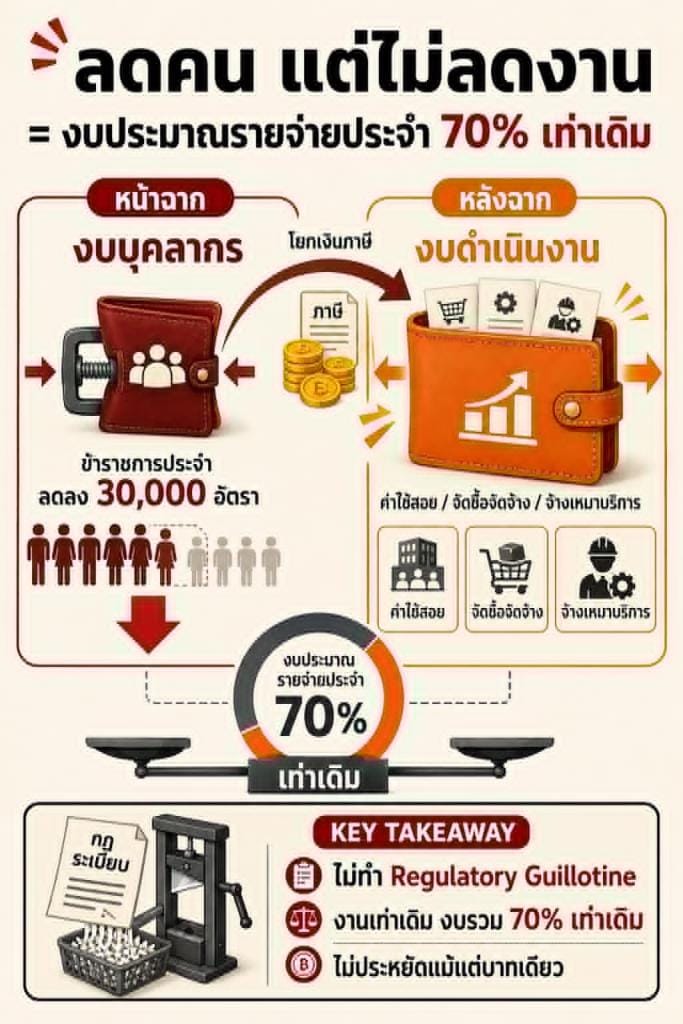
The Cabinet resolution that aims to slash routine expenditure to 30% by freezing and reducing 30,000 permanent civil service positions is creating a fiscal illusion — misleading society into believing the bureaucratic state will shrink and save a vast amount of taxpayer money. But when the national budget structure is dissected, it becomes clear that reducing the civil service headcount is nothing more than numbers on paper. Taxpayers' money continues to balloon at exactly the same level, merely shifted into a new pocket: "service contracts" — opening the way for an "outsourcing cycle" to flourish and transforming it into a hundred-billion-baht treasure trove of sweet kickbacks.
**The Money-Bag Shuffling Trick**
Why does cutting 30,000 permanent civil service positions not actually save the national budget? The simple answer is that the government "reduces the people, but refuses to reduce the work."
That is to say, when a freeze is ordered on new permanent civil servant recruitment, the way out for various government agencies is to exercise discretionary authority to sidestep the rules and enter into service contracts, bringing in outsiders to do the work instead.
The budgetary accounting outcome is nothing more than a theatrical performance. This is because on the front stage, the personnel budget shows a falling number of permanent civil servants, and the cost of salaries and benefits for new civil servants appears to be under control — as presented by the Civil Service Commission (CSC) and the Office of the Public Sector Development Commission (OPDC).
Yet on the back stage, taxpayer money is instead redirected and disbursed, hidden within the "operating budget" category (remuneration, expenses, and materials), channelled through procurement contracts to pay for outsourcing.
When both budget pockets are combined, the routine expenditure that underpins approximately 70% of the public-sector structure remains just as bloated and unwieldy as ever — not a single baht saved.
**A Two-Tier Bureaucratic State, Deeply Entrenched**
The accounting sleight of hand in shifting payment pockets has perfectly entrenched a "two-tier bureaucratic state" system deep within Thai society, through the distribution of rights and budgets at extreme levels of inequality. An examination of the Government Workforce Statistics Report published by the Office of the Civil Service Commission (OCSC) reveals a total public-sector workforce of 3,037,803 people.
The first group is the permanent civil servant group: 1.76 million people.
This group of permanent civil servants consumes the largest share of the national budget — as high as 1.15–1.20 trillion baht per year, or nearly half of total routine expenditure — which can be broken down as follows:
1. Teachers and educational personnel (under the Ministry of Education and the Ministry of Higher Education, Science, Research and Innovation): 40,000 people (holding the highest proportion in the Thai civil service system). 2. Ordinary civil servants (administrative and governance ministries — Interior, Finance, Agriculture, etc.): approximately 410,000 people. 3. Military personnel (Ministry of Defence): approximately 360,000–380,000 people. 4. Police officers (Royal Thai Police): 213,510 people. 5. Public health civil servants (exclusively permanently appointed doctors and nurses): approximately 210,000 people. 6. Local government civil servants (local administrative organisations and Bangkok Metropolitan Administration): approximately 150,000–170,000 people.
In stark contrast, what challenges public sentiment most is whether the outcomes of their work actually delivered back to the people are sufficiently effective.
Worse still, under nearly a century of management by the OCSC, the allocation of that 1.76-million-strong workforce has also produced a "bloated head, withered legs" condition. Approved positions have been piled up in administrative, expert, and advisory roles at the C9–C11 level within central ministries in Bangkok until they are grotesquely top-heavy — in order to preserve benefits and discretionary authority over approvals and licensing. Yet permanent positions are refused for professional nurses, public health officers, and teachers in rural schools, citing long-term budgetary burdens, leaving front-line workloads to fall on contract employees.
The second group is the contract employee group: 1.28 million people.
This group accounts for as much as 42.19% of the total public-sector workforce, yet collectively receives a budget allocation of only 180–250 billion baht per year — a per-capita average four to five times lower than that of permanent civil servants. The fate of this group of workers is left hanging on year-to-year employment contracts or monthly service contracts, with no pension, no bonuses, and no civil servant medical benefits. They must even pay social security contributions out of their own pockets or rely on the Gold Card universal healthcare scheme.
To avoid paying welfare benefits to the 1.28 million shadow workers, the government uses public-sector lawyers to perform a "legal camouflage" through a loophole in the Government Procurement and Supplies Management Act 2017, distorting employment contracts into "contracts for work" under Section 587 of the Civil and Commercial Code.
The government invokes the exemption under Section 4(1) of the Labour Protection Act 1998 and the Social Security Act 1990, which state that these acts do not apply to central and regional government agencies, in order to deny the payment of overtime (OT), public holiday entitlements, severance pay upon termination, and to deny contributing the 5% employer's share to the Social Security Fund.
In reality, however, the on-the-ground behaviour of government agencies is completely at odds with the contractual form. Contract employees must clock in and out by fingerprint scan according to official working hours of 08:30–16:30, carry out routine tasks on the orders of civil servants, and face disciplinary action if they break the rules — which in legal terms clearly constitutes an employment contract. The government's actions therefore amount to a distorted whitewashing of labour suppression.
**The Hundred-Billion-Baht Kickback Treasure Trove**
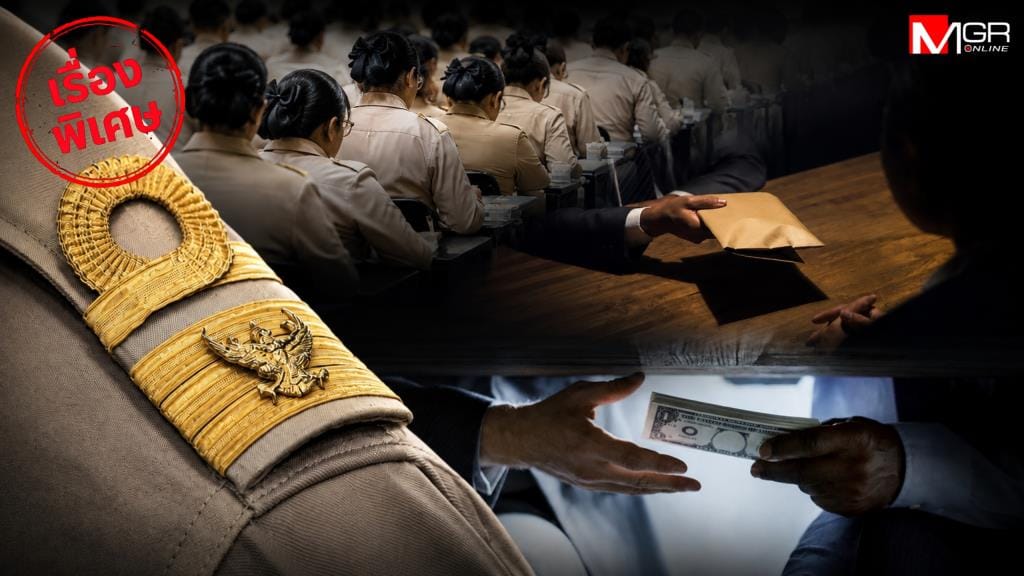
The outsourcing procurement budget worth hundreds of billions of baht per year does not merely destroy the quality of workers' lives — it also becomes the "corruption feeding pipeline" that is hardest to scrutinise, operating through a three-stage deduction equation.
• Stage 1 — Locking the TOR specifications: Procurement committees use their discretionary authority to write TOR specifications that are rigged to ensure that nominee companies or private firms within the networks of senior civil servants win the tender.
• Stage 2 — Cutting commissions and kickbacks: The Budget Bureau allocates a service contract budget at a rate of 15,000–18,000 baht per person per month. But once the outsourcing company receives this budget, it deducts profit and management fees of 15–20%, and then pays an "under-the-table kickback of 10–15%" back to the senior civil servants and the work-inspection committee members, in exchange for easy work sign-offs and the renewal of the contract in the following year.
• Stage 3 — Squeezing on-the-ground labour: The final portion of taxpayer money that actually reaches the hands of the employees doing the real work has been squeezed down to just 9,000–11,000 baht per month, with no welfare benefits remaining whatsoever.
Worse still, this cycle also creates an opening for "ghost employees": private companies collude with work-inspection committee members to submit budget claims for the full amount specified in the contract — for example, claiming payment for 100 contracted positions while in practice sending only 70 people to work on site. The budget for the remaining 30 ghost positions is then split fifty-fifty between the private company and the civil servant who signs off on the work inspection.
The government of Prime Minister Anutin Charnvirakul's plan to reduce 30,000 permanent civil service positions is therefore not a reform of the bureaucratic system to improve fiscal efficiency — it is merely an exercise in "opening the national budget safe" so that taxpayer money can be collectively siphoned off through the loopholes of service contracting, wrung cold-bloodedly from the labour and sweat of 1.28 million low-level working people.
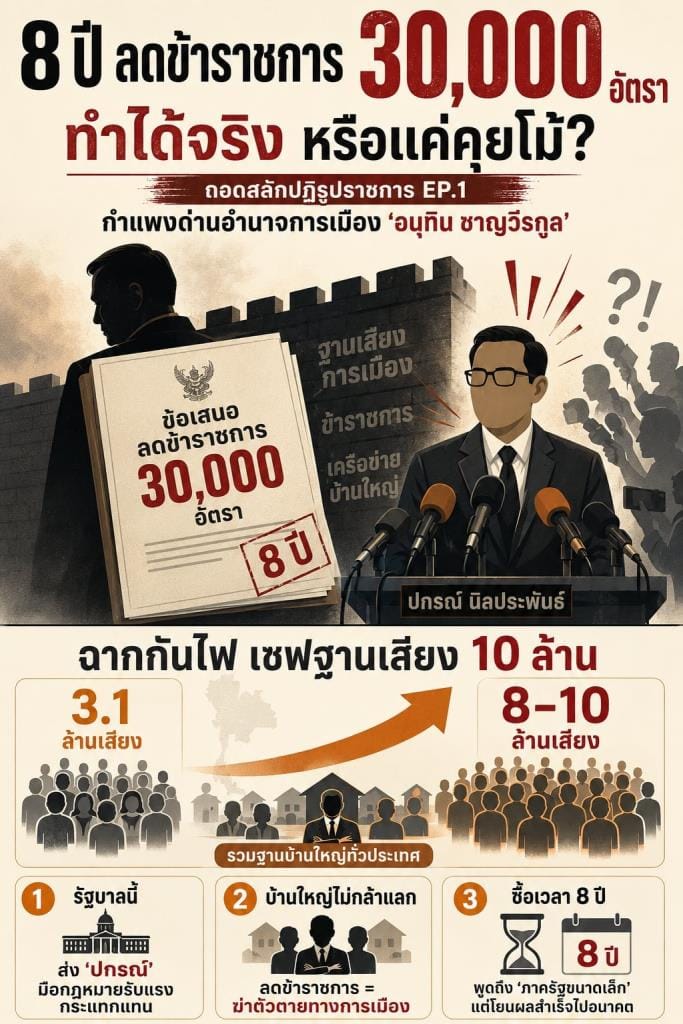
Read back >> Unpinning Bureaucratic Reform EP.1: 8 Years to Cut 30,000 Civil Service Positions — Is It Real or Just Hot Air?