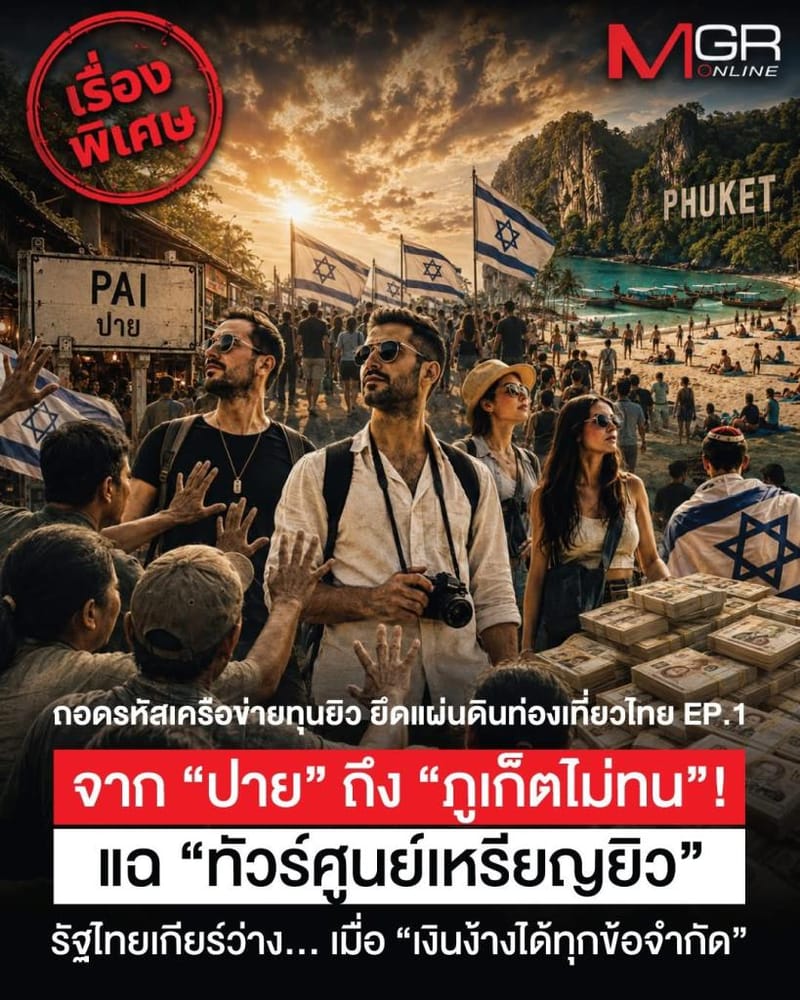
Series: Decoding the Israeli Capital Network Seizing Thailand's Tourism Landscape — EP.1: From "Pai" to "Phuket Won't Tolerate It"! Exposing the "Zero-Baht Israeli Tour" Racket — Thai State in Neutral… When "Money Can Bend Every Rule"
Decoding "Zero-Baht Tours 2.0, Israeli Edition" — from Pai to Phuket! An in-depth look at the shadow economy operating beneath the state, exposing nominee schemes hijacking tourist towns, as the Thai state sits in neutral and money bends every rule.
The fierce wave of backlash against the inappropriate behaviour of Israeli tourists in Phuket — Thailand's world-class tourism hub — is not merely a daily drama of clashing personalities. It is a warning signal that has escalated into a crisis of "intolerance" among the Thai people, at a moment when state authority has disengaged and the comfort of foreign visitors is always placed first.
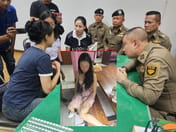
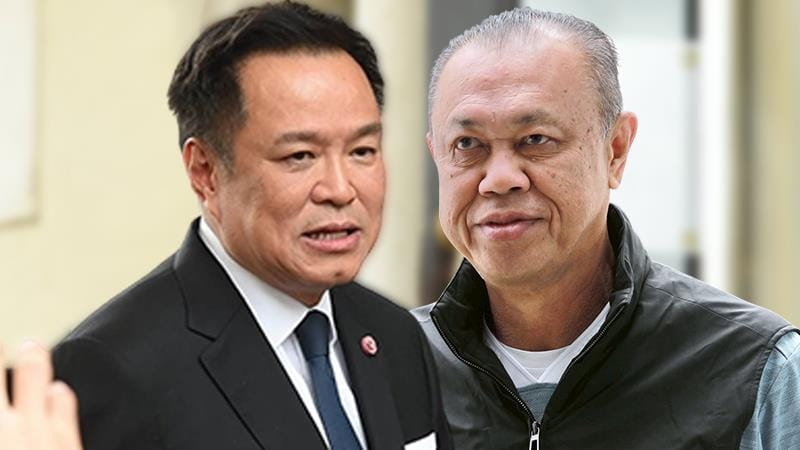
Images of shops in the heart of Patong putting up "No Israel" signs, protest flags planted in defiance of arrogant conduct, and the rallying of residents and local business operators under the banner of the "Protect Phuket Homeland Group" — led by Mr. Saichon Nuchet, together with Mr. Chalermphong Saengdi, a Phuket MP — who marched to submit a complaint to Patong Police Station and launched a large symbolic rally at the Dolphin Public Park on Patong Beach, all of this was done to shout a message to the government: Thai people will not accept intimidation, non-payment, arrogance toward the local community, or the move to take over the tourism business from top to bottom.
The big question the Thai government must answer to society is: how did what began as individual behavioural issues develop and spread into a city-wide wave of resistance?
The answer is that Thailand is being infiltrated by a "parallel economy" — also called a "closed-money empire" — in which foreign capital does not simply come to visit and leave, but instead lays down a network to seize the entire trade chain, from accommodation and restaurants to car rentals and tour guides, cutting local people out of the income circuit. This mirrors the old nightmare of zero-baht tours, but is far more sophisticated and far more deeply entrenched.
Decoding the "Hummus Trail": From "Pai" to 4 Key Hot-Spot Locations
Viewed through a social-science lens, this phenomenon is not unique to Thailand. It is part of a global behavioural network known as the "Hummus Trail" — the travel route of young Israelis after completing military service, who typically embark on extended stays abroad to decompress from the wounds of war, gravitating toward nature-focused tourist towns with low costs of living and lax local law enforcement.
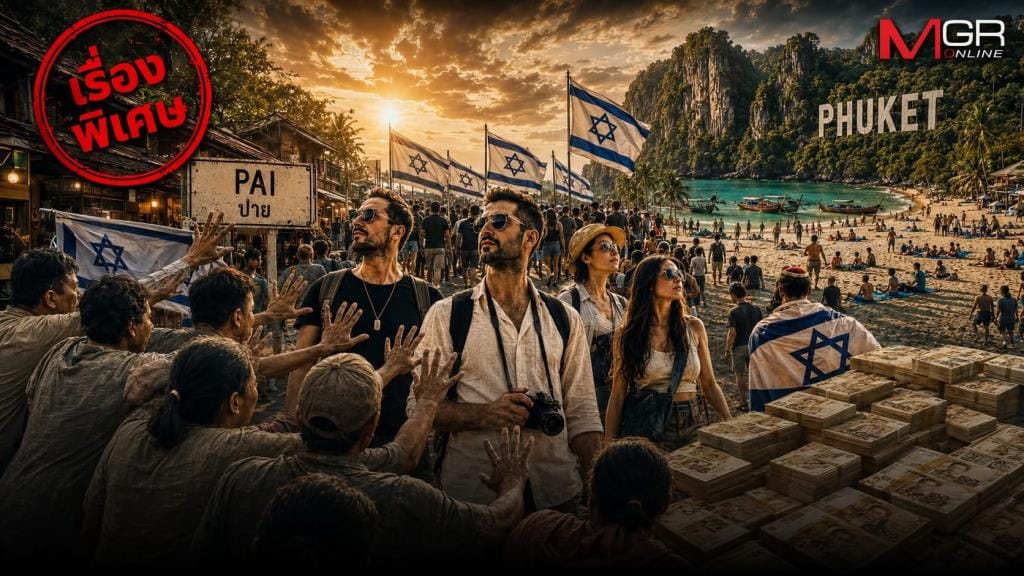
From the "Mini Israel" in the Parvati Valley in India to Arugam Bay beach in Sri Lanka, Thailand has become "the largest revolving destination in Southeast Asia." The process began with the establishment of the "Pai Model" in Pai District, Mae Hong Son Province, before the network spread its influence and expanded across the country through 4 key hot-spot locations:
• 1. Pai District (Mae Hong Son) and Chiang Mai Province — The War-Wound Recovery Zone. Role: A territory taken over by foreigners as a "safe-zone for psychological rehabilitation" to release accumulated stress after combat. It began with the establishment of Chabad House centres, then expanded into a Hebrew-language enclave complete with hostels, kosher restaurants, and service businesses where money circulates exclusively within the group.
• 2. Bangkok (the Rambuttri–Phra Athit area and Sukhumvit) — Entry Point and Foreign Capital Coordination Hub. Role: A travel interchange and business coordination point; the first port of entry into the country, a centre for cash and digital asset exchange, and a place to arrange the registration of front companies before dispersing upcountry.
• 3. Koh Phangan and Koh Samui (Surat Thani) — Health and Wellness Zone and Long-Term Family Base. Role: A zone for long-term family relocation, with prime locations such as Ban Tai and Sri Thanu occupied. There are reports of illicit "informal schools / foreign children's learning centres" being opened, along with health and yoga service establishments, and the formation of self-organised neighbourhood security patrols that disregard Thai authorities.
Koh Phangan in particular was once referred to as a "Second Tel Aviv."
• 4. Phuket Province (Patong / Rawai / Chalong) — Luxury Real Estate Hub and Underground Foreign Business Centre. Role: The destination for premium property investment; a centre for the buying and selling of pool villas and condominiums, and a hub for closed-circuit tourism businesses that have bought up enterprises from local people through a large-scale nominee network.
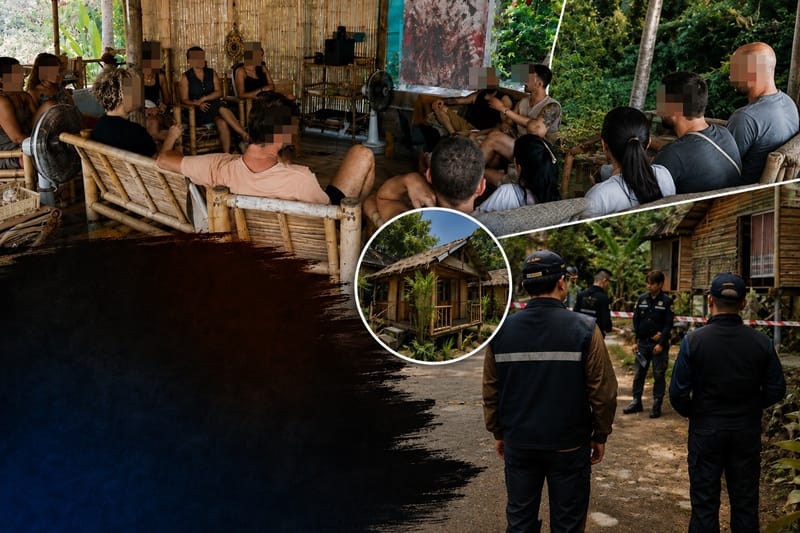
One clear example of this is "David's Circle," an Israeli mental health rehabilitation centre on Koh Phangan, Surat Thani Province.
The centre previously made headlines in October 2025, after reports emerged that it was a recovery space for veterans, survivors, and those psychologically affected by the events of 7 October and the war in Gaza, using non-medical therapeutic approaches such as psychological support, artistic expression, and community-building activities. The founders claimed that more than 700 Israelis had participated in the therapy.
However, its operations were called into question regarding its legal status, its use of the premises, and its business activities, alongside allegations that Thai nationals were being used as "nominees" to hold land titles and operate the business.
A source from a government agency on Koh Phangan disclosed that the relevant authorities had been investigating the premises since 2025. At that time, the site was found to be operating as a yoga teaching space, renting the premises from Thai nationals. However, after a joint force of officials conducted an inspection, the premises closed down and had been left abandoned since 2025.
Then, last Friday, multi-agency officials conducted another joint inspection of the premises following online reports. The inspection found that the site had not reopened as a mental health rehabilitation centre. The premises had changed to a new tenant — preliminary information indicates they are Italian nationals — who are renting part of the space to operate a bungalow business.
As for Phuket, Mr. Saichon Nuchet, representative of the Protect Phuket Homeland Group, provided information that, to his knowledge, Israeli tourists currently travel directly to Phuket from Tel Aviv three flights per week. Upon arrival, Israeli tourists disperse to various areas of Phuket, but the majority gather for religious observance at Chabad Patong.
Upon arriving in Phuket, this group of tourists stays at and uses services that are Israeli-owned — including hotels, restaurants, transport services, tour services, and others — because Israelis have come in to buy or lease hotels in Phuket and operate them as Israeli-owned businesses. Tourists then stay at these Israeli-owned hotels, which are marketed and booked directly through Israeli-operated platforms.
For example, in Patong, Israelis have come to lease or purchase hotels along Rachautit 200 Pi Road, also known as the Soi Song of Patong, around the Chabad area, where they have opened hotels, restaurants, tour agencies, and car rental services to cater to Israeli tourists.
In addition, the Kamala area is another location popular with Israeli tourists for accommodation. One source stated that in the Kamala area, Israeli tourists come to rent villas or pool villas and stay at various hotels — not renting entire villages. Some of these Israeli tourists show little respect for the local community's way of life; some have even lodged complaints about the Muslim call to prayer from mosques in the area — mosques that have coexisted with the community for a very long time — claiming the sound disturbs their rest, despite the community having practised its faith there for generations.
When "Money Can Bend Every Rule"
What is it that allows these "closed-money empires" to grow and expand so rapidly? The short but deeply cutting answer is: "the state of money being able to bend every rule" within the Thai bureaucratic system.
From in-depth investigations and on-the-ground scrutiny in Phuket and Koh Phangan, the rot of the legal-camouflage operation has been laid bare — carried out with considerable sophistication:
First — the "Security Guard Nominee on 14,000-Baht Salary" scam: Foreign capital uses the names of hotel security guards, housekeepers, or shop employees earning only 10,000–14,000 baht per month to act as paid Thai shareholders holding a 51% stake in company registration documents. These employees have no actual capital, no knowledge of the business, and not the slightest administrative authority, yet their names are used as fronts to open companies operating pool villa rentals, car rental activities, and travel agencies.
Second — the "ID Card Starting with the Number 8" operation: This is the most alarming dark-network scheme. From an X-ray of the Phuket Provincial Commerce Office database — which found more than 6,000 companies flagged as high-risk nominee entities — tip-offs have revealed that persons holding "identity cards for individuals without Thai nationality" (cards beginning with the number 8), who have obtained naturalisation or residency rights, are being recruited to serve as directors and major shareholders in foreign companies, with a single individual appearing as a shareholder in as many as 5 to 19 layered nominee companies.
The question is: what are the local administrative authorities, police, and commerce officials doing? And why does this policy deadlock exist? While the Thai government depends on sending Thai agricultural workers to Israel and maintains a relationship of diplomatic deference, operational-level officials on the ground choose to "sit in neutral" — turning a blind eye, succumbing to under-the-table money — and allow zoning laws, business licences, and the Foreign Business Act to become nothing more than meaningless scraps of paper.
3 Structural Dimensions Undermining Thai Society
If society continues to view this issue as merely "drama news about people quarrelling," Thai society will fail to see the three structural threats that are steadily creeping in and eroding Thai society and national security:
1. War-Wound Economy — Post-Combat Accumulated Stress: Thailand is becoming a "war-wound absorber economic zone," allowing former soldiers carrying "post-combat trauma" to come and form aggressive clusters in tourist towns. The behaviour that results is expressed as aggression, the creation of insular guard groups suspicious of outsiders, and a posture of self-appointed dominance — with the Thai government possessing absolutely no screening or management mechanism whatsoever.
2. Importing Cross-Border Conflict: Allowing large parallel communities to take root risks transforming Thailand's peaceful tourist cities into "symbolic targets" for opposing conflict factions. The burden of security management and counter-terrorism surveillance then falls on the taxes of the Thai people.
3. Displacement of Local People: The phenomenon is driving land prices, rents, and the cost of living up sharply. Local residents and small Thai business operators are being priced out and pressured into transferring their businesses to foreign investors. Ultimately, Thai people in these areas are reduced to being mere "cheap labour" — wiping tables and washing dishes — in their own homeland.
This covers only the social-science dimension and the physical occupation of space… But how do they move enormous sums — billions of baht — into Thailand to buy up Thai land without Thailand collecting a single baht in tax, and what enormous consequences does this create?
Stay tuned for EP.2: International Money Laundering Paradise! Dissecting the Israeli Money Laundering Mechanism Seizing Thai Land — Pressuring the State to Settle the Bill Before the Country Is Lost!