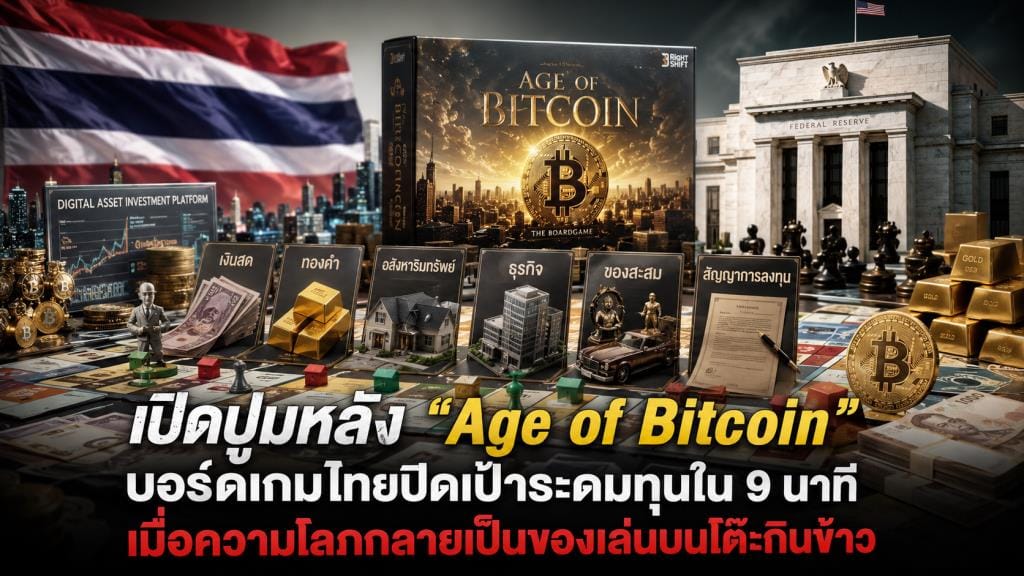
Imagine an idea born from one board game enthusiast's personal obsession ending up as a phenomenon that raised eleven times its target in less than a month. This is no fiction — it is the true story of "Age of Bitcoin," a board game crafted by Thais that has made both the crypto world and the board game community sit up and take notice.
**The beginning: when a board game fanatic and a Bitcoin fanatic meet — in the same body**
Behind this game is BitToon, one of Thailand's well-known crypto influencers, owner of a page with more than 185,000 followers, and a Thai crypto enthusiast with a genuine passion for both Bitcoin and board games. The starting point was not complicated. He had always collected and played board games, and one day a simple question floated into his mind: why had no one ever created a board game specifically about Bitcoin? At the time it was just a vague thought — until he came across a project competition at the Thailand Bitcoin Conference in 2024, assembled a team, built the game in earnest, and walked away with the top prize from that stage.
From that point, BitToon partnered with game studio Four Comma Game to develop and complete the project. The game was playtested by both general board game players and genuine Bitcoiners before its official debut at a preview event in mid-June 2025, supported by Bitazza, one of Thailand's major digital asset trading platforms.
**Opening the box: how this game is played, and why it is not just Monopoly in a crypto costume**
The game's story begins in 1971 — the year the world departed from the gold standard, inflation began its climb, and the cost of everything kept rising — until 2009, when Bitcoin was born. At first it was overlooked, laughed at, and even used to buy pizza, before people gradually started paying attention, studying it, joining in, holding their coins tight (HODL), until it was finally recognised as digital gold. And that is the point where the "Age of Bitcoin" — as the game's name suggests — begins.
Players take on roles from various professions and must accumulate wealth through seven types of assets: cash, gold, real estate, business, collectibles, investment contracts, and Bitcoin. The game uses a Worker Placement system, supports one to four players, and includes a solo scenario mode. Each session takes approximately 30 minutes per player and is suitable for players aged 14 and above. A much-discussed feature is the asset price board, designed as a magnetic candlestick chart — something the Thai crypto community has widely credited as the first Bitcoin-themed board game to use this mechanism.
What sets this game apart from being merely "Monopoly in a crypto costume" is a system far more intricate than that. According to in-depth reviews from international board game websites, every asset has its own "Hype Track." The more players buy and sell, the higher this track climbs, and when it peaks, a bubble bursts immediately: Bitcoin's price drops two steps, gold's price moves up, and every player loses one step of credibility in that asset. Crucially, the bubble in this game is not triggered by a random card draw or a dice roll — it is caused purely by the players' own actions. The greedier you are, the faster you accelerate the crisis. It is a painfully accurate simulation of real crypto market psychology.
**The night the goal was hit in 9 minutes — a phenomenon nobody saw coming**
On 21 July 2025, Age of Bitcoin officially launched its Kickstarter campaign with a target of just USD 10,000. The team announced via social media that the campaign hit its funding goal within just nine minutes of going live. When the campaign closed on 20 August 2025, total funds raised had surged to USD 117,519 — or 1,175% of the original target — from 1,025 backers, averaging USD 115 each. Those numbers make it clear that this was not a passing trend but a market with genuine demand.
The team further amplified their marketing by offering a special "Satoshi Nakamoto" character card, valued at USD 6, for free to anyone who backed the project within the first 72 hours — a strategy that proved effective with a target audience already well-versed in crypto culture.
**Perfect timing — when the Thai government gave the green light at the same moment**
What makes this particularly interesting is that the game's launch coincided with a major policy development. In mid-June 2025, the Cabinet resolved to exempt individuals from personal income tax on capital gains from digital asset sales conducted through operators under the supervision of the Securities and Exchange Commission (SEC), covering the period from 1 January 2025 to 31 December 2029 — a five-year window. The Deputy Finance Minister stated that Thailand is among the first countries in the world to have clear tax measures on digital assets, with the aim of attracting foreign investment and stimulating domestic consumption.
In simple terms: just as the government was rolling out the red carpet to energise the Thai crypto market, a board game speaking directly to that subject launched at exactly the same moment. Whether this was coincidence or an astute reading of market timing by the team is open to debate. Either way, it has made Age of Bitcoin something more than just a toy — it is a reflection of an era in which digital assets are officially entering the mainstream of Thai society.
**Voices from foreign reviewers: this game is not easy, and it is not for everyone**
Despite its strong crowdfunding performance, when the game reached the hands of international reviewers, the feedback was candid and unsparing. International board game review sites noted clearly that this is a highly complex game, not one to recommend for a casual evening with friends. And if a player misjudges the moment and holds more assets than they can manage, they can fall behind very quickly. Reviewers concluded that this is a game that rewards adapting when plans fall apart, more than perfecting a strategy from the outset — which will sound very familiar to anyone who has ever actually traded crypto.
**An angle worth probing: does this game teach real lessons, or is it just riding the FOMO wave?**
The question that financial journalists like us always set as our benchmark is this: "A board game that simulates greed and bubbles this realistically — is it serving as a financial literacy tool, or is it making a culture of speculation seem a little too fun and adorable?" It must be acknowledged that the mechanism which lets players see that bubbles burst because of their own actions — not fate — is a rare educational strength among economy-themed board games in general. It teaches you to visualise how FOMO in the real market arises from collective behaviour, not from some mysterious force.
But on the other hand, the fact that a major crypto brand like Bitazza stepped in to sponsor the launch event, and that the game was promoted in subtle tandem with news about the government's tax measures, cannot conceal the faint scent of embedded marketing designed to broaden enthusiasm for digital asset investment at the same time. Novice investors who play this game and find themselves caught up in the excitement of speculation must be able to distinguish between the fun at the game table and the real risk in their wallets — they are entirely different things. Money lost in the game is points; money lost in the real market is real money.
**From one person's idea to Thailand's crypto cultural export**
Whichever angle you view it from, what cannot be denied is that Age of Bitcoin has proven that an idea born from one Thai person's personal passion can grow far enough to draw money from collectors around the world. From a small competition stage at a crypto conference in 2024, to a thousand-percent crowdfunding phenomenon in 2025 — this is a case study worth watching for what it reveals about how the Thai board game world is moving in step with the country's digital asset wave. And the real question still waiting for an answer is: as this board game reaches more and more Thai players, will it become a tool that builds financial immunity — helping Thais see through bubbles — or will it simply become yet another impulse pushing people to jump into the market without truly understanding the risks?