Manager Online — It's perfectly normal to forget what your ex looked like, but why is it that the scent of a Thai nasal inhaler is impossible to forget? We dive deep into the world of Sensory Design, tracing how an ordinary household remedy became a secret item for the new generation — before uncovering the full story behind the five-billion-baht nasal inhaler war among four industry giants, set against the emerging Functional Inhaler trend. Twist open the cap and find out why foreign countries have nasal inhalers too, yet none can compete with Thailand's — to the point that it has become a Soft Power shaking the world.
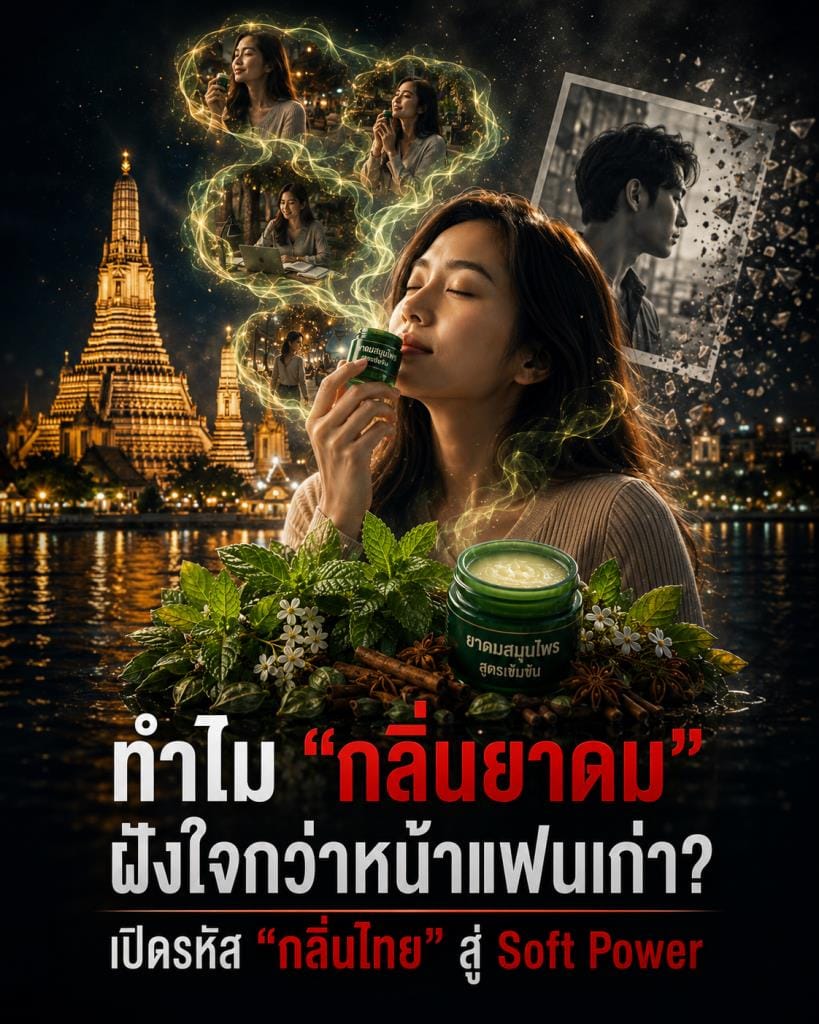
It's an undeniable truth… the face of a former lover may fade with time, but let just a whiff of that familiar cool scent from "the same old nasal inhaler jar" drift by, and memories and emotions from days gone by come crashing back instantly. This is no dreamy sentiment like the song "Klin Khwam Rak" (The Scent of Love) — it is a hard reality in which the smell of a nasal inhaler hits us with full force.
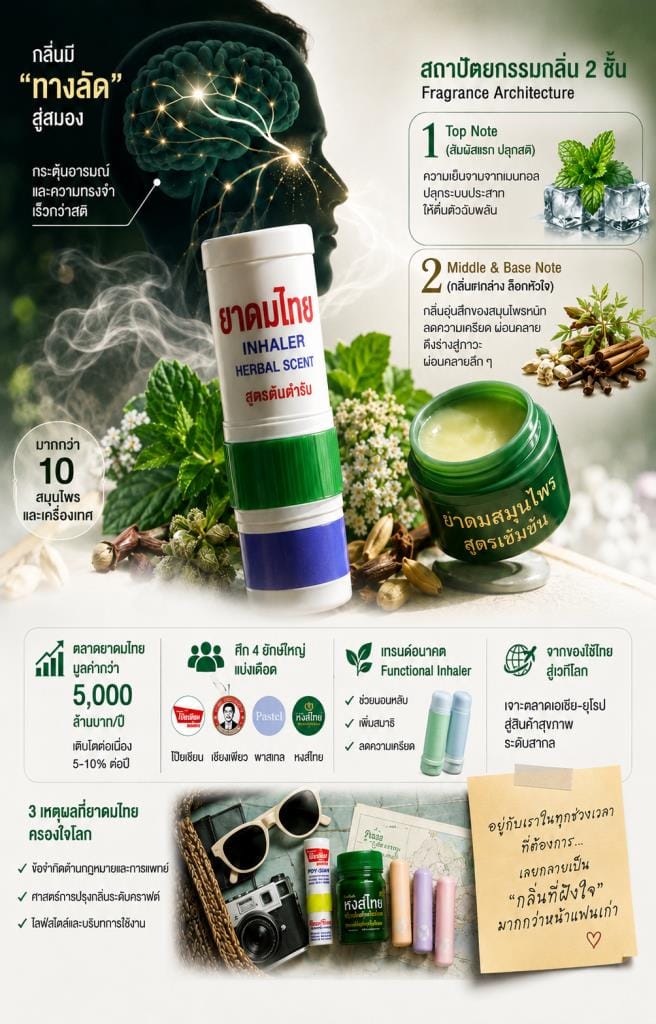
The reason a nasal inhaler's scent is lodged more firmly in the mind than any mental image is that "scent has a direct shortcut," shooting straight into the brain's centers for emotion and raw memory without having to pass through the analytical thinking regions the way facial recognition does. Scent-based memories therefore operate faster than conscious thought — especially memories tied to emotion and personal experience. To put it in simpler terms, scent may not always work "faster than conscious awareness," but it is intimately connected to the systems governing emotion and memory, and so it can retrieve images linked to past experiences with remarkable power.
What is even more remarkable is that Thai nasal inhalers have been engineered to "lock in" those memories through the science of Sensory Design — through a calculated blend of more than ten herbs and spices, including borneol camphor, camphor, peppermint crystals, cloves, cardamom, and Mimusops elengi blossoms — giving rise to a two-layer Fragrance Architecture:
1. Top Note (the first touch that awakens the senses): A bracing, satisfying coolness from menthol that surges in and jolts a drowsy nervous system into sudden alertness.
2. Middle & Base Note (the lingering scent that locks the heart): As the cool rush begins to subside, the deep, warm aroma of fermented herbs slowly reveals itself, helping to lower stress hormones and drawing the weary body into a state of Deep Relaxation.
Because the scent of a nasal inhaler has a shortcut into the brain and is crafted with a subtly complex fragrance architecture, it does not merely serve to relieve dizziness from heat — it becomes an instrument of emotional comfort, sending a signal to the brain each time that says "this place is safe now." It is a sense of reassurance that entices us into fondness, drawing us back for repeated sniffs, until it becomes a scent embedded deeper in us than the face of any former lover.
Looking more closely, in Thailand the nasal inhaler is not merely a product for relieving dizziness — it is a business battlefield worth more than five billion baht per year, a sizeable slice of Thailand's herbal industry. With average repurchase frequency running at one to two sticks per month — driven partly by the habit of losing the inhaler itself, or losing its cap — combined with the accumulating stress of modern life, the nasal inhaler market has grown by leaps and bounds and is fiercely competitive.
For some time the nasal inhaler market has been a Red Ocean with deeply entrenched incumbents, but it is now being disrupted by new players who have carved out clearly defined segments of their own. The legendary heritage brand "Poy Sian" (Gold Mint Products Co., Ltd.) continues to hold the traditional market throne, commanding more than half of the stick inhaler segment through a strategy of accessible pricing, a distribution network that reaches every shop across the country, and a brand image long embedded in the lives of Thai people. This year, Poy Sian has also begun to make more moves to attract new customer groups, stepping up its marketing activity through mystery boxes, collectible new packaging, and collaborations with other brands for fun joint projects.
Earlier, Dr. Nattaphong Lapbuntap (known as Khun Ton Khun), the fourth-generation heir, revealed that before COVID-19 there were no more than ten key players in the Thai nasal inhaler market, but today new entrants and lifestyle brands have flooded in, totaling more than forty brands. As a result, the value of the nasal inhaler market has soared — the top five brands alone account for nearly five billion baht — and the market is expected to continue growing at no less than five to ten percent for at least another five years.
As for the financial performance of "Poy Sian" as the market leader, it achieves annual sales approaching one billion baht and net profit exceeding 500 million baht per year. The company targets steady growth of five percent per year, driving the organization toward becoming a 100-year Thai nasal inhaler brand, expanding into international markets alongside operations grounded in innovation and environmental responsibility (CSR) for sustainable social benefit.
There are also major players such as "Siang Pure" and "Peppermint Field" (Bertram 1958 Co., Ltd.), regarded as the premium and lifestyle players holding the second-tier market share. They target Gen Z and younger consumers, highlighting their innovation of a slide-cap inhaler that prevents cap loss, paired with gentle aromatic scents. Combined revenue across all their brands runs at no less than 1,900 million baht per year.
Following closely is the fast-rising newcomer "Pastel" (Multiply by Eight Co., Ltd.), a modern design brand under the King Power group that has transformed the nasal inhaler into the ultimate cool portable gadget, leading with minimalist design and enlisting top global celebrities for promotions — driving revenue that has already leapt past 1,200 million baht.
And one that cannot go unmentioned is "Hong Thai" (Hong Thai Thai Herbs Co., Ltd.), the king of fermented herbal nasal inhalers, the brand that fired the starting gun for the herbal inhaler market and spawned a wave of imitators — so many that they could fill an entire mythical forest. Crucially, "Hong Thai" is the pioneer of the green-jar inhaler, championing an intense, deep, satisfying herbal scent that went viral through top-tier global K-Pop idols, propelling annual revenue to more than 360 million baht today.
Looking ahead, driven by the fever surrounding Thai nasal inhalers, the market is expected to shift from simple dizziness relief toward specialized Functional Inhalers — such as sleep-aid formulas, focus-boosting formulas for work, or anxiety-reduction formulas. This will also involve an elevation from being merely a "Thai souvenir" to an internationally recognized health product, targeting Asian and European markets that are broadly embracing the Wellness trend.
Meanwhile, the opportunity for Thai nasal inhalers in overseas markets is drawing increasing attention. The key reasons why "Thai nasal inhalers" have exploded in popularity worldwide — even though nasal inhalers are sold in other countries, such as Vicks VapoInhaler in France and America, and menthol inhalers in Japan and China — may not be solely a matter of Soft Power. There may be three important reasons:
1. Legal and medical constraints. In many countries, nasal inhalers are positioned as products for relieving respiratory conditions, or are products whose ingredients and usage are governed by laws that vary from country to country — in some cases available only with a doctor's prescription. That said, there are also many countries, such as the United States, where both OTC nasal inhaler products and the current Vicks VapoInhaler exist — with the manufacturer explicitly describing the latter as a "non-medicated nasal inhaler" intended for inhaling menthol and camphor vapors for refreshment, not for treating colds or influenza.
2. The craft of scent formulation. Many Thai nasal inhaler formulas blend menthol, camphor, borneol camphor, and multiple essential oils or herbs, creating a scent experience that differs from brand to brand and formula to formula. Nasal inhaler products abroad also carry a variety of formulas. Thailand's distinction, therefore, lies more in the uniqueness of its formulas and the culture of use than in any other single factor.
3. The shift into lifestyle. The truly interesting point about Thai nasal inhalers may not be that "Thailand is the only country with nasal inhalers" — because in reality many countries have comparable products. Even Japan has nasal inhaler products that use menthol and essential oils for freshness and are presented as items for use during work, study, or everyday activities. What is more compelling is the question of "context of use" in Thailand: the nasal inhaler has been turned into an item that is widely carried on one's person and used freely in daily life. At the same time, a number of Thai brands have expanded beyond the image of an herbal product into design, fashion, lifestyle, and pop culture. When combined with the fact that foreign tourists and international celebrities have adopted and shared them, Thai nasal inhalers now stand a strong chance of being remembered as one of Thailand's contemporary symbols of Soft Power.
Ultimately, the success of the "Thai nasal inhaler" may not stem solely from the coolness of menthol, but from the fact that it has woven itself into the "feelings" of Thai people — transitioning from an ordinary household item to an object carried through days of exhaustion, stress, dizziness, or simply moments when one just needs to pause for a breath. And when that feeling is carried forward through design, lifestyle, celebrities, and culture alike, it is no surprise that the small jar that was once simply "ya dom" has gradually become a product the world recognizes by the name "Thai nasal inhaler."
"…Because sometimes the reason we remember a nasal inhaler more vividly than our ex's face may not be because that scent is the most beautiful — but because it was with us in the moments when we needed it most."