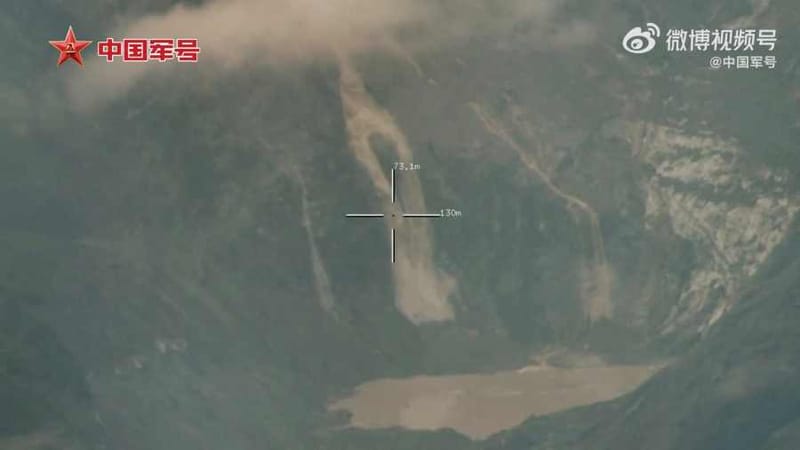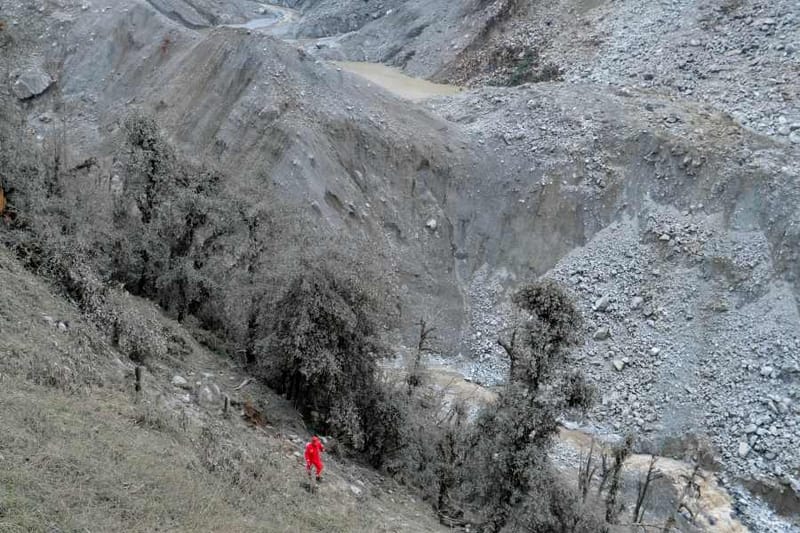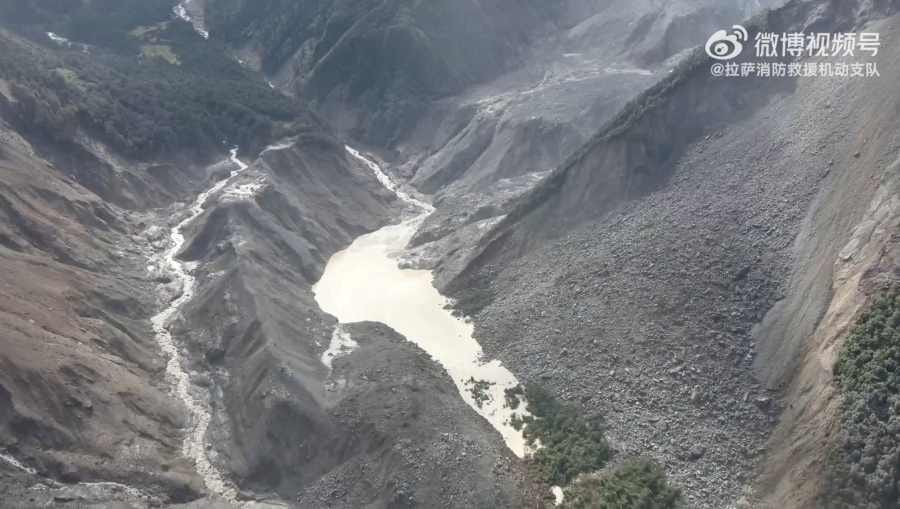
Rescue teams operating along the border between Nepal and China's Tibet temporarily suspended operations on Friday (28 Aug.) due to fears of a repeated flood or mudslide risk from a "barrier lake" — also described as a "debris lake" — with a surface area equivalent to a combined 1,000 Olympic swimming pools.
The so-called "barrier lake" or "dammed lake" emerged in the aftermath of a mudslide and flash flood that struck the Nepal-China border crossing on Wednesday (26 Aug.).
China's Ministry of Water Resources announced on 27 Aug. that officials had been closely monitoring the risk of the barrier lake bursting and had activated Level 4 emergency flood response measures. By the morning of Thursday (27 Aug.), the barrier lake had already accumulated approximately 2 million cubic metres of water, and inflows were expected to rise to 3 million cubic metres over the following three days due to continuous rainfall.
The barrier lake that formed after the mudslide is a large body of water pooling debris from the landslide, making it a "debris lake" that functions like a "natural time bomb."
Reuters, citing eyewitnesses, reported on the moment rescue teams suspended their work: helicopter rescue operations in Nepal's flood-hit Rasuwa district came to an abrupt halt, and local residents rushed uphill after reports emerged that water in the lake had begun to flow out.
China Central Television (CCTV) reported on Friday that water in the newly formed lake had begun to overflow, creating renewed risks of flash flooding or mudslides, and that rescue teams had been ordered to pause operations upon being notified that the lake had started to release water.
However, rescue teams resumed work a few hours later once the risk had dropped to a "manageable" level.
China had dispatched a monitoring team to the barrier lake located upstream, 10 kilometres from the Jilong border crossing in Tibet.
The monitoring team told CCTV reporters that the lake stretches 150 metres in length and stands 40 to 50 metres high.
"The rocks and soil in the area are unstable… during the situation assessment operation, multiple secondary collapses occurred above the barrier lake," Chen Hanxiao, a member of the China Anneng Engineering Rescue Lhasa Base team deployed to monitor the barrier lake, told CCTV.
Chen said the safety monitoring team at the site would "withdraw immediately" if any significant signs of movement were detected.
The main concern regarding changes to the barrier lake is that ongoing rainfall will continue to raise the water level, increasing the risk of the lake bursting.
Sources: Xinhua, China Central Television (CCTV), CNN