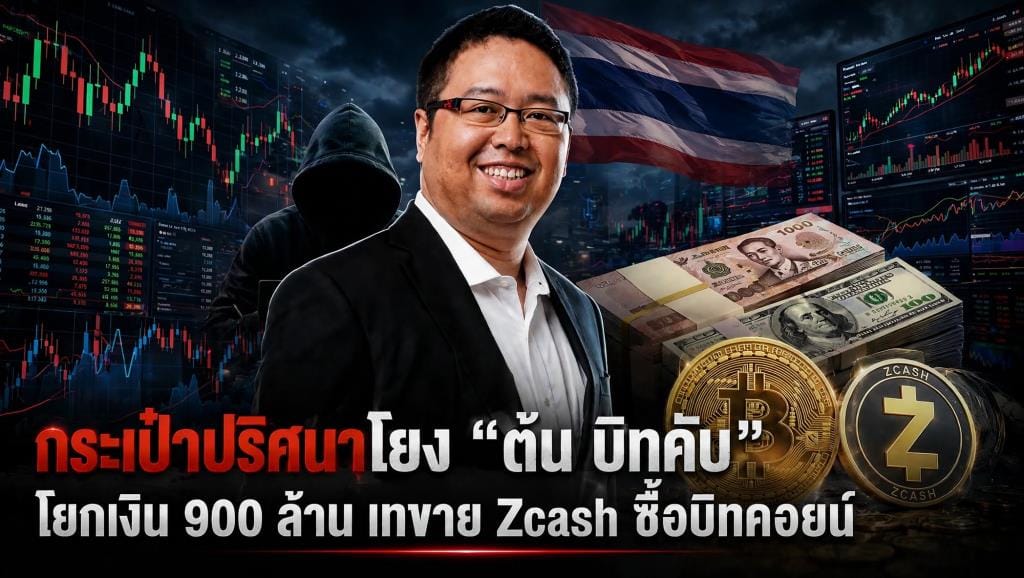
A digital wallet suspected of being linked to Sakolkorn Sakavee, founder of Bitkub, has unshielded privacy features on Zcash (ZEC) coins worth more than 26 million dollars and aggressively sold them in exchange for Bitcoin — just one month after his name was referred by the Securities and Exchange Commission for criminal prosecution on charges of concealing a hacker theft of customer assets worth more than 1.7 billion baht for five months, before he admitted sole responsibility and resigned from all board positions.
No one has officially confirmed that this wallet truly belongs to him, but the timing, the scale of the funds, and the path chosen are telling something to Thailand's crypto market and investors worldwide.
**A Fortune Vanishes, a Privacy Coin Unmasked**
Blockchain analytics firm Lookonchain reported that on 26 August 2026, a cluster of wallets suspected of being linked to Sakolkorn Sakavee carried out a transaction known as "unshielding" — removing the privacy protection on Zcash (ZEC) coins from a pool called Orchard, which is the core mechanism that earns ZEC its designation as a privacy coin. The total amount was 34,100 ZEC, valued at approximately 26.1 million dollars, or around 860 million baht, and the entire sum was transferred into the Hyperliquid platform within less than 24 hours.
The wallet in question then sold 24,000 ZEC, worth approximately 18.5 million dollars or more than 600 million baht, immediately converting all the proceeds into 238 Bitcoin (BTC). The remaining roughly 10,000 ZEC, valued at approximately 7.6 million dollars, remained sitting on Hyperliquid with a pending sell order placed at approximately 780 dollars per coin.
On that same day, the price of ZEC surged to an intraday high of 912 dollars before pulling back slightly, yet still closed up more than 6.2%. Such a massive sell-off therefore did not hammer the price downward as many had initially expected, reflecting that buying interest in the market was still thick enough to absorb this enormous order. Following that, the same wallet continued to steadily unshield additional ZEC from the Orchard pool for further selling in successive waves.
**Who Is the Person Who (Possibly) Stands Behind This Wallet?**
Sakolkorn Sakavee, widely known as "Ton," is the founder of Bitkub, Thailand's largest digital asset exchange, who built Bitkub from a small startup into a unicorn of the Thai crypto world. Its most celebrated milestone was the historic deal in 2021 when Siam Commercial Bank (SCB) announced its acquisition of Bitkub.
Thailand's SEC had issued a notification dating from 15 March 2022, effective from 1 April 2022, prohibiting all digital asset business operators — including Bitkub itself — from providing trading services in "Privacy Coins," or digital assets designed to conceal the identity of senders, recipients, or the amount of transfers, to investors in the country, on the grounds of preventing their use as tools for money laundering and criminal activity.
Zcash is one of the coins that directly falls under this definition, as it features a shielded pool that can hide both sender and recipient and the amount on demand. This means that ordinary Thai investors using Bitkub or any licensed exchange in the country have no way whatsoever to legally trade ZEC through regulated channels.
Yet the wallet suspected of being linked to the very founder of that exchange reportedly holds ZEC worth billions of baht, and chose to use Hyperliquid — a decentralized perpetual exchange with no identity verification, not subject to direct oversight by Thailand's SEC or any regulatory body in the world — as the channel for accessing and converting these coins into cash or other assets freely.
The question that ought to be raised here is not merely "did he break the law?" — because personally holding digital assets through foreign platforms is not directly illegal under Thai law. The real question is one of governance: to what degree should a founder-level executive of an exchange that is prohibited from offering privacy coins to customers be held to a standard of transparency regarding his own personal assets — especially at a moment when he is in the midst of criminal proceedings on charges of concealing information from regulators?
**Why the World Is Drawing Boundaries Around Privacy Coins**
Thailand is not the only country keeping a close eye on this class of coins. Japan banned the trading of privacy coins as far back as 2021, requiring all exchanges to delist them. South Korea banned deposits and withdrawals of such coins in the same year. Australia tightened its rules through anti-money-laundering legislation from 2022. Singapore ordered service providers to stop offering these coins from 2023. Hong Kong followed in 2024. And most recently, the central bank of the Philippines just announced a ban on the registration and trading of Monero and Zcash in June 2026.
The primary pressure comes from the FATF's Travel Rule standard, which requires exchanges to collect and transmit information about the sender and recipient for every transaction above a specified threshold — something that privacy coins are inherently incapable of supporting by their very nature.
Yet on the other side, Zcash has been growing against the tide of bans in a remarkable way. Its price surged more than 358% in the space of a single month, with its total market capitalization overtaking Hyperliquid's own HYPE token at certain points. A key supporting factor was that in early 2026, the U.S. Securities and Exchange Commission (U.S. SEC) closed its investigation into the Zcash Foundation without any enforcement action — a clear regulatory green light. This was followed by Grayscale converting its own nine-year-old Zcash trust into the world's first Zcash spot ETF under the name ZCSH, listed for trading on NYSE Arca, with assets under management of more than 304 million dollars at launch.
In simple terms: while many countries are shutting the door on privacy coins for retail investors within regulated systems, institutional money on the U.S. side has just opened the door for them to enter mainstream capital markets for the first time. This is the paradox of the crypto regulatory landscape in 2026 that Thai investors need to fully understand.
**Why Switch from ZEC to BTC?**
Rotating a portfolio out of a smaller privacy coin and into Bitcoin at a moment when ZEC's price had just surged to an eight-year high above 850 dollars only days earlier reflects the classic behavior of a large investor — taking profits out of an asset that has run hard and has thinner liquidity, and rotating into an asset with deeper liquidity and broader acceptance, namely Bitcoin, which remains the world's number-one digital asset with a market capitalization of over 1.3 trillion dollars and continues to enjoy sustained inflows from institutional investors.
Analysts note that ZEC's technical picture still has some strength, with key support around 746 dollars and resistance at 888 dollars and 1,000 dollars respectively. This means the sell-off has not yet been enough to break the uptrend; it is simply a partial profit-taking by a large holder.
**Before Believing, Before Following the Crowd: What Retail Investors Must Watch Out For**
It must be emphasized once more that the identification of the wallet owner in this case comes from on-chain transaction pattern analysis by the private firm Lookonchain, based on historical wallet-labeling previously associated with this entity. It is not a direct confirmation from Sakolkorn Sakavee or Bitkub themselves, and there always remains the possibility that this type of analysis can be mistaken.
For retail investors, seeing a "whale move" in the news should not be used as an immediate trading signal without careful scrutiny, because ZEC's liquidity is far thinner than that of Bitcoin or Ethereum. A single large movement of funds therefore impacts the price far more sharply than usual, and what appears to be a strategic signal from a big player may simply be personal risk management that has nothing whatsoever to do with any broader market view.
**Drawing Lessons: A Path to a Safer Future**
This case leaves at least three layers of lessons for Thailand's crypto industry to reflect on.
The first layer is the corporate governance of exchange executives. The Bitkub case proves that choosing to conceal critical information simply out of fear of short-term risks ultimately creates a far greater risk in the long run — to the organization's reputation, its fundraising plans, and to the executives themselves. Having independent directors and a system of checks and balances that prevents power from being overly concentrated in the hands of a single person is something that needs to be taken seriously, not merely pledged in a press release.
The second layer is the regulatory gap in cross-border digital asset oversight. No matter how strictly Thailand's SEC bans privacy coins from domestic exchanges, it cannot prevent a Thai individual from holding or trading those same coins through an unregulated overseas platform. This is a major question that regulators worldwide, including Thailand, must urgently work to resolve — particularly when the person doing so holds a special status both as the founder of a regulated business and as a criminal defendant in a case involving the concealment of financial information.
The third layer is consuming crypto whale news with critical judgment. On-chain data is a powerful tool that makes every transaction auditable in retrospect, but interpreting who the wallet owner is and what the intent behind the movement might be still always requires additional verification of the facts. Investors who hope to use such information as part of their decision-making must be able to distinguish between "on-chain facts" and "speculation about identity and intent" — which are entirely different things.
Ultimately, regardless of who the true owner of the wallet turns out to be, this episode is a clear reflection that the crypto industry in 2026 has traveled far beyond simply watching daily coin prices go up and down. It is entangled with corporate governance, the credibility of regulatory bodies, and the thin line between financial freedom and systemic risk — matters that investors, regulators, and even operators themselves must keep firmly in their sights, together, without looking away.