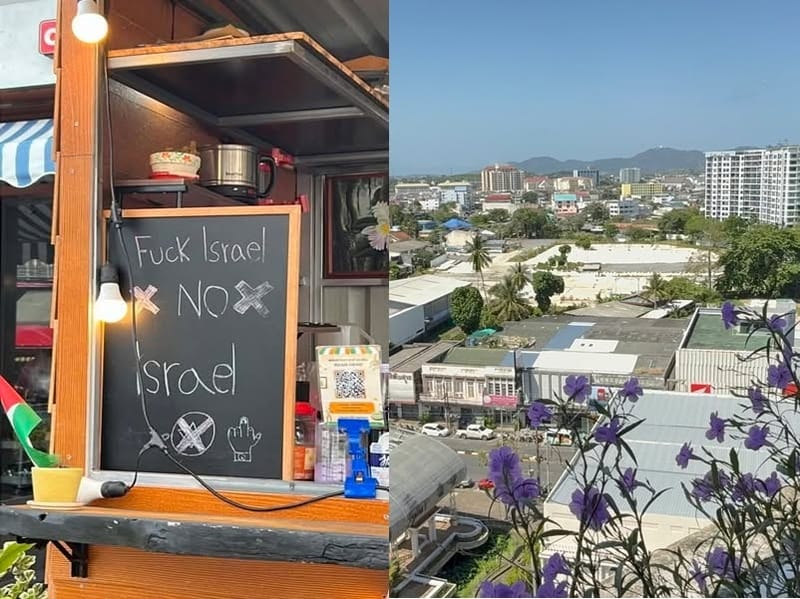
It is almost hard to believe that right now a growing tide of "dislike" toward Israelis — or "Jewish people" — is steadily intensifying to the point where it can be called outright "hatred," particularly among Thais, even if it may be confined to "certain areas" where Jewish communities have settled, such as Phuket, Koh Samui, or Pai district in Mae Hong Son province. This shift is quite a dramatic reversal, because if one looks back just a few months ago — when Israel was waging its military campaign against Hamas in the Gaza Strip on 7 December 2024 — quite a few Thais were still cheering Israel on. Even during the fighting with Iran, a number of Thais still supported Israel, and tens of thousands of Thai workers were employed in agriculture there.
Yet, unbelievably, within just a few months, sentiment has flipped sharply negative. Nearly all the news reports that have come out describe a situation of being "unable to tolerate the bad behavior" of the growing "Jewish community" that has settled in Thailand — their disregard for Thai law — as well as Israeli tourists who visit and tend to behave in much the same way. These individuals not only show disrespect for laws and regulations, but also engage in threatening behavior, until many areas have reached their breaking point and have begun organizing in opposition, such as in Phuket, Koh Samui, and Koh Phangan, among others.
Most recently, an Israeli national's visa had to be revoked after he went so far as to threaten to kill a Thai businessman on Koh Samui. It is believed that in the near future, more movements opposing the "Jewish community" in Thailand will continue to emerge.
According to news reports, a group of Phuket residents have arranged a protest against Israelis on August 28, saying they can no longer tolerate the aforementioned objectionable behavior.
Nonetheless, that is the movement within Thailand reflecting anti-Jewish sentiment. What is also worth watching is that this kind of backlash is occurring in many other places and many other countries — for instance, something similar had previously taken place in Sri Lanka.
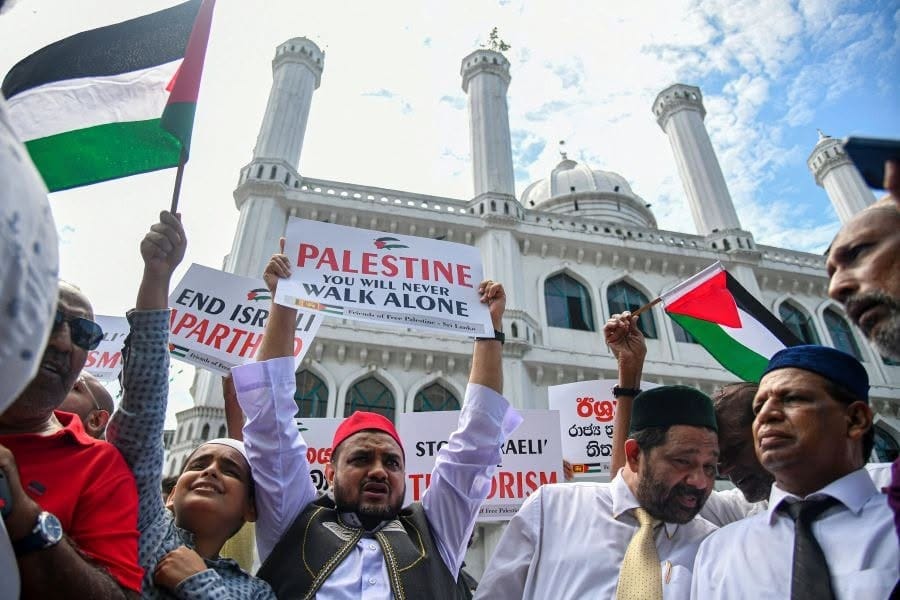
Foreign news agencies reported that in the middle of last month, Sri Lankan monks joined local villagers in the coastal town of Hiriketiya to protest against the presence of Israeli tourists settling there, accusing the Israelis of setting up illegal establishments and disturbing the peace near one of the country's most famous Buddhist temples.
Hiriketiya is a fishing village located in a small bay along Sri Lanka's southern coastline. In recent years, the area has gained considerable fame as one of the country's top surfing destinations.
Most of the residents in the area are Buddhist and belong to the Sinhalese community. There are several temples there, including Wewurukannala Viharaya, an ancient temple built in the 18th century and home to Sri Lanka's tallest seated Buddha statue.
Recently, however, pilgrims and foreign tourists visiting Hiriketiya and surrounding villages have witnessed an influx of Israeli visitors. Earlier this year, a Chabad — a community center and pilgrimage site of Hasidic Judaism — was established there.
This Chabad was set up without authorization and without community consent, fueling the protests. Around 300 people gathered, including monks representing two local Buddhist temples, who joined together in demonstrations over the weekend of August 15–16.
"The influence of Israel is becoming intolerable. Even over minor matters, they pick fights with locals and disturb the peace of this area," one protester stated.
Villagers also recounted that Israeli visitors had set up businesses operating illegally without the necessary licenses, employed fellow Israeli nationals without proper work visas, and discriminated against local residents and other tourists.
The abbot of Tikwela Digawapukaramma Dighawaapi Rajamahavihara, one of the two temples whose monks participated in the protest alongside the villagers, told reporters that allowing the Chabad to remain would worsen the situation.
"We do not want Israeli tourists to come into our area, because their presence disturbs other tourists who wish to visit our land," he said. "The number of other tourists has dropped significantly because Israeli tourists have polluted this place."
This sense of dislike — now turning into "hatred" — is spreading across multiple countries, particularly those that have never had any historical or religious ties to the issue, such as Thailand, or as has just happened in Sri Lanka. These are countries that have, both historically and to this day, welcomed foreign tourists and investors, yet the emotions being expressed like this indicate that people have truly been pushed past their limit.
Even former Israeli Prime Minister Naftali Bennett expressed this sentiment last week, saying that Israel is losing support from the United States and the international community, and warned that the government of current leader Benjamin Netanyahu is failing on every front, amid increasingly severe international isolation resulting from the Gaza war.
Speaking last Wednesday, Bennett delivered a sharp critique of the current government's diplomatic performance and management of international relations, saying that Tel Aviv has now lost "the United States and the broader international community," and warning that the country's standing on the world stage has plunged to its lowest point in history since the nation's founding.
Of course, these feelings toward "Jewish" people or Israelis all stem from their own objectionable behavior. Because if they fail to adapt, respect the laws, rules, regulations, and norms of coexistence in other countries — and continue to take advantage of and look down on local people — they will face ever-greater resistance, and it will ultimately turn into outright "hatred." And if sentiment goes that far, one may yet see Israel cease to exist as a nation once more!!