The Prime Minister has signed the new Prime Minister's Office regulation on deportation, to take effect on 28 August. Tough measures are invoked to deal with foreigners who break the law, restoring peace and safety to society.
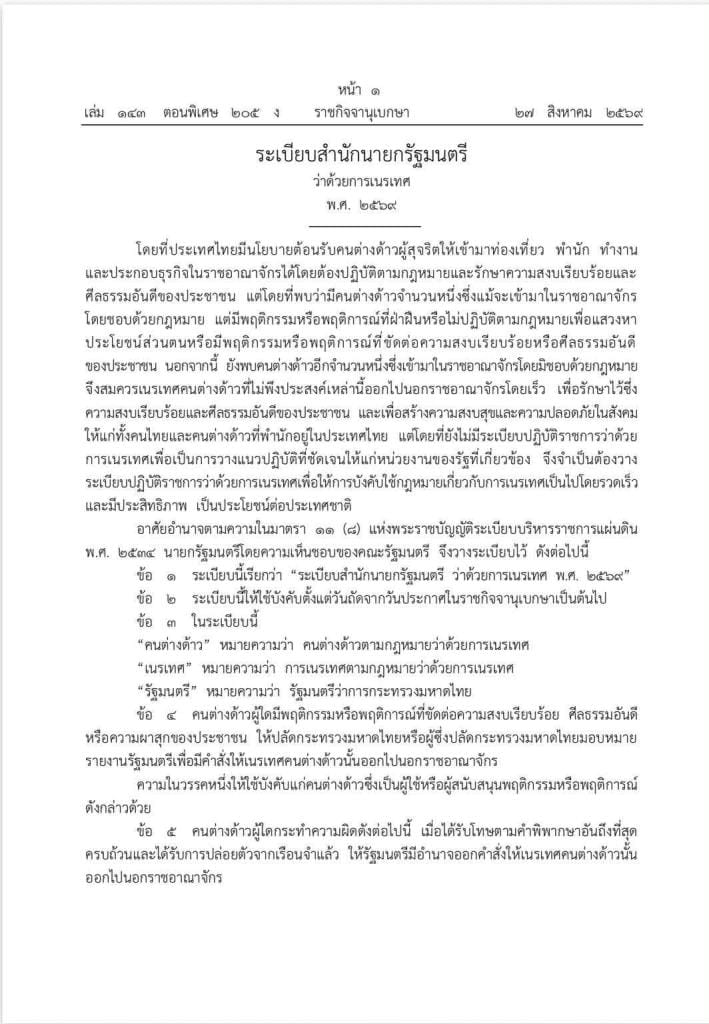
On 27 August 2026, the Royal Gazette website published the "Prime Minister's Office Regulation on Deportation 2026," which was signed and promulgated by Prime Minister Anutin Charnvirakul on 26 August 2026.
The regulation was announced in order to ensure that the enforcement of laws relating to deportation proceeds swiftly and effectively, and it takes effect from the day following its publication in the Royal Gazette onward.
The primary purpose of issuing this regulation is to maintain public order, good morals, and safety in society, as it has been found that foreign nationals — both those who entered the country legally and those who entered illegally — have engaged in conduct that violates the law for personal gain. The regulation grants authority to the Permanent Secretary of the Ministry of Interior, or a designated representative, to report to the Minister of the Interior in order to issue deportation orders against foreign nationals whose conduct is contrary to public order, including those who use or support such conduct, expelling them from the Kingdom.
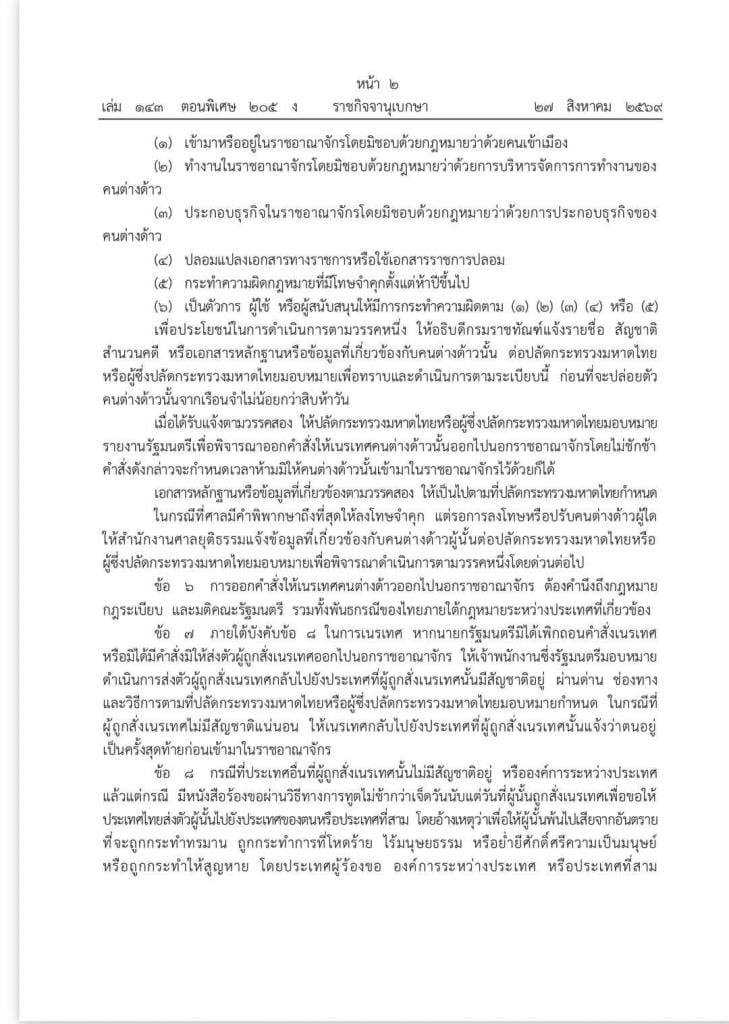
In the case of foreign nationals who have committed an offence, served a final sentence as determined by court judgment, and been released from prison, the Minister has the authority to order their immediate deportation. The offences that fall within the scope of this regulation are as follows:
Entering or remaining in the Kingdom unlawfully under immigration law; working unlawfully under the law on the management of foreign workers' employment; engaging in business unlawfully under the law on foreign business operations; forging or using forged official documents; committing an offence under a law carrying a prison sentence of five years or more; and being a principal offender, instigator, or supporter in the commission of any of offences 1–5.
Regarding the coordination process with the Department of Corrections, the Director-General of the Department of Corrections is required to notify the Permanent Secretary of the Ministry of Interior of the names, nationalities, and case files of such foreign nationals "no fewer than 15 days before their release from prison," so that a deportation order may be issued without delay. Such an order may also include a specified period during which the individual is "prohibited from entering the Kingdom." In cases where the court has ordered a suspended sentence or a fine, the Office of the Courts of Justice is required to urgently notify the Permanent Secretary of the Ministry of Interior for immediate action.
With regard to human rights principles and repatriation, the issuance of a deportation order must take into account relevant laws, Cabinet resolutions, and international obligations. Officials will return the individual to their country of nationality, or, if their nationality is uncertain, to the country they stated they last resided in before entering Thailand.
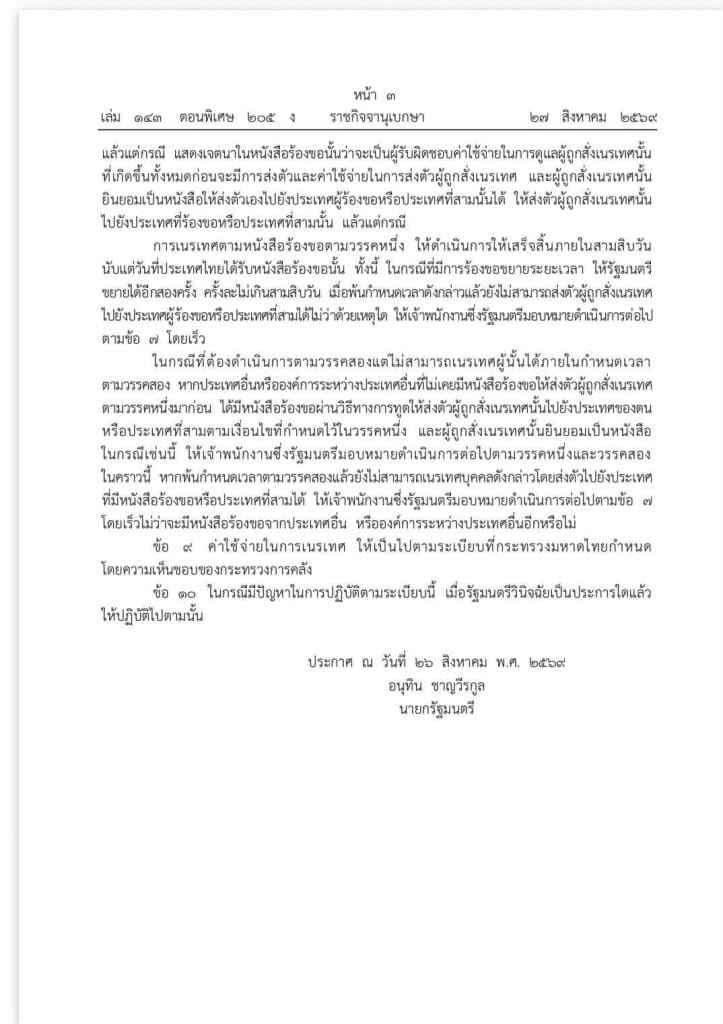
Exceptions for cases involving danger and resettlement to a third country: If another country or an international organisation submits a request through diplomatic channels within 7 days of the date of the deportation order, seeking to receive the foreign national and transfer them to that country or a third country on grounds of safety concerns — including the risk of being subjected to torture, cruel, inhuman, or degrading treatment, or enforced disappearance — and the requesting country agrees to bear all costs, and the person subject to deportation provides written consent, then the transfer may be carried out.
Regarding the timeframe for proceedings, deportation pursuant to a foreign request must be completed within 30 days, with the Minister able to grant extensions of no more than 2 times, each extension not exceeding 30 days. If the deadline has passed and the individual has still not been transferred to the requesting country, officials must immediately proceed to return the individual to their country of origin or nationality through standard procedures.
Furthermore, with respect to the costs of deportation, these are to be governed by regulations set by the Ministry of Interior with the approval of the Ministry of Finance. Should any difficulties arise in implementing this regulation, the ruling of the Minister of the Interior shall be final and binding.