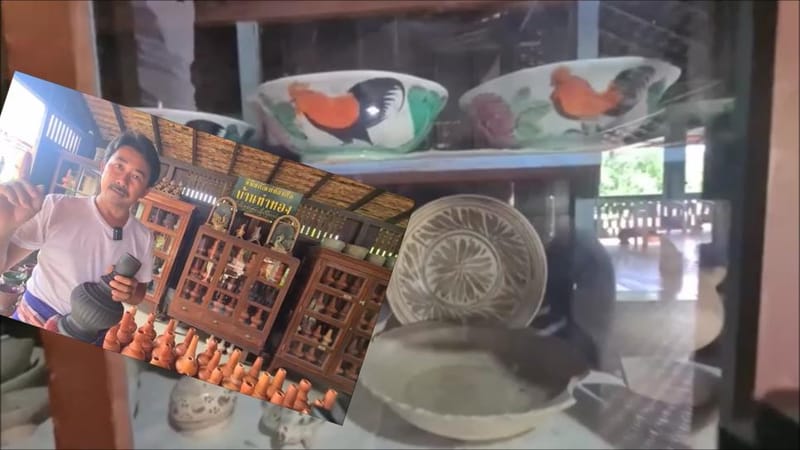
Lampang — A local scholar specializing in Lanna history, architecture, and cultural way of life — and owner of the Baan Tham Thong Museum, a repository of Lanna heritage stories — has turned to reviving the ancient craft of "Nam Ton Dam" (black traditional water vessels), the only such practice remaining in Lampang. He advises that the survival of ceramics here depends on selling its true roots, which go far deeper than the Rooster Bowl, a product only 70 years old.
For many years now, Lampang's ceramic factories have been locked in battle against Chinese goods being dumped into the market, and as a result, more than half of all small and medium-sized factories have gradually shut down, unable to bear the losses any longer.
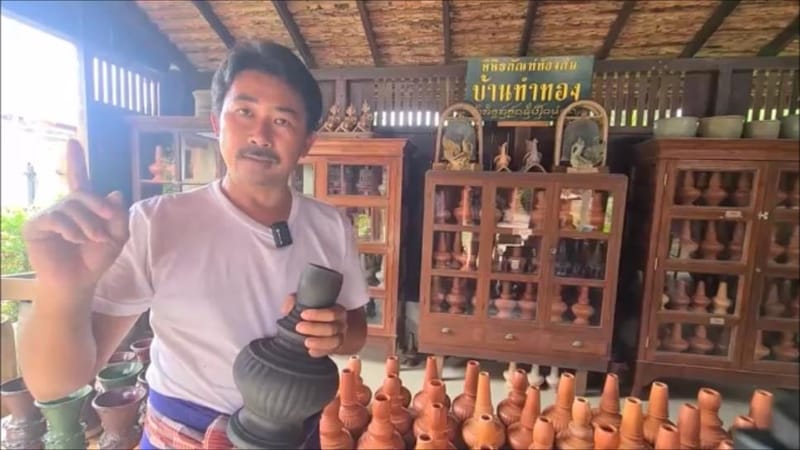
Ajarn Thawatchai Tham Thong, a lecturer on the Tourism Innovation and Service Business programme at the Faculty of Management Science, Lampang Rajabhat University, a local scholar with expertise in Lanna history, architecture, and cultural way of life, and the owner of the Baan Tham Thong Museum located in Ban Sala Mo village, Ko Kha district — a traditional ceramics-producing community of Lampang — has shared his views on the situation. He argues that if Lampang ceramics is to survive, it must seek out its own roots and sell what it truly means to be Lampang ceramics, not merely the "Rooster Bowl," which is only 70 years old, whereas Lampang earthenware has existed for more than 700 years.
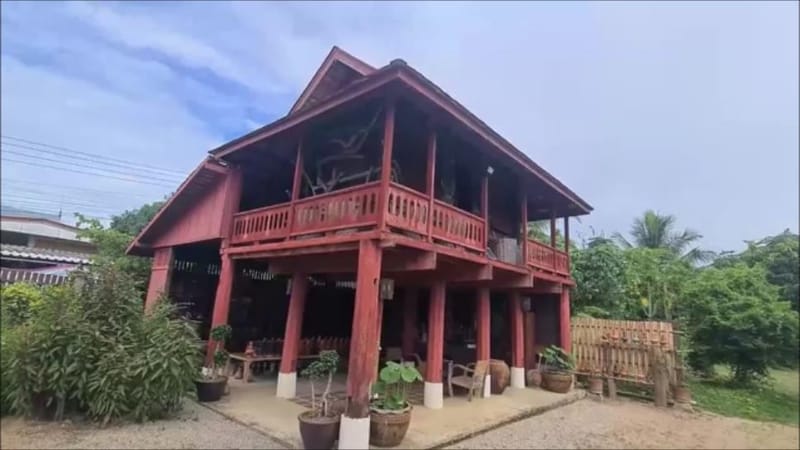
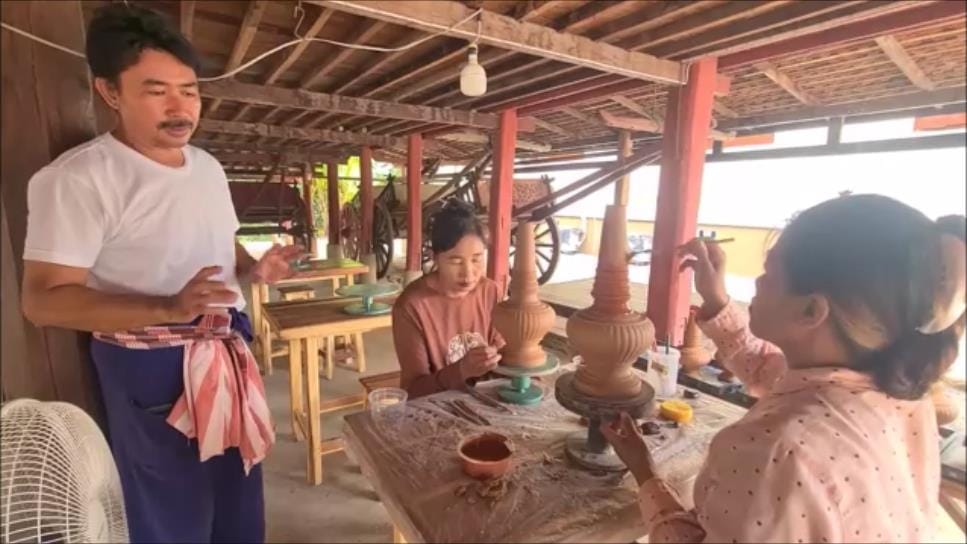
He also offered a tour of the interior of the museum, which is constructed from old traditional-style houses and serves as a learning centre and exhibition space for a collection of objects from ancient Lanna daily life. It is open as a cultural learning destination and hosts folk-wisdom workshops, such as clay sculpting (including sculpting the Mom mythical beast) and the making of ancient Lampang earthenware — a practice he has only just revived over the past year or so. That revived product is the "Nam Ton Dam," fired using ancient techniques, and it is the only such workshop of its kind in Lampang.
Ajarn Thawatchai spoke about Lampang ceramics, saying that after conducting research funded by the Bachelor of Science unit at Lampang Rajabhat University, he studied the subject of Lampang ceramics and discovered that Lampang ceramics does not end with the Rooster Bowl, which is only 70 years old. The genuine original ceramic tradition of Lampang stretches back 700 years, or even further. He therefore went back to examine what was truly original, and began reviving it — helped by the community where he lives, "Ban Sala Mo," whose traditional occupation has always been producing earthenware: throwing pots, jars, bricks, and even clay roof tiles, evidence of which can be seen at Wat Phra That Lampang Luang.
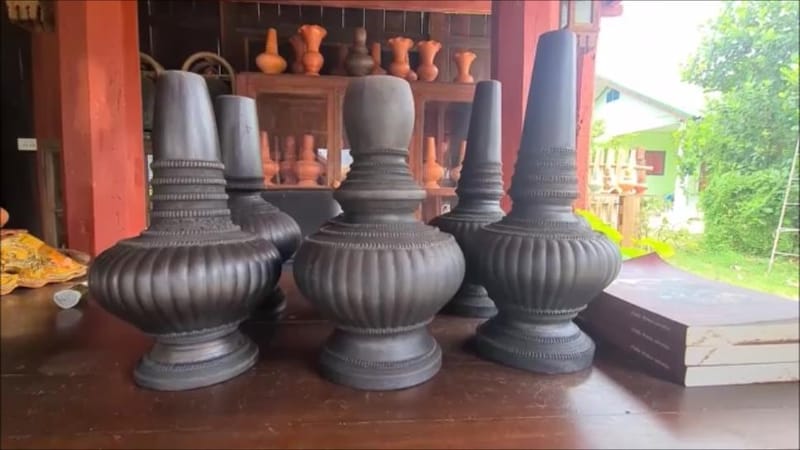
As for the ancient "Nam Ton" (traditional water vessel) — or "Nam Ton Dam" — it had completely disappeared. Most production in the area had shifted to modern ceramics, which only arrived approximately 40 years ago. This prompted him to revive the old form. The process does incorporate some modern techniques, specifically the creation of a mould, but it uses traditional raw materials, and then returns to hand-finishing, polishing, and firing using ancient methods.
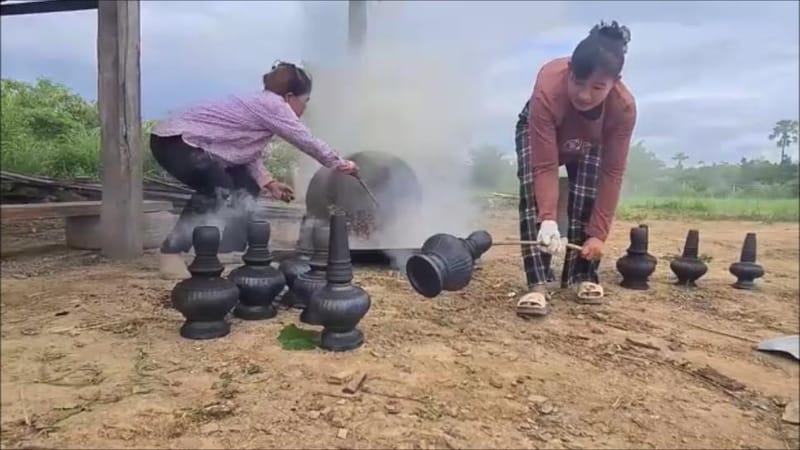
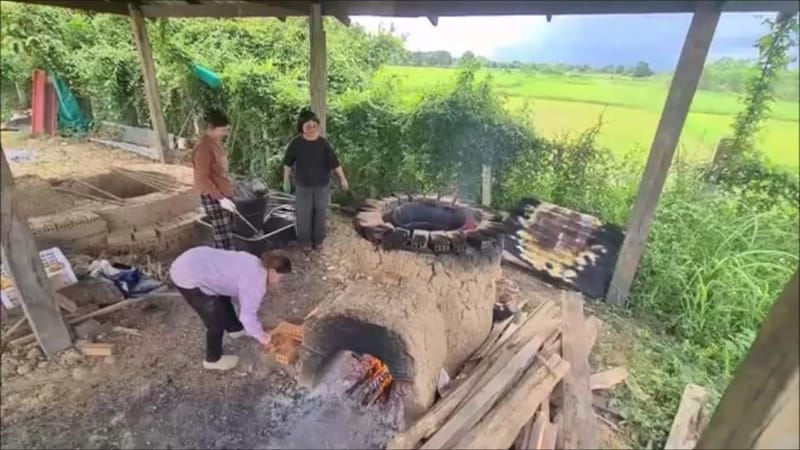
If one visits the museum at Wat Phra That Lampang, the Lai Hin Museum, or various other locations, one can see that ancient black Nam Ton vessels — likely dating back 80 to 100 years or more — are characteristically black in colour, achieved through a blackening technique. He uses two types of kiln: the first firing employs a biscuit-firing method, or "raw firing," as commonly used in ordinary ceramic factories, to harden the ceramic to a certain degree, before it is then fired using the ancient method — a wood-fired kiln, covered with rice husks to produce the natural black colour inherent to the clay.
The form of the Nam Ton vessels he produces follows the ancient design throughout. Contemporary craftspeople may be capable of the technique, but they cannot replicate the form. Ordinary ceramic factories today also make Nam Ton vessels for sale, but in a contemporary form. Those who study the subject can distinguish which pieces are ancient in style and which are contemporary. As for the ancient form, there is currently only one place in Lampang producing it, along with its associated techniques — and that is here.
The buyers form a specific group — temples, conservationists, collectors, or those who acquire pieces for use in traditional ceremonies. This does not address the market for ordinary white-clay ceramics aimed at border trade or everyday use. Some buyers do put the vessels to practical use — for storing water, decorative display, or as vases — and he wishes to see this practice continue indefinitely. He does not close his doors to anyone; he is ready to teach and pass on the knowledge, as the space is open as a learning centre.
Ajarn Thawatchai further emphasised that the current problem facing ceramics is that, unless a factory is large-scale and genuinely exporting or receiving international orders, Lampang ceramics will struggle to move forward — because we have overlooked something, we have abandoned our roots. We have only dug back 70 years to the Rooster Bowl, so when we try to extend further, it becomes very difficult.
As he noted, we have not studied ceramics in the dimension of looking back at what each kiln site in each area — such as the kiln sites of Soem Ngam, Ko Kha, Hang Chat, Wang Nuea, and Sobprap — had to offer, what techniques they employed. If we were to study these and revive them, we would arrive at new product forms. We would gain deep cultural roots; the deeper the roots, the further we can grow. We might adapt them and be able to say with full conviction: this is Lampang ceramics.
"We try to be a ceramics city, but as long as we only look back as far as the Rooster Bowl, we are finished — it will be very hard to move forward. Many factories are trying to revive themselves, but they still lack knowledge of their own roots. Anyone who is interested is welcome to come and study and learn."
As for the products inside this local Baan Tham Thong Museum, one can see that most are ancient Nam Ton vessels topped with antique roof finials — such as the Mom figure, birds, and celestial beings — as well as ancient clay roof tiles. The prices are relatively high, but there is a dedicated customer base, and since it is the only such place in Lampang, sales are unaffected. Orders come in every day on a continuous basis. Part of the workforce consists of local young people from the area who assist with the simpler tasks as a way of earning supplementary income for themselves — while the white-clay ceramic factories producing general goods have, one by one, shuttered more than half of their number.