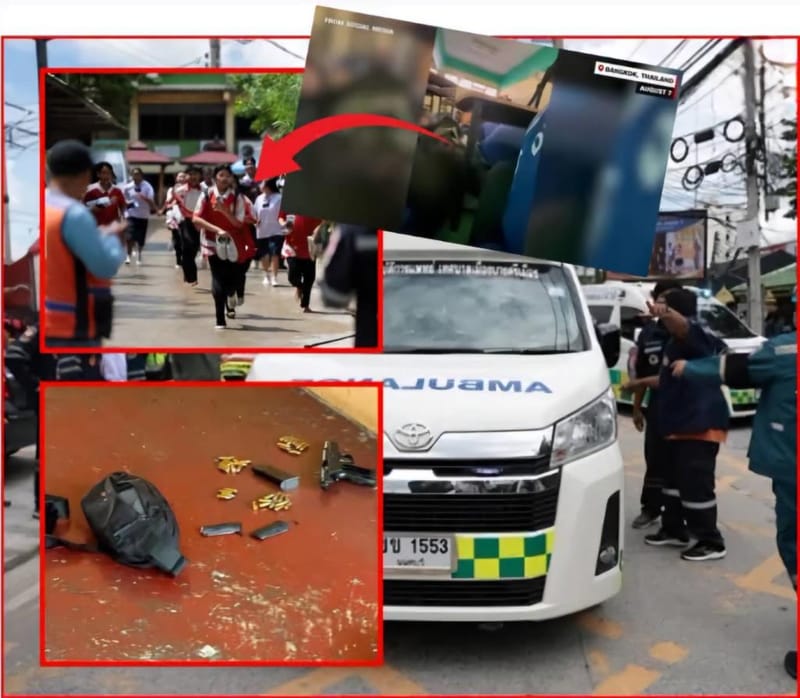
Following the tragedy in which a 14-year-old boy stole his grandfather's gun and shot both his grandfather and grandmother before opening fire at Debsirin Nonthaburi School, killing 9 people, Prime Minister and Interior Minister Anutin Charnvirakul has ordered a crackdown on firearms and is preparing to amend the law. Any household in possession of a firearm must hold a valid licence in accordance with the law, and if that weapon is used illegally — whether by a child or by anyone else — the registered owner of the gun will also be treated as a co-suspect.
Prime Minister "Noo" emphasised that if a government official is found carrying a firearm in a public place or outside their residence while not on duty, that constitutes an offence punishable by law. For ordinary members of the public, carrying a firearm is absolutely prohibited. As for illegal firearms, they must all be seized; there will be no "changing of status" to make them legal. Anyone found in possession of an illegal firearm who then commits an offence will face additional charges. It would be far better, he said, to hand such weapons over to the authorities. He has also instructed the Permanent Secretary of the Interior Ministry and the National Police Chief to set up firearms checkpoints across the country.
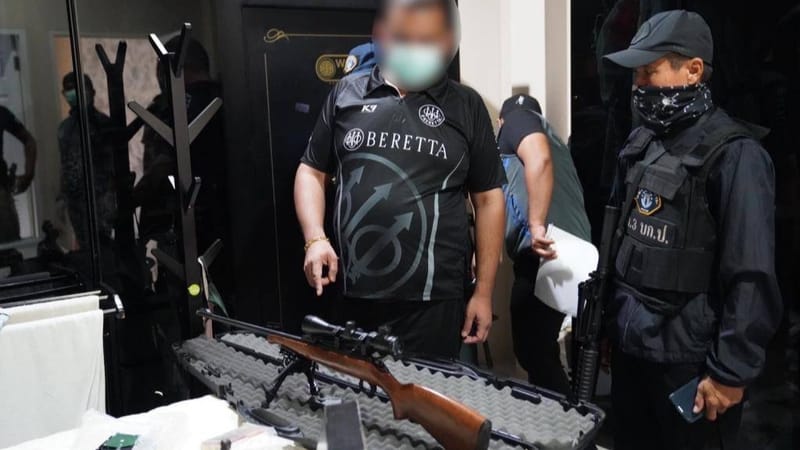
Whether or not this is accurate is unclear, but foreign media have been reporting in the same direction — that Thailand imports the most firearms in the world, resulting in one of the highest average rates of gun ownership globally. They cite, as an example, the case that dismantled the transnational arms-trafficking network known as "Belle — A Thousand Guns," in which the suspect contacted government officials and various volunteers serving on district-level explosive ordnance disposal (EOS) units in order to obtain their names and use them to apply for Por 3 licences — entitling the holders to purchase welfare-scheme firearms — while giving benefits to those officials and jointly forging documents. The weapons were then collected and sold on black markets in neighbouring countries, running into the hundreds and eventually thousands of guns.
It is therefore no surprise that foreign media view Thailand as a country with a large accumulation of firearms. Another problem is that a portion of those guns have ended up in the hands of youths, persons under surveillance, individuals with mental illness who are capable of striking at any time, and people who have recently been released from prison and are addicted to violence — as in the case of "Pong," who liked to carry a gun while impersonating a police officer and was able to commit repeated offences whenever the opportunity arose.
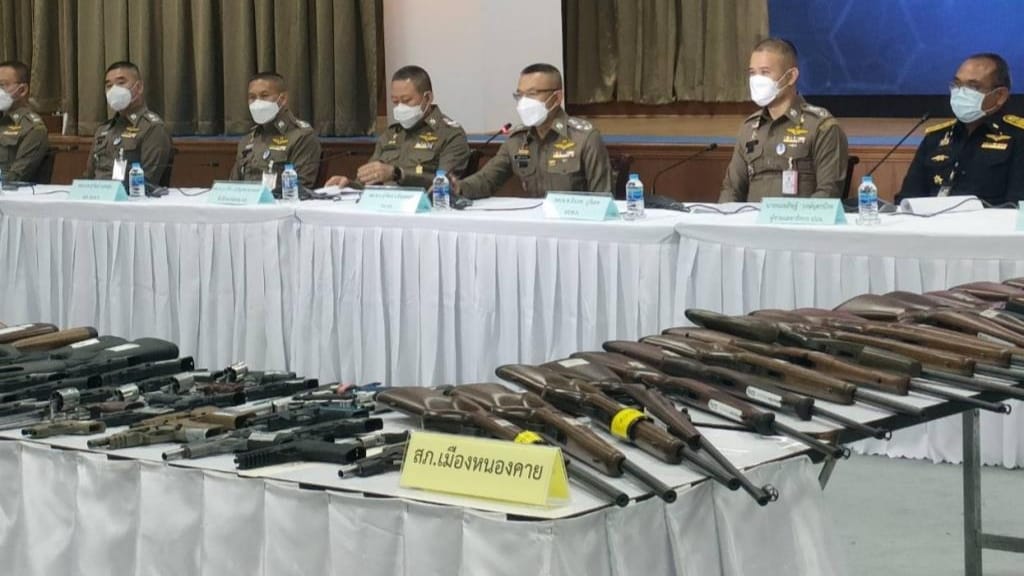
According to the data, only 6 million firearms are registered and legally licensed for possession. The number of unregistered, stockpiled firearms circulating on the black market is double that figure — consistent with the 30,000 to 60,000 firearms-related cases recorded each year, meaning roughly one hundred cases per day. The weapons used to commit these offences are welfare-scheme firearms that were purchased in order to be resold on the black market. Because such a large number of stockpiled weapons are circulating on the black market and a crackdown is difficult to carry out — since it is not known whose hands they are in — they constitute a time bomb. Should they fall into the hands of high-risk individuals, violent incidents could occur again and again, and every public space could become the scene of a tragedy at any moment.
Most recently, Prime Minister "Noo" spoke following the incident in which Chalong Riauraeng, a former MP for Nonthaburi, shot and killed Police Colonel Thongchai Yenprasert, President of the Nonthaburi Provincial Administrative Organisation (PAO), inside the PAO's offices. "Gun-carry permits no longer exist from today. Anyone holding a gun-carry permit should consider it expired, as they must be renewed every year." This incident highlights the widespread use of firearms in Thailand. Controlling firearms is therefore a major challenge for the government in solving the problem. Although the government has previously had a firearms-control policy, it has yet to produce results because guns can still be obtained with ease. If this issue can be brought under control, gun-related crime will decrease.