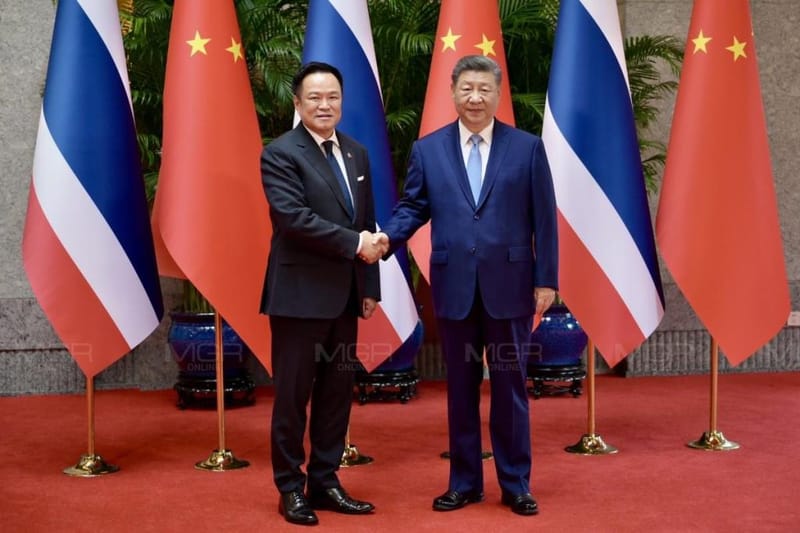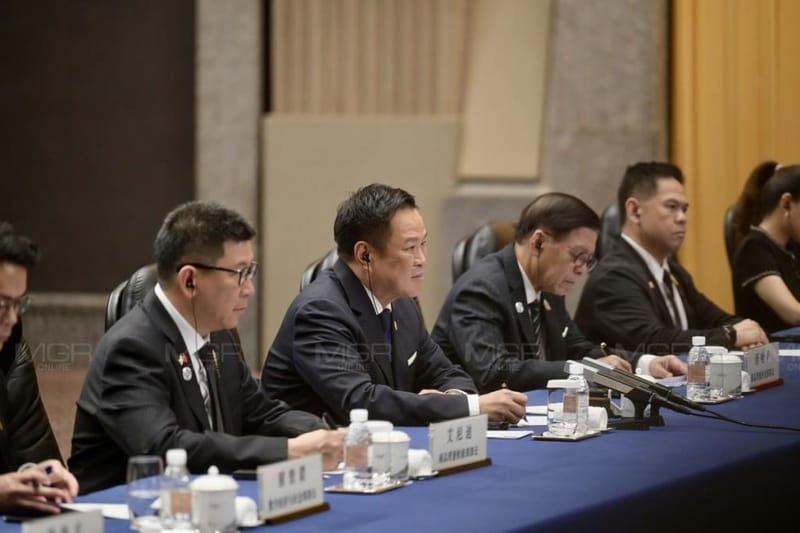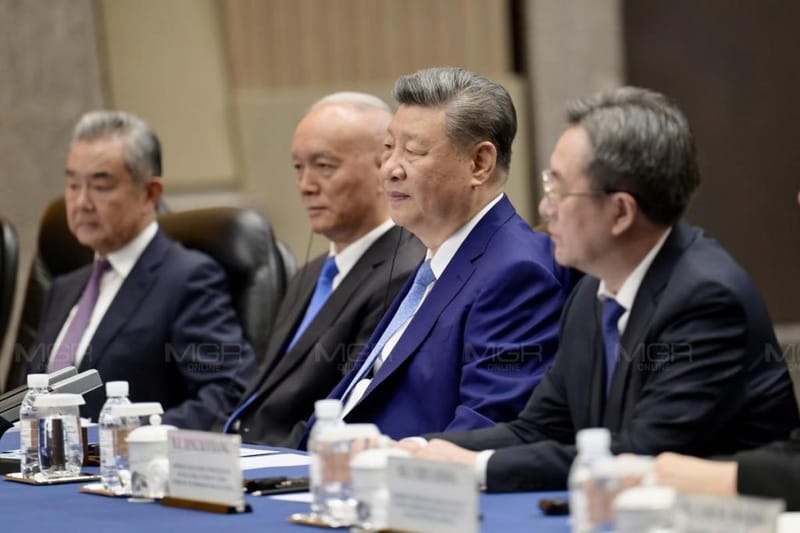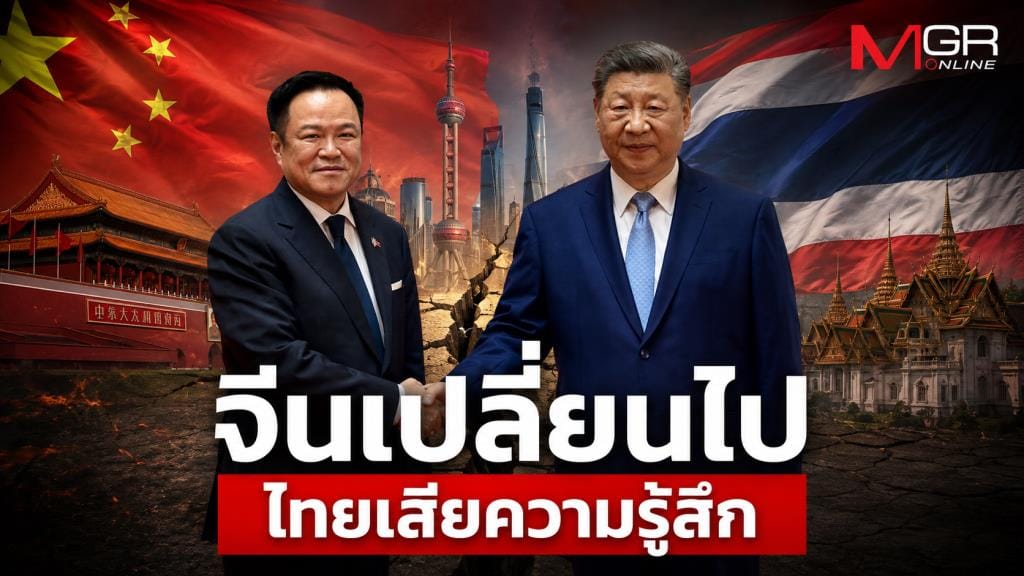
Although Prime Minister and Interior Minister Anutin Charnvirakul and Chinese President Xi Jinping have repeatedly stressed the notion of being "one family" with a special relationship, in reality everything has begun to change, and "China is no longer the same as before" — to the point where Thais are starting to feel it, and the time may have come to take stock and recalibrate, starting right now.
"China and Thailand, no strangers we — we are kin." For Thais, this phrase has been heard for a very long time and has resonated deep within their hearts throughout the years. The bond between people of these two nationalities stretches back a long way, and the two have become so intertwined that they are now inseparable. Chinese immigrants who settled in Thailand also faced none of the discrimination and exclusion experienced in other countries, allowing them, at this point, to blend in seamlessly.
At the same time, focusing on the international relationship between Thailand and China, it has naturally moved in the same direction. Even though their political ideologies may have differed in the past and their political and governing systems are not the same, the long-standing bond described above has made it easy for the two sides to maintain close ties.
Moreover, viewed from a geopolitical perspective in the region, Thailand and China have no issues between them — no border disputes, no territorial claims of the kind China is entangled in elsewhere in the region over the South China Sea. Everything has therefore been smooth sailing.
But then, suddenly, everything began to feel "different from before." China started to change. The phrase once used — "Thai-Chinese" or "China-Thailand, brothers and sisters" — has begun to ring hollow, giving way instead to "interests must come first." China is increasingly being seen as treating Thailand "like any other country," with none of the old sense of kinship remaining. And Thais have begun to notice this more and more clearly.
What has crystallised this feeling among Thais is the "Thailand-Cambodia" situation, which at this moment amounts to a conflict that has cut to the bone — with no telling how long it will take to resolve, or whether this sense of estrangement may simply persist forever. Yet for Thailand, a different feeling toward China has begun to emerge following the declaration by China's ambassador to Cambodia, Wang Wenbin, expressing support for Cambodia's sovereignty while emphasising that China is a reliable partner.
Of course, China's position on the matter can be understood as an effort to protect its interests in Cambodia — particularly the Ream Naval Base, which China has invested in refurbishing and which serves as a key strategic point for balancing power against the United States. But at the same time, given China's long-standing relationship with Thailand, China should not have taken that kind of stance and caused Thailand to feel slighted. This extends as well to China's accelerating arms transfers to Cambodia — transfers whose clear purpose would be to equip Cambodia to fight Thailand should the situation escalate once again.
Turning back to the bilateral relationship with Thailand, which in recent times has increasingly been seen as going "off-kilter" in a way it never was before: this is especially evident in the conduct of the new Chinese ambassador to Thailand, who has been displaying a series of peculiar stances. These began with an episode in which the ambassador stepped in to pressure the Thai government over an incident involving a Chinese tourist clashing with security personnel, and most recently over the case of "fan club" members of a Chinese entertainer who violated internal rules at Suvarnabhumi Airport by breaching security measures. Even though some Thai officials in that incident did behave in a manner that could be characterised as discriminatory — something that warrants individual disciplinary action — the Chinese ambassador's response was to deploy the full weight of his government's position to defend his own citizens to an excessive degree.
This eventually became too much for Deputy Prime Minister and Foreign Minister Sihasak Phuangketkeow, who felt compelled to come out and publicly criticise the ambassador's tone and conduct, calling on him to be more constructive and to fulfil his role of promoting the relationship between the two countries.
Both incidents triggered an increasingly negative reaction among Thais toward Chinese tourists and Chinese people in general. People flocked to the Chinese Embassy's page to voice their displeasure and deep disappointment. Whether or not that backlash was a factor, the Chinese Embassy in Thailand subsequently issued a notice on Saturday (8 August) urging Chinese citizens travelling to Thailand for cultural and sporting activities to comply with local laws and regulations, respect local customs officials, familiarise themselves with the rules of the relevant activities, and pursue their rights through official channels.
This advisory was issued in the wake of a series of incidents involving Chinese nationals in Thailand, including one in which security personnel at Suvarnabhumi Airport were accused of behaving inappropriately while dealing with a Chinese passenger who had caused a disturbance and violated security regulations.
A report by Global Times, China's state media outlet, stated that the Chinese Embassy in Thailand urged Chinese citizens visiting Thailand for cultural and sporting activities to comply with local laws and regulations, respect local customs officials and local culture, and abide by the administrative rules and requirements of the various activities concerned.
The Chinese Embassy urged Chinese visitors to interact with Thais respectfully, in a friendly manner, and with an open mind, and to help preserve the long-standing friendship between the two countries under the spirit of "China and Thailand are one family."
In July, the Chinese Embassy in Thailand had called on all relevant parties to investigate the facts as quickly as possible and handle the matter appropriately, following an incident in which a Chinese fan was physically grabbed by a security guard and removed from a venue during a fan-meeting event for two Thai artists.
The shift in stance of the Chinese Embassy in Thailand under the new Chinese ambassador may stem from multiple causes, but one factor may well be the growing wave of discontent among Thais in recent times — driven by the problems of "grey capital and grey Chinese," as well as the frequent and recurrent trouble caused by certain Chinese tourists. These issues have been accumulating resentment steadily.
Added to this is the fact that in recent times the Chinese government has adopted an increasingly assertive posture in international affairs, perhaps because it believes it is becoming a major world power capable of leveraging its capabilities to apply greater pressure on counterparts and other countries. At the same time, its relationship with Thailand has shifted as described, and even on the economic front some matters have made no progress — such as the agreement to "purchase 500,000 tonnes of Thai rice," which to this day has still not moved forward in any way.
Although Prime Minister and Interior Minister Anutin Charnvirakul and Chinese President Xi Jinping have repeatedly stressed the notion of being "one family" with a special relationship, in reality everything has begun to change, and "China is no longer the same as before" — to the point where Thais are starting to feel it, and the time may have come to take stock and recalibrate, starting right now!!