Asst. Prof. Dr. Noppadon Kannika, a lecturer in the Master's degree programme in Peace Innovation, Faculty of Public Administration, Siam Technology College, stated that following the shooting incident at Thepsirin Nonthaburi School, one question has once again risen loudly in Thai society: "If the police cannot arrive in time, who will protect the children?" This is a question no one should overlook. And when Police Lieutenant General Rewat Klinkaesorn put forward the idea of allowing teachers to carry firearms to protect against incidents inside schools,
I would like to commend Police Lieutenant General Rewat Klinkaesorn for having the courage to raise an issue that may draw both supporters and opponents, but is a proposal of great value in that it prompts society to turn and think seriously about the safety of teachers and students. What is important is that Pol. Lt. Gen. Rewat did not merely raise a question about firearms — he made society aware of the gap during the "critical window" before police officers can reach the scene, which is a problem that policymakers should not overlook. I therefore believe his proposal should be used as a starting point for designing a more comprehensive safety system — encompassing pre-incident prevention, weapons control, surveillance, early warning, drills, and bringing the public in as legally recognised safety partners — because sometimes "a proposal that makes society debate" can also be the starting point of "a policy that makes society safer." This proposal has consequently attracted rapid attention. For my part, I do not want to rush to say I "agree" or "disagree."
I want to start with the word "listen," because no matter how divided people in society may be, I believe the starting point of the proposal is concern for the lives of teachers and students, and anxiety about the "critical window" between the moment an incident begins and the moment police arrive. But having listened, I think we must be bold enough to ask a bigger question — not merely,
"Should teachers have guns?" but rather, "How can Thailand build a system so that teachers and children do not have to face the barrel of a gun in the first place?" That, I believe, is the more important question. One gun in the hands of a perpetrator should not automatically lead to the easy answer that there must be another one.
Schools are not like ordinary places. Every morning, a vast number of parents send what is most precious in their lives through the school gate and entrust their trust to teachers and the state system that their children will return home safely. Introducing firearms into a children's environment — whatever the justification, whether self-defence or prevention of incidents — requires the most careful thought. Who carries the weapon? Who authorises it? How much training has been given? How is the weapon stored? What happens if a child gains access to it? If there is a misunderstanding in an emergency situation, who is responsible? And if police arrive at the scene to find several people holding weapons, how can they distinguish the perpetrator from the defender in a split second?
These questions do not mean that we are rejecting the proposal of Pol. Lt. Gen. Rewat. On the contrary, his proposal gives society the opportunity to open a very important conversation about which direction the school safety system in Thailand should go.
For me, "a gun" — if the law were to permit it under any condition — should be the very last element in the safety system. But what must come first is pre-incident prevention. Before asking who should have a gun, we should ask: how do we make it harder for illegal firearms to reach people?
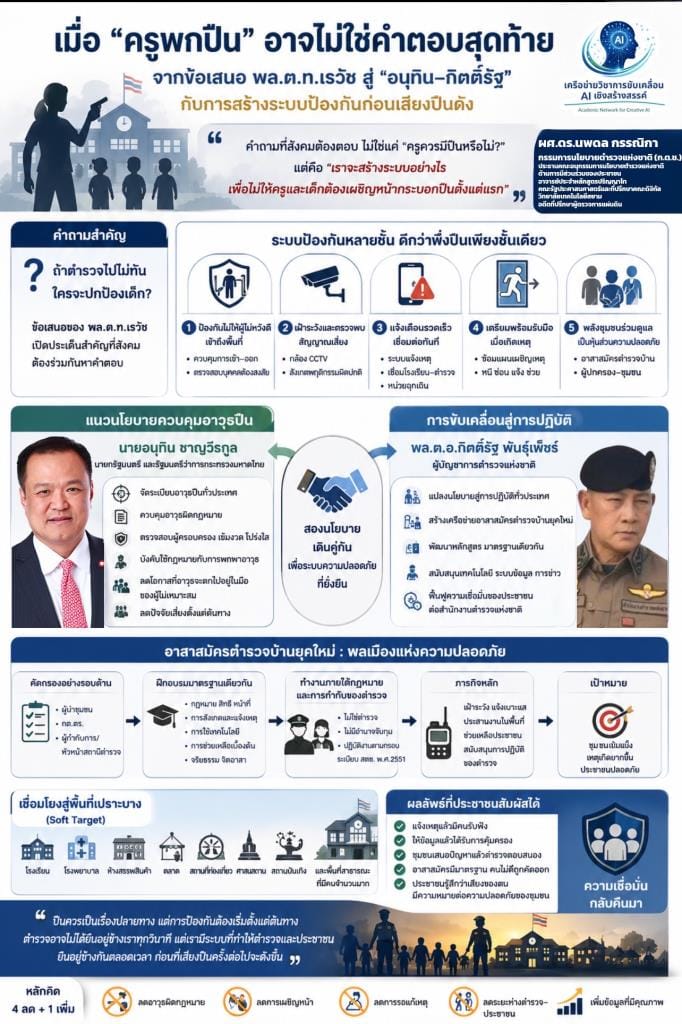
This is where I see the importance of the policy direction of Mr. Anutin Charnvirakul, Prime Minister and Minister of Interior, on gun control — because preventing violence should not begin only when a perpetrator has already walked up to the school gate, but must start at the source. Regulating firearms, controlling illegal weapons, checking on those who possess them, enforcing laws on carrying weapons, and reducing the chances of weapons falling into the hands of those who should not have access — these are key components of reducing risk before an incident occurs. It may be necessary to amend legislation relating to firearms.
I therefore view the concepts of "gun control" and "new-era village police volunteers" as two policies that should be seen as immediately linked — because the first reduces risk factors, while the second increases a community's protective capacity.
On one side, making it harder for weapons that should not exist in society to reach the public; on the other side, equipping people within communities with knowledge, systems, and alert channels so they can work more closely with the police.
When these two things move forward together, what is being built is not merely a weapons-control measure, but a "public safety system" — from the Prime Minister's vision to the "new-era village police volunteers." Another concept I regard as extremely important is that of the new-era village police volunteers.
This concept carries an important policy insight: in a country with a large population, where villages, communities, schools, hospitals, markets, tourist sites, and public spaces are spread across the entire nation, we cannot increase the number of police officers enough to stand at every single point. But what we can do is enable people in every area to become safety partners of the police.
I believe this is a point where credit should be given to Prime Minister Anutin Charnvirakul, because upgrading the village police volunteer programme should not be seen merely as adding manpower to the police, but as recognising the "social capital" that Thailand already possesses — namely, citizens who love their home communities, know the area, know the people in the community, and are ready to sacrifice for the common good.
The duty of the state is therefore not simply to call on citizens to help, but to build a system in which those citizens can help correctly, safely, knowledgeably, to a standard, and within the law. This is the difference captured by the words "new era."
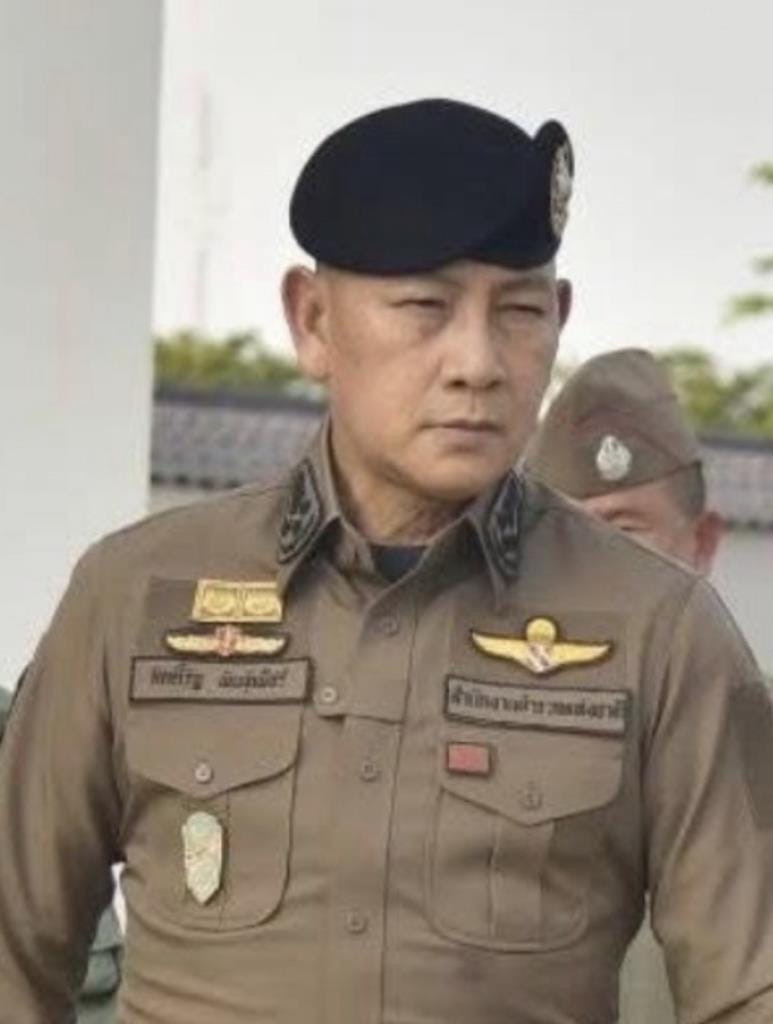
From policy to practice is the test of police leadership. A good policy is meaningless if it does not "reach" police stations and communities. This is the role I believe is crucial for National Police Chief Police General Kitrat Phanphet. His leadership as National Police Chief is standing out greatly in this era, because he does not measure success merely by the number of cases cleared — he measures whether it is possible to make incidents harder to occur, whether the public can be brought into greater participation, and whether public confidence that the police are a reliable refuge can be restored.
This leader of the Royal Thai Police has shown me a direction of management that has shifted from the past — an effort to move the police organisation from the concept of "police doing things for the public" toward "police doing things together with the public."
These two phrases may appear to differ only slightly, but in policy terms they differ enormously — because "doing together" means the public are not merely recipients of police services, but partners of the police. New-era village police volunteers are not "another set of police officers." I want to make this point as clearly as possible.
Building new-era village police volunteers is not about turning citizens into police officers, not about creating armed groups in communities, and not about handing police authority to the public to exercise independently. It is about taking the community-participation mechanism — framed under Royal Thai Police Headquarters Regulations 2008 — and developing it to be suited to the threats of the new century. Those who take on the role must pass a screening process; the community must know them; community leaders must be involved; the police advisory committees must be involved; and the station commander or head of the local police station must be involved in the consideration. Once admitted, they must receive training to a uniform standard. I see this approach reflected in the appointment order designating Police General Thatchai Pitaneelaboot, Deputy National Police Chief, as head of the working group, pursuant to Royal Thai Police Order No. 239/2025.
This is the reason I am currently participating in designing the new-era village police volunteer curriculum together with the educational unit of the Royal Thai Police, so that those who will become safety partners of the police have knowledge, discipline, an understanding of the law, respect for human rights, and know what they "can and cannot do."
The most important thing is that volunteers must know the boundaries of their own role — because a good volunteer is not someone with the greatest authority, but someone who exercises the authority or role defined by law most correctly. New-era volunteers must have "information" before they have "force."
Modern threats have changed. New-era village police volunteers should therefore not be pictured merely as people standing guard, doing patrols, or assisting at various events. What should be most valuable is information. People in communities often see abnormal things before the police do. Teachers see changes in students. Parents see changes in their children's behaviour. Security personnel see who comes and goes. Shop owners see unfamiliar individuals. Residents know who is in the area. Technology should therefore be used to connect the "eyes of the public" with "the police's systems" in a standardised and accountable way.
New-era village police volunteers should therefore be developed in the areas of observing abnormalities, reporting leads, using digital channels, coordinating information, providing assistance in emergency situations, protecting personal data, and passing on necessary information to authorised officers for action. This is the shift from "volunteers with force" to "volunteers with knowledge and information."
From community to schools and vulnerable soft targets — if this system can be successfully developed, I would like to see new-era village police volunteers become more closely linked to vulnerable areas, or soft targets: schools, hospitals, shopping centres, markets, tourist attractions, places of worship, entertainment venues, and public spaces with large numbers of people.
Consider what it would mean if one school had a connected system linking police — teachers — parents — community leaders — village police volunteers — local authorities: when an abnormal sign is spotted, someone is aware of it; when a risk is found, someone reports it; when an incident occurs, someone knows how to survive; when information reaches the police, the police do not have to start from zero; and when nothing has yet happened, all parties work together to prevent it.
This is what I call "prevention before the gunshot rings out." Restoring public confidence does not begin with public-relations statements. I believe this is another important dimension in which both Prime Minister Anutin Charnvirakul and National Police Chief Pol. Gen. Kitrat Phanphet are driving efforts for the safety of the public in every community across the country.
Public confidence in the state and in the police cannot be built through slogans or public-relations efforts alone. Confidence comes from experience — when the public reports an incident and someone listens; when the public provides information and receives protection; when a community raises a problem and the police respond; when volunteers are trained to a proper standard; when bad actors are screened out of the system; and when the public feels that their voice has meaning for the safety of their community. When that happens, confidence will gradually return.
Therefore, if the Prime Minister's firearms control policy can move in step with the building of new-era village police volunteers, and if the Royal Thai Police under the leadership of Pol. Gen. Kitrat can translate these two policies into outcomes that the public can actually feel, I believe what will be received in return is not merely a crime figure that may decline, but something more valuable than that — "the trust of the people."