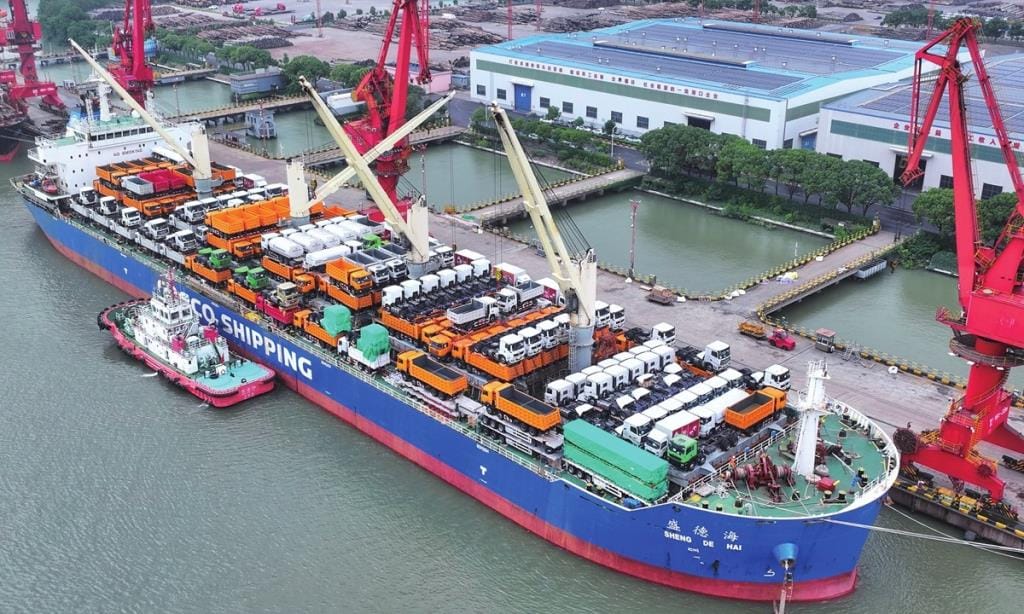
Tariff walls and other trade restrictions have made it increasingly difficult to export vehicles directly to the United States and Europe, so Chinese automakers are now looking for alternative routes to expand their business.
South Korea is attracting growing attention as a potential manufacturing hub that could support the growth of electric vehicles, amid a global trade environment that has become ever more politically charged.
According to a report by American news agency UPI, Chinese automakers are forging manufacturing partnerships and alliances with South Korea in order to circumvent trade restrictions and sustain the continued growth of electric vehicle production. South Korean automaker KG Mobility (KGM) plans to sell convertible bonds worth approximately USD 75 million (2,475 million baht) to Chery Global Innovations, a subsidiary of China's Chery Automobile.
Once converted into ordinary shares, those bonds would give Chery a shareholding of approximately 10% in KGM.
In addition, the two companies plan to jointly develop a large multipurpose vehicle as their first co-developed model — the SE10 — which is scheduled to be launched in January 2027.
Geely is another example, holding a 34.02% stake in Renault Korea, a South Korean automaker in which the French automotive giant Renault Group currently holds the majority share. The Renault plant in the city of Busan already produces the Polestar 4 electric multipurpose vehicle for export to North America.
The European Union has imposed additional anti-dumping measures on electric vehicles imported from China, while the United States continues to levy high tariffs on vehicles and components manufactured in China.
The investment in KGM gives Chery a foothold in South Korea without having to start from scratch, while KGM gains funding and product development support.
For Geely, the key advantage lies in its ability to utilise the existing South Korean manufacturing base through Renault Korea to produce vehicles there for sale abroad — reducing tariff risk, attracting experienced labour, and enhancing supply chain flexibility.
However, because the United States has also tightened restrictions on connected vehicles that use Chinese software, assembling vehicles in South Korea does not automatically guarantee access to the American market.
Nevertheless, South Korea still holds several significant advantages: a solid supplier network, a skilled workforce, strong manufacturing standards, and trade agreements with major markets.
China's state-run media outlet Global Times noted that the automotive industries of China and South Korea had already built extensive cooperation with each other, with Chinese manufacturers of intelligent driving system components having established a presence in South Korean automakers' supply chains, while certain South Korean auto parts companies have supplied components to Chinese new-energy vehicle manufacturers.
The move to acquire a 10% stake in KGM reflects the fact that China–South Korea cooperation is gaining greater momentum from rising global trade protectionism, and that East Asia's automotive industry chain is actively seeking concrete collaboration to unlock mutual benefits.
Source: TCD / GT