Supavud Warns Thailand Risks Slow Growth, Worried About Current Account Deficit Cutting Off Rate Cut Chances, Flags AI Bubble Risk and US Tariffs — Urges Strict Fiscal Discipline as Essential, Cautions Government Against Stimulus Measures in the Vein of "Thai Help Thai" Projects That Could Affect Long-Term Fiscal Position
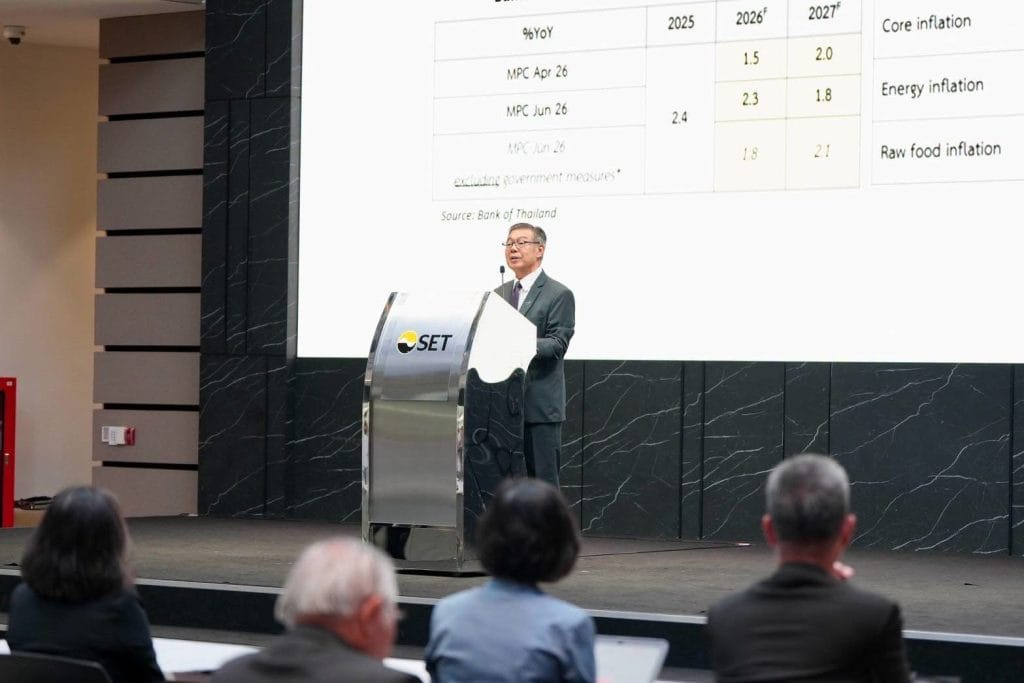
Supavud Saicheau, Chairman of the National Economic and Social Development Council and adviser to the Kiatnakin Phatra Financial Group, said that following the announcement of Thailand's Q2 2026 GDP growth figure of 1.9%, while it appeared better than some analysts had initially forecast, a closer look at the details reveals that this growth rate was lower compared to Q1 2026.
The Q2 2026 GDP figure reflects that, in statistical terms, economic numbers did not improve as expected. The main factor driving the economy in recent periods has been exports; however, import values expanded at a far higher rate. In Q2 2026, exports grew by approximately 12%, while imports grew by as much as 24% — more than double the export growth rate. This situation caused the National Economic and Social Development Council (NESDC) to revise its current account balance projection, from an expected surplus to a current account deficit, which is a significant issue, as a current account deficit signals that the economy as a whole is spending beyond its means.
Meanwhile, the current account deficit, combined with oil prices and inflation that remain at elevated levels, means the Bank of Thailand (BOT) will not be able to cut its policy interest rate, as there are insufficient supporting factors to pursue accommodative monetary policy to stimulate the economy at this time. Furthermore, if the current account deficit is not offset by adequate capital inflows, it could cause the baht to experience volatility and trend toward depreciation.
Nevertheless, there are currently capital inflows in the form of foreign direct investment (FDI), particularly in industries related to artificial intelligence (AI) technology, such as investment in data center businesses, electronic components manufacturing, and printed circuit boards (PCBs), with Thailand currently in a phase of expansion in line with the global AI investment cycle.
The wave of AI technology investment is expected to continue to serve as a significant driving force for approximately another year and a half, based on confirmed investment figures. However, there is a note of caution regarding the long-term return on investment, as questions have begun to be raised about whether future demand for AI will be sufficient to generate returns commensurate with the massive investment outlays. This comes as early signals of over-investment risk are beginning to appear, with major technology companies competing to be market leaders and consequently committing capital well in excess of what the market can absorb.
There are also circular financing patterns, such as cases where major semiconductor manufacturers invest in data centers so that those data centers will in turn purchase their own products. If a problem occurs at any point in this chain, it could have cascading effects throughout the entire system. Such conditions could lead to a bubble in the technology industry if, ultimately, the returns from AI usage are unable to service debts or generate profits for shareholders as expected.
As for the risks facing the Thai economy in the second half of the year, the most concerning issue is trade negotiations with the United States, as the US is a key export market accounting for as much as 25% of total exports, or 14% of Thailand's GDP. If negotiations run into difficulties to the point of affecting the export sector, it will have a direct impact on GDP growth and put pressure on the government to introduce assistance measures, which would lead to a widening budget deficit and could risk a downgrade of the country's credit rating.
At present, Thailand's level of public debt is complex and trending upward, particularly when obligations under Section 28 are included, which could push the debt-to-GDP ratio close to or above 70% under the fiscal discipline framework.
Supavud also expressed the view that strict consideration of fiscal discipline is therefore an absolute necessity, and that the government should exercise caution in rolling out economic stimulus measures in the manner of "Thai Help Thai" projects that could affect the long-term fiscal position. Although in the short term there are FDI inflows from AI investment, other impacts must also be considered — for example, the fact that data centers consume enormous amounts of electricity, which could result in Thailand needing to import more natural gas to generate power, potentially leading to higher electricity costs for other sectors nationwide. Additionally, the data center industry generates relatively few jobs compared to the volume of investment.
He further expressed the view that driving the Thai economy going forward will require careful management across fiscal affairs, the preservation of key export markets such as the United States, and a comprehensive assessment of risks from investment in modern technology, in order to achieve sustainable growth and avoid accumulating an excessive debt burden in the future.