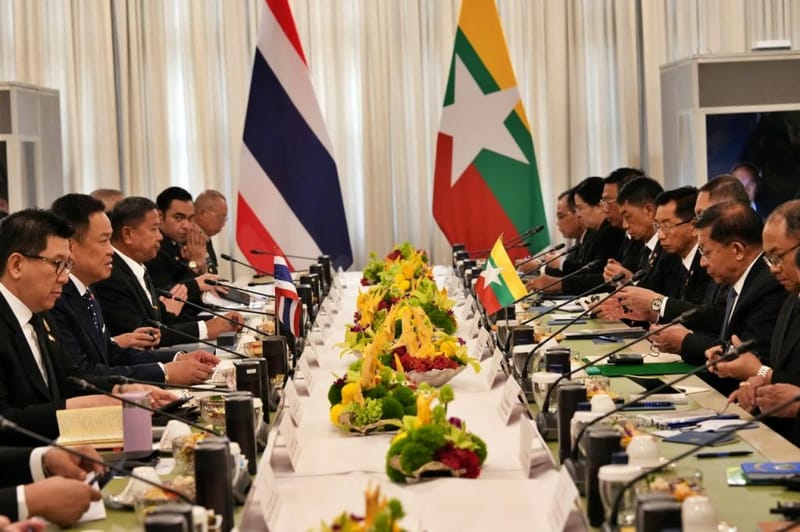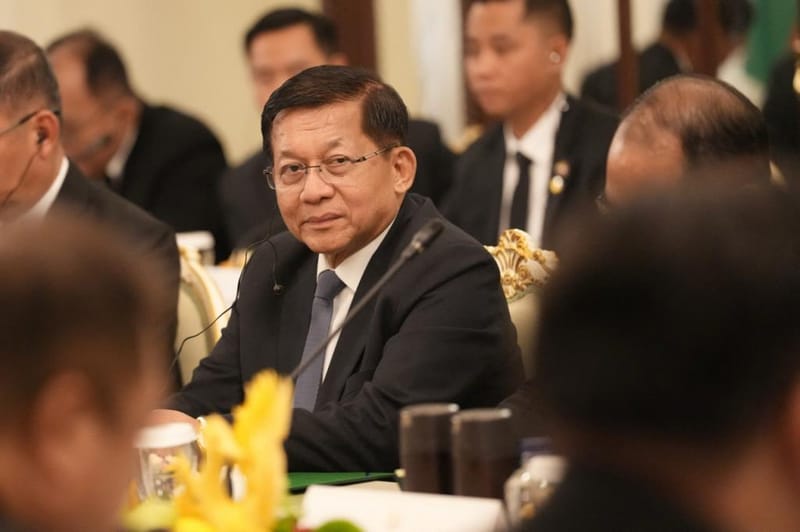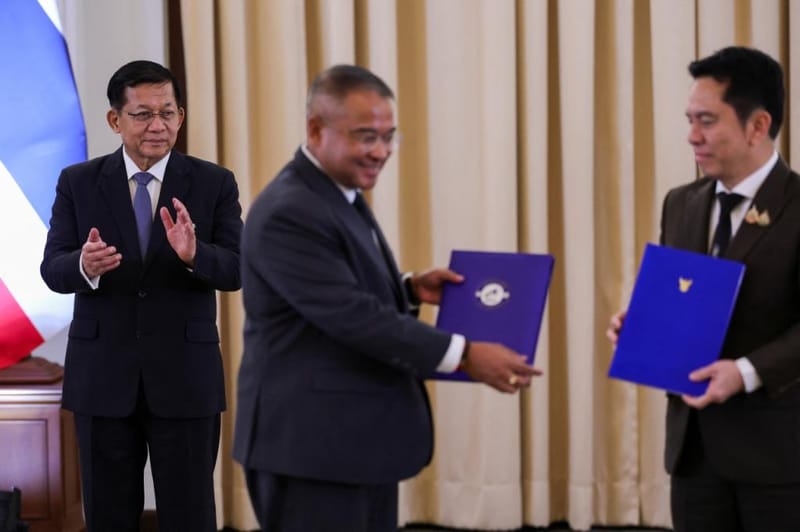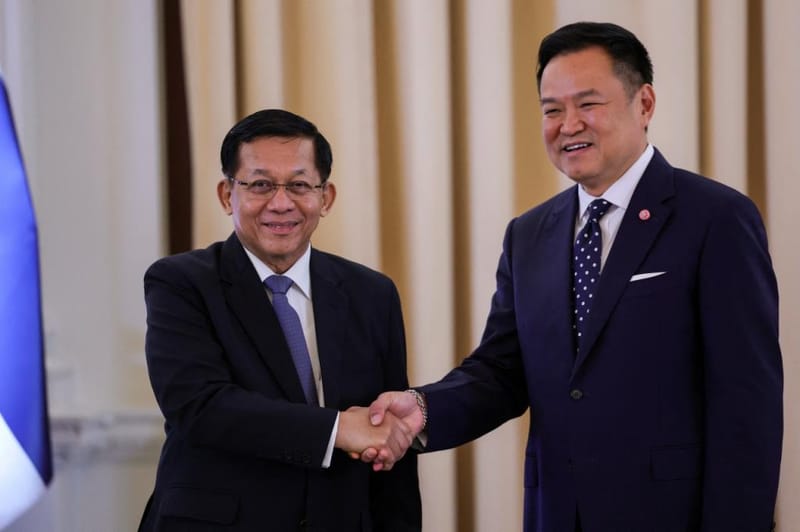
AFP/Reuters — Myanmar President Min Aung Hlaing met with Thailand's prime minister in Bangkok today (6) in his first visit to a neighboring country as a civilian leader, as he attempts to bring his isolated nation back into the diplomatic fold.
As a general, Min Aung Hlaing led the 2021 coup that ousted democratic leader Aung San Suu Kyi, igniting a civil war that has claimed the lives of more than 100,000 people from all sides.
He was appointed Myanmar's president in April following an election that democracy watchdogs and Western nations have described as a sham designed to whitewash the military government's image.
Since then, Thailand has taken the lead in efforts to normalize relations with Myanmar both bilaterally and through the 11-member Association of Southeast Asian Nations (ASEAN).
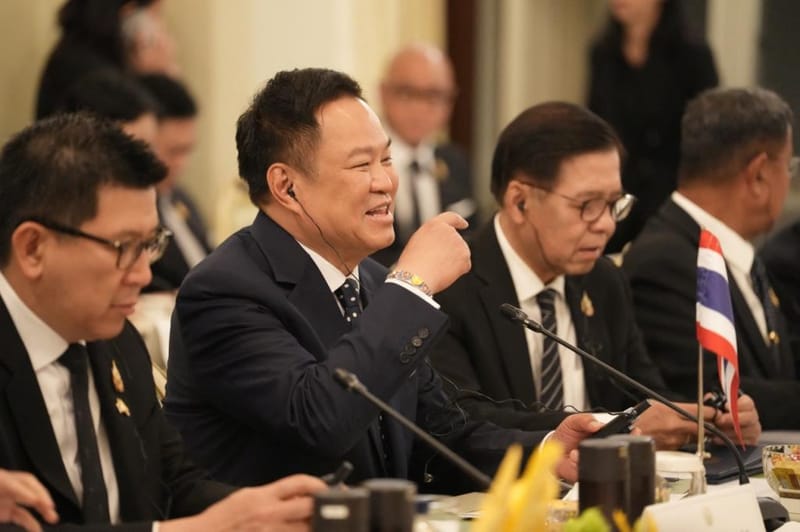
Thai Prime Minister Anutin Charnvirakul said that today's discussions with President Min Aung Hlaing at Government House were an opportunity to "push forward cooperation."
"Both Thailand and Myanmar are members of the ASEAN family, and Thailand fully supports Myanmar's full participation in ASEAN," Prime Minister Anutin said, as he sat with Thai officials at a long conference table across from Min Aung Hlaing and his delegation.
The Myanmar leader said his government is working toward democracy and stability in the country, including the restoration of relations with ASEAN.
However, his government has refused to engage with the bloc's Five-Point Consensus framework, which aims to end the conflict in Myanmar through dialogue.
ASEAN has excluded Myanmar's leader from the group's summits since the coup, but Myanmar's foreign minister participated in informal meetings with counterparts from other countries in the region last month in Bangkok.
And Min Aung Hlaing has pursued an intensive diplomatic agenda since transitioning from a military uniform to civilian dress, having made visits to India, key ally China, and ASEAN member Laos.
Ahead of the Bangkok visit, Aung San Suu Kyi, who remains under house arrest, was permitted to meet with a representative from the International Committee of the Red Cross on Monday — marking the first time she has been seen with a foreign official since she was removed from power.
"Full re-engagement with ASEAN would open pathways to normalizing relations with other countries, including Western nations that continue to oppose the military government," said Myanmar expert Morgan Michaels.
However, Myanmar has already gained acceptance from India, China, Russia, and Thailand, making normalization with the regional bloc less of a necessity, Morgan Michaels noted.
President Min Aung Hlaing was received with an honor guard at Government House and held talks with Prime Minister Anutin.
Nevertheless, critics say Bangkok has lent legitimacy to Min Aung Hlaing and his civilian government by hosting him.
The former commander-in-chief of Myanmar's military is sanctioned by numerous Western countries and is wanted by the International Criminal Court on charges of crimes against humanity.
Thailand's Foreign Minister Sihasak Phuangketkeow told reporters that Bangkok's diplomatic initiative was pragmatic in nature.
"It's not a matter of legitimacy — it's a matter of reality," Sihasak said.
"We have problems to deal with along the border, and at the same time we have to play a proactive role in helping Myanmar move toward peace and stability. The best way to achieve that is to engage with those who hold power," the senior diplomat said.
Observers broadly agree that Bangkok has reason to pursue normalized relations.
Fighting between Myanmar's military and various rebel groups has spilled across the lengthy border shared with Thailand, which is hosting millions of refugees from Myanmar.
Thailand also has to contend with cyber-fraud networks and illegal drug traffickers operating in Myanmar's volatile border areas.
Sihasak said the two sides discussed various regional issues including trade, border security, and cyber fraud, and have established a working group to address river pollution problems.
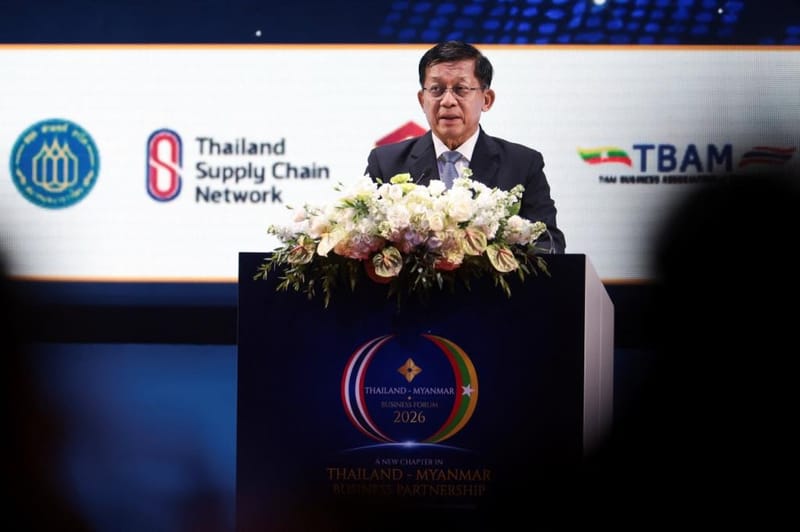
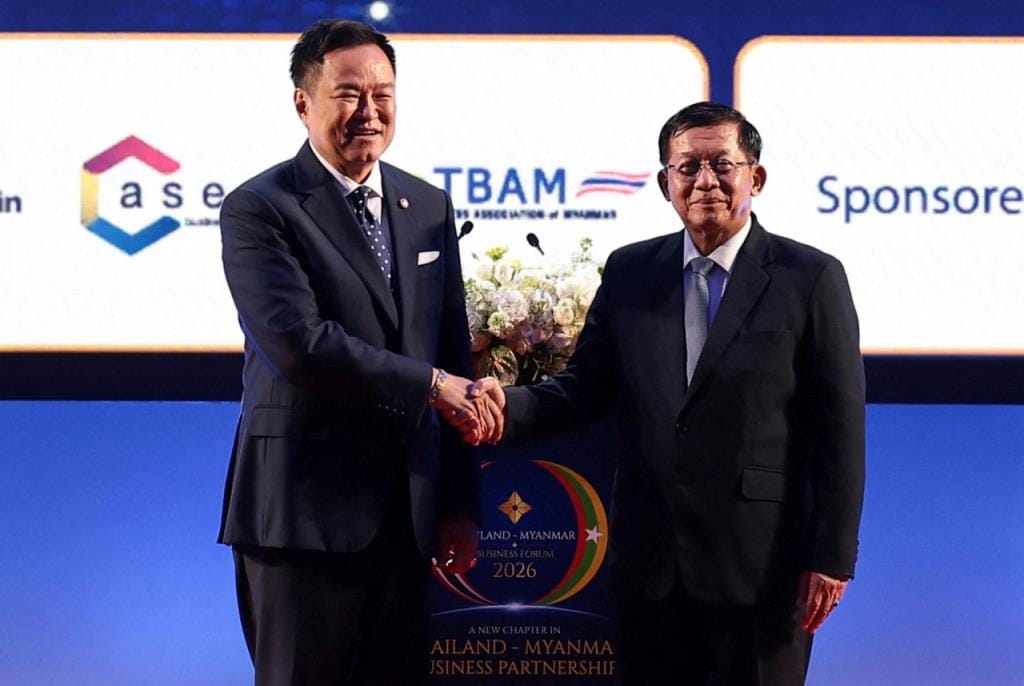
Also on the same day, President Min Aung Hlaing and Prime Minister Anutin attended the Thailand-Myanmar Business Summit, at which both pledged to cooperate across multiple sectors and to boost bilateral trade to $12 billion per year, up from $7.4 billion per year.
Thailand is Myanmar's fifth-largest investor, with investments in the energy, hotel, banking, and manufacturing sectors, but its interests have been affected by the civil war. Disrupted border trade and sanctions have also prompted some Thai companies that do business with the West to withdraw their investments.
"Our two countries are ready for a new chapter in economic cooperation," Prime Minister Anutin said at the Thailand-Myanmar Business Summit.
For his part, President Min Aung Hlaing said Myanmar is open to investment and is developing the Dawei project — a strategically located but long-stalled industrial zone — with plans to build a deep-sea port and transport links connecting the Indian Ocean and the Pacific Ocean.
He also said that Myanmar and Thailand, "as good friends," need to work together to combat illegal cross-border trade, which is costing both countries revenue.
Thailand's foreign minister said the talks today were "frank and constructive" and that Bangkok wishes to facilitate dialogue in Myanmar through ASEAN initiatives.
"We have emphasized to the president of Myanmar that we want to bring Myanmar back into ASEAN. We have not abandoned the region's concerns," Sihasak said.
Earlier in the week, Sihasak also welcomed the meeting between Suu Kyi and the International Red Cross representative, saying he hoped Myanmar's authorities would take further positive steps toward peace and stability.